Some nonfiction books feel like a chore before you even open them. Too many dates. Too many names. Too much dry context.
Then there are the best narrative nonfiction books. These books are true, but they don’t read like textbooks. They move like novels. They have tension, scenes, danger, secrets, strong characters, and real emotional weight.
That’s the hook. You get the pleasure of a story and the value of real life.
A great narrative nonfiction book can take you into a murder case, a mountain disaster, a medical scandal, a political conflict, a rowing race, a shipwreck, or a hidden part of history. The people are real. The stakes are real. And when the writing works, you forget you’re “learning” at all.
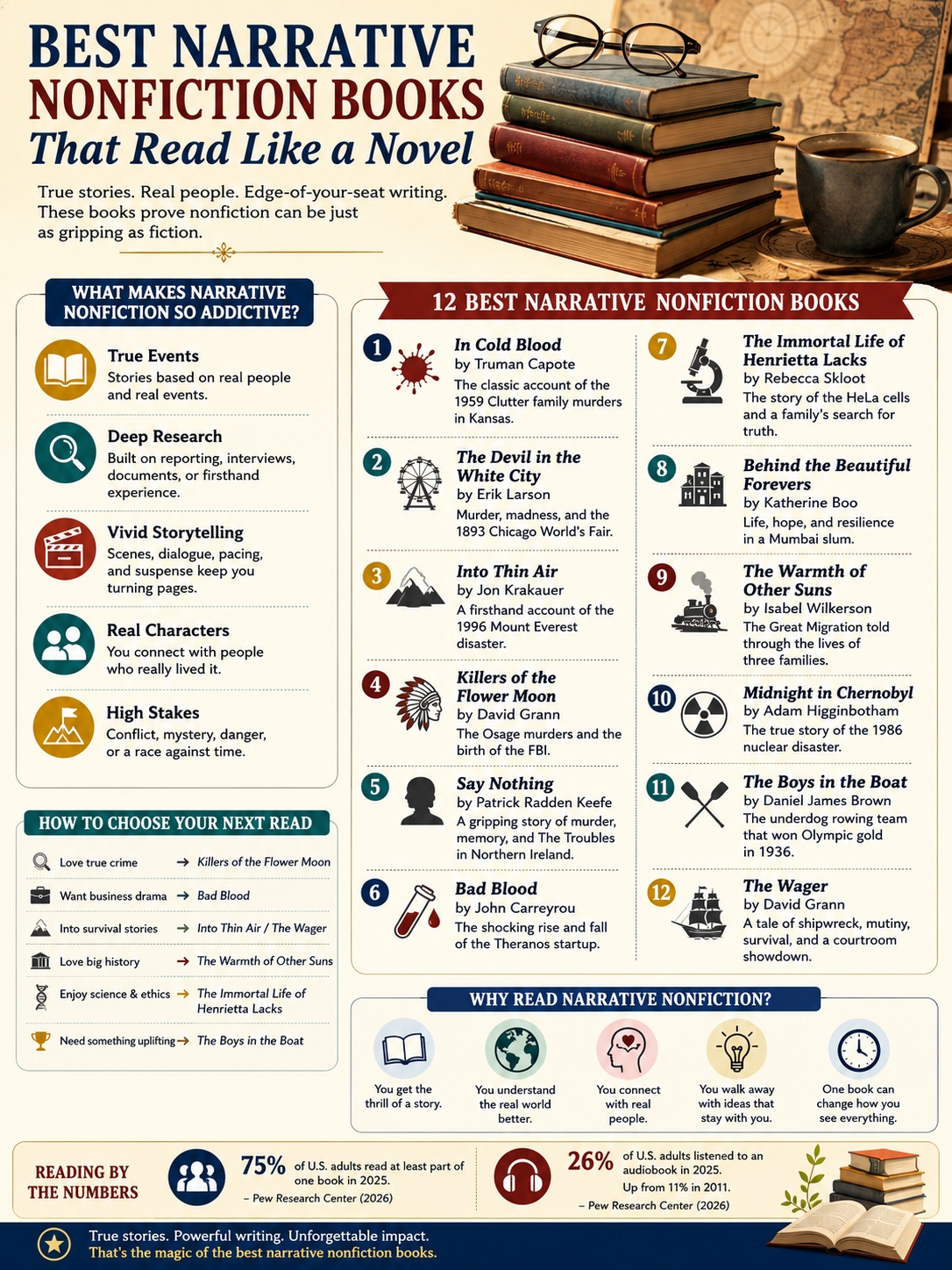
Reading habits also show why this genre matters. Pew Research Center reported in 2026 that 75% of U.S. adults had read at least part of one book in the previous year. Print still led, but e-books and audiobooks kept growing. E-book reading rose from 17% in 2011 to 31% in 2025, while audiobook use rose from 11% to 26% over the same period.
That makes narrative nonfiction a great fit for modern readers. These books work in print. They work on Kindle. Many work beautifully as audiobooks because they have pace, suspense, and strong scenes.
What Makes Narrative Nonfiction So Good?
Narrative nonfiction tells true stories with the craft of fiction. It still needs facts, research, interviews, records, archives, or firsthand reporting. But it doesn’t just stack information on the page.
It builds a story.
A strong narrative nonfiction book has people under pressure. It has a clear setting. It has conflict. It has questions the reader wants answered. It may even have the shape of a thriller, mystery, family saga, courtroom drama, or survival story.
|
Feature |
What It Means |
Why It Works |
|
True events |
The story comes from real life |
The book feels grounded |
|
Deep research |
The author uses reporting, records, interviews, archives, or firsthand experience |
Readers can trust the work |
|
Strong scenes |
Events unfold moment by moment |
The book feels alive |
|
Real people |
Characters are actual people, not invented ones |
The emotional pull is stronger |
|
Clear tension |
There’s danger, mystery, conflict, or pressure |
Readers keep turning pages |
The best writers in this genre don’t lecture. They guide. They show you what happened, then let the meaning land.
That’s why the best narrative nonfiction books often appeal to people who say they “don’t read nonfiction.” They aren’t built like school assignments. They’re built like stories you can sink into.
The National Endowment for the Arts has also reported a drop in pleasure reading among U.S. adults. In 2022, 48.5% of adults read at least one book for pleasure, down from 52.7% in 2017. That makes readable, story-driven nonfiction even more useful. It gives busy readers substance without making the experience feel heavy.
Best Narrative Nonfiction Books: Quick Comparison
This list covers true crime, history, science, business, survival, sports, and literary journalism. Some are modern classics. Some are newer. All of them prove that nonfiction can have the pull of a great novel.
|
Book |
Author |
Main Subject |
Best For |
|
In Cold Blood |
Truman Capote |
Kansas murder case |
Classic true crime |
|
The Devil in the White City |
Erik Larson |
Chicago World’s Fair and H. H. Holmes |
Historical suspense |
|
Into Thin Air |
Jon Krakauer |
1996 Everest disaster |
Survival writing |
|
Killers of the Flower Moon |
David Grann |
Osage murders and early FBI |
Crime and hidden history |
|
Say Nothing |
Patrick Radden Keefe |
The Troubles in Northern Ireland |
Political mystery |
|
Bad Blood |
John Carreyrou |
Theranos scandal |
Business thriller |
|
The Immortal Life of Henrietta Lacks |
Rebecca Skloot |
HeLa cells and medical ethics |
Science and human story |
|
Behind the Beautiful Forevers |
Katherine Boo |
Life in Annawadi, Mumbai |
Social reporting |
|
The Warmth of Other Suns |
Isabel Wilkerson |
The Great Migration |
Sweeping American history |
|
Midnight in Chernobyl |
Adam Higginbotham |
Chernobyl nuclear disaster |
Disaster history |
|
The Boys in the Boat |
Daniel James Brown |
1936 Olympic rowing team |
Underdog sports story |
|
The Wager |
David Grann |
Shipwreck, mutiny, and trial |
Sea adventure |
1. In Cold Blood by Truman Capote
In Cold Blood is one of the most famous true crime books ever written. Truman Capote tells the story of the 1959 murders of the Clutter family in Holcomb, Kansas, and follows the killers, the investigators, and the shaken town left behind.
The book helped shape the idea of the “nonfiction novel,” though that phrase needs care. Capote didn’t invent literary nonfiction. And over the years, some details in the book have been questioned. Still, its influence is huge.
What makes it work is the control. Capote doesn’t rush. He lets dread build slowly. The writing feels cold, clean, and unsettling.
Read it if you want a true crime classic with literary weight. Don’t expect comfort. This one stays under the skin.
Read Also: Best Romance Books to Read in 2026
2. The Devil in the White City by Erik Larson
Erik Larson knows how to make history feel cinematic. In The Devil in the White City, he follows two linked stories: the building of the 1893 Chicago World’s Fair and the crimes of H. H. Holmes.
One side of the book is about ambition, design, pressure, and spectacle. The other is about deception and murder. That contrast gives the book its charge.
The National Book Foundation listed The Devil in the White City as a 2003 National Book Award finalist for nonfiction. It remains one of the most popular gateway books for readers new to narrative history.
This is one of the best narrative nonfiction books for people who like mood. You get Chicago, architecture, gaslight, crowds, danger, and a dark story hiding inside a bright public event.
3. Into Thin Air by Jon Krakauer
Into Thin Air works because Jon Krakauer wasn’t just researching the Everest disaster from a distance. He was there.
The book covers the deadly 1996 Mount Everest disaster, when a storm trapped climbers high on the mountain. The broader May 1996 tragedy is commonly linked with eight deaths on Everest, while publisher summaries of Krakauer’s expedition often focus on five deaths tied closely to the events he witnessed.
That careful wording matters. But the reading experience is simple: the book is tense from start to finish.
Krakauer writes with guilt, fear, anger, and precision. You feel the thin air. You feel the bad calls. You feel how quickly confidence turns into panic.
If you like survival stories, start here.
4. Killers of the Flower Moon by David Grann
David Grann’s Killers of the Flower Moon investigates the murders of Osage people in 1920s Oklahoma. After oil made the Osage Nation wealthy, greed and racism turned deadly. The book also follows the early FBI investigation.
It was a 2017 National Book Award finalist for nonfiction.
The book reads like a mystery, but it carries far more weight than a standard crime story. Grann reveals the truth layer by layer. Each chapter adds more dread.
What makes it powerful is the mix of reporting and restraint. Grann doesn’t overplay the drama. He lets the facts do the work.
This is a must-read for anyone interested in crime, American history, corruption, and buried injustice.
5. Say Nothing by Patrick Radden Keefe
Say Nothing opens with the disappearance of Jean McConville, a mother of ten in Belfast. From that one case, Patrick Radden Keefe moves into the larger story of the Troubles in Northern Ireland.
The book won the 2019 National Book Critics Circle Award and the 2019 Orwell Prize.
It has the shape of a mystery, but it isn’t only about solving a crime. It’s about silence. Memory. Fear. Loyalty. Guilt. And what happens when violence becomes part of daily life.
Keefe writes with patience and control. He never turns the conflict into simple heroes and villains. That’s what makes the book feel honest.
Pick this if you want nonfiction that feels tense, smart, and morally complicated.
6. Bad Blood by John Carreyrou
Bad Blood is one of the easiest nonfiction books to recommend. It’s fast. It’s clear. And it’s hard to put down.
John Carreyrou tells the story of Theranos, the Silicon Valley blood-testing company founded by Elizabeth Holmes. The company promised to change medicine. But its technology didn’t live up to the hype.
Carreyrou first reported the story for The Wall Street Journal. The book later won the 2018 Financial Times and McKinsey Business Book of the Year Award.
This is one of the best narrative nonfiction books for business readers, but you don’t need to care about startups to enjoy it. The story has pressure, secrets, whistleblowers, legal threats, investor faith, and a founder whose image becomes harder to believe with each chapter.
It reads like a corporate thriller. The scary part is that it really happened.
7. The Immortal Life of Henrietta Lacks by Rebecca Skloot
Rebecca Skloot’s The Immortal Life of Henrietta Lacks tells the story of Henrietta Lacks, whose cancer cells became the famous HeLa cell line. Those cells became important in medical research, but her family didn’t know the full story for years.
Johns Hopkins Medicine notes that HeLa cells have been used in studies involving toxins, drugs, hormones, viruses, radiation, the human genome, and vaccines.
The book won the National Academies Communication Award for best book in 2011.
What makes the book so readable is its human center. Skloot doesn’t write only about cells. She writes about a woman, a family, a medical system, and a painful question: who benefits from scientific progress?
This is a strong pick for readers who want science, ethics, race, medicine, and family history in one deeply moving story.
8. Behind the Beautiful Forevers by Katherine Boo
Katherine Boo’s Behind the Beautiful Forevers follows life in Annawadi, a settlement near Mumbai’s airport. It’s based on deep reporting, but it reads with the closeness of a novel.
The book won the 2012 National Book Award for nonfiction.
Boo doesn’t flatten people into symbols. She gives them ambition, humor, anger, fear, pride, and flaws. That’s why the book works so well. It doesn’t ask readers to pity people from a distance. It asks them to pay attention.
This is a hard book, but not a hopeless one. It shows how people fight for dignity inside systems built against them.
9. The Warmth of Other Suns by Isabel Wilkerson
The Warmth of Other Suns is big, but it never feels abstract. Isabel Wilkerson tells the story of the Great Migration through three people who left the American South and built new lives elsewhere.
The book won the National Book Critics Circle Award for nonfiction. It has also been widely recognized as one of the major nonfiction works of the 2010s.
Wilkerson turns a massive historical movement into a human story. You feel the fear of leaving. You feel the hope. You feel the cost.
Readers who enjoy sweeping family sagas may love this book. It has the scale of an epic novel, but every life in it is real.
10. Midnight in Chernobyl by Adam Higginbotham
Midnight in Chernobyl tells the story of the 1986 nuclear disaster in Soviet Ukraine. Adam Higginbotham covers the plant workers, the science, the Soviet system, the emergency response, and the aftermath.
The book won the William E. Colby Award and the Andrew Carnegie Medal for Excellence in Nonfiction.
It’s detailed, but it doesn’t feel cold. Higginbotham builds dread step by step. You see the warnings. You see the pressure. You see the confusion. Then everything breaks.
This is the kind of disaster book that makes systems feel human. Not because the system works, but because people are trapped inside it.
11. The Boys in the Boat by Daniel James Brown
The Boys in the Boat tells the story of the University of Washington rowing team that won gold at the 1936 Berlin Olympics.
It follows working-class young men during the Great Depression as they train, struggle, and push toward Berlin. The University of Washington recognizes the crew as the famous 1936 Olympic gold medal team known through Brown’s book.
This is the most uplifting book on the list. It has hardship, teamwork, rhythm, craft, and a classic underdog arc.
Read it when you want nonfiction with heart. It’s inspiring without feeling cheap.
12. The Wager by David Grann
David Grann’s The Wager is a true story of shipwreck, survival, mutiny, and trial. It has storms, hunger, fear, violence, and competing versions of the truth.
Grann’s official description frames it as a story of shipwreck, survival, savagery, and court martial.
This book feels like an old sea adventure, but with modern reporting behind it. Grann is especially good at showing how people rewrite events to protect themselves.
If you like survival stories with moral tension, this one is a strong choice.
How to Choose the Best Narrative Nonfiction Books for Your Taste
Don’t start with the “most important” book. Start with the story you already want to read.
That’s the easiest way into the genre.
|
If You Like… |
Start With |
Why It Fits |
|
True crime |
Killers of the Flower Moon |
It blends murder, history, and injustice |
|
Fast business drama |
Bad Blood |
It moves like a startup thriller |
|
Survival stories |
Into Thin Air |
Every decision feels urgent |
|
Big American history |
The Warmth of Other Suns |
It makes history personal |
|
Science and ethics |
The Immortal Life of Henrietta Lacks |
It turns medical history into a family story |
|
Political mystery |
Say Nothing |
It mixes crime, memory, and conflict |
|
Uplifting nonfiction |
The Boys in the Boat |
It has a strong underdog story |
|
Sea adventure |
The Wager |
It has survival, mutiny, and courtroom drama |
If you’re new to narrative nonfiction, I’d start with Bad Blood, Into Thin Air, or The Boys in the Boat. They move quickly and don’t require much background knowledge.
If you want something deeper, try Say Nothing, Behind the Beautiful Forevers, or The Warmth of Other Suns. These books ask more from you, but they give more back.
If you want a book that feels closest to a novel, pick The Devil in the White City, In Cold Blood, or The Wager.
Why the Best Narrative Nonfiction Books Read Like Novels
A strong true story isn’t enough. Plenty of real events are fascinating but dull on the page.
Craft makes the difference.
The best writers know where to begin. They know when to hold back. They know how to build tension without twisting the truth. They give readers enough context to care, but not so much that the story stops moving.
|
Storytelling Tool |
Book Example |
How It Helps |
|
Central mystery |
Say Nothing |
A disappearance pulls readers into a larger conflict |
|
Ticking clock |
Into Thin Air |
Weather, oxygen, and altitude create pressure |
|
Dual storyline |
The Devil in the White City |
Public ambition contrasts with private horror |
|
Investigative reveal |
Bad Blood |
Each chapter exposes another crack |
|
Human lens |
The Warmth of Other Suns |
A huge historical shift becomes personal |
|
Moral tension |
The Immortal Life of Henrietta Lacks |
Science progress clashes with consent and fairness |
That’s why these books stay with readers. They don’t just explain what happened. They make you feel the pressure of the moment.
They also respect the reader. They don’t shout lessons. They let the story carry the meaning.
Final Thoughts
The best narrative nonfiction books prove that true stories can hit as hard as fiction. Sometimes harder.
They give you real events, real people, and real consequences. But they also give you pace, suspense, emotion, and scenes you remember.
Start with what already pulls you in. Choose Bad Blood for scandal, Into Thin Air for survival, Killers of the Flower Moon for crime and history, The Immortal Life of Henrietta Lacks for science and ethics, or The Warmth of Other Suns for a sweeping American story.
A good novel can move you. A great nonfiction story can do the same—and leave you with a sharper view of the world.
|
Best Pick For |
Recommended Book |
|
Fastest read |
Bad Blood |
|
Strongest survival story |
Into Thin Air |
|
Best book club choice |
The Immortal Life of Henrietta Lacks |
|
Best historical sweep |
The Warmth of Other Suns |
|
Best true crime-history blend |
Killers of the Flower Moon |
|
Best uplifting read |
The Boys in the Boat |
|
Best sea adventure |
The Wager |
Uncommon FAQs About Best Narrative Nonfiction Books
|
Question |
Quick Answer |
|
Is narrative nonfiction the same as history? |
No. History can be broad and analytical. Narrative nonfiction uses story structure. |
|
Is it the same as creative nonfiction? |
Not always. Creative nonfiction is a wider category. |
|
Can memoir count? |
Yes, if it tells a true story with a strong arc. |
|
Are these books always fully accurate? |
They should be fact-based, but readers should still check notes and sources. |
|
Do they work as audiobooks? |
Often, yes. The strong story structure helps. |
Is narrative nonfiction the same as creative nonfiction?
Not exactly. Creative nonfiction is the wider term. It can include essays, memoir, travel writing, personal writing, literary journalism, and reported stories.
Narrative nonfiction is usually more story-driven. It has a clear arc, strong scenes, and people moving through conflict.
Can memoir be narrative nonfiction?
Yes. A memoir can count if it tells a true story with shape and movement.
A loose collection of memories may feel more like personal essay. A memoir with scenes, tension, growth, and structure often fits well under narrative nonfiction.
Are narrative nonfiction books always accurate?
They should be grounded in facts. But readers should still pay attention.
Check the author’s notes, source list, bibliography, and reporting method. This matters most with older books, reconstructed scenes, and quoted dialogue.
Which narrative nonfiction book is best for beginners?
Bad Blood is probably the easiest first pick. It’s fast, clear, and dramatic.
Into Thin Air is another good choice if you like danger and survival. The Boys in the Boat works well if you want something warmer and more uplifting.
Which book is best for a book club?
Try The Immortal Life of Henrietta Lacks, Say Nothing, or Killers of the Flower Moon.
Each one gives readers plenty to discuss. They raise questions about justice, memory, science, consent, violence, race, power, and truth.
Do narrative nonfiction books work well as audiobooks?
Yes. Many of them do.
Books with suspense, investigation, danger, or strong scenes often sound great in audio. Bad Blood, Into Thin Air, The Wager, and Say Nothing are especially good picks for listeners.
What should I read after this list?
Follow the authors.
If you like David Grann, read The Lost City of Z. If you like Patrick Radden Keefe, try Empire of Pain. If you like Erik Larson, try Isaac’s Storm or Dead Wake. If you like Jon Krakauer, try Into the Wild.