

Most people don’t need to read faster. They need to make reading easier.
That’s the real secret behind practical read more books tips. Not tricks. Not pressure. Not forcing your eyes to fly across a page while your brain struggles to keep up.
Speed reading sounds great on paper. Finish more books. Save more time. Become that person who says, “I read 100 books this year.” But reading isn’t only about finishing. You want to understand the book. You want to remember something. You want the ideas, stories, and details to stay with you.
If you rush every page, you may finish more text but enjoy less of it.
A better goal is simple: read more often.
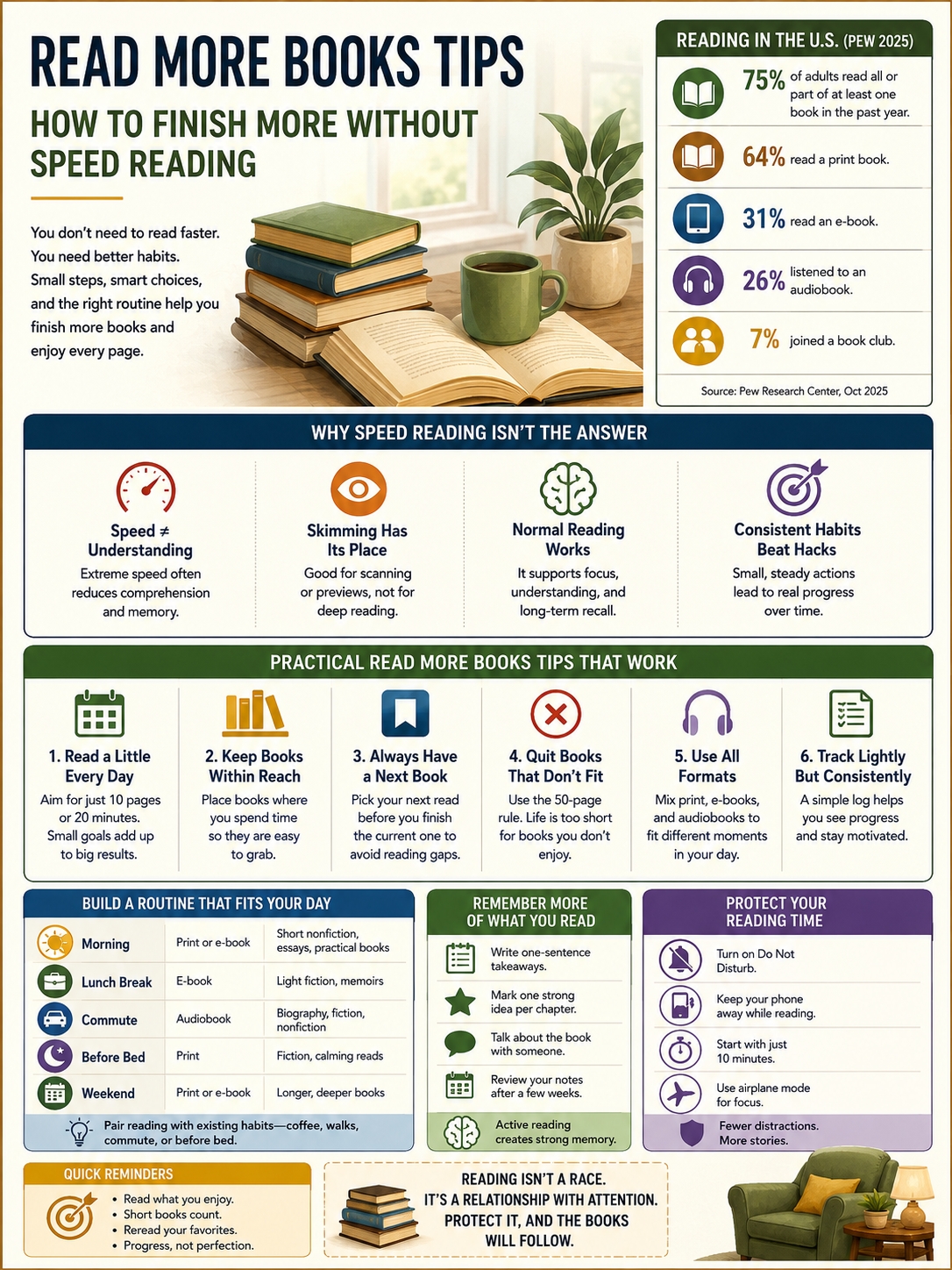
Pew Research Center reported that 75% of U.S. adults read all or part of at least one book in the previous 12 months, based on its October 2025 survey. Print books still lead, but e-books and audiobooks now play a big part in modern reading habits.
That matters. Reading more books today doesn’t always mean sitting in a quiet room with a hardcover. You can read on paper, on a phone, on an e-reader, or through your headphones while walking.
The goal isn’t to turn reading into another productivity contest. The goal is to build a reading habit that fits your actual life.
What the Data Says About Reading Today
|
Reading Data |
Verified Finding |
Why It Matters |
|
Adults reading books |
Pew found that 75% of U.S. adults read all or part of at least one book in the past year |
Reading is still common, but habits vary |
|
Print books |
64% read a print book in the past year |
Physical books still lead |
|
E-books |
31% read an e-book in the past year |
Digital reading is now normal |
|
Audiobooks |
26% listened to an audiobook |
Audio helps people read during busy moments |
|
Book clubs |
Only 7% joined a book club |
Most readers build habits on their own |
Books are not disappearing. But reading now fights for attention.
Your phone is right there. Streaming apps are easy. Work follows you home. Family duties don’t pause just because you bought a new novel.
That’s why reading more takes design, not guilt.
Pew’s 2025 survey shows that print remains the most popular format. But e-books and audiobooks have grown a lot since 2011. Audiobooks, in particular, have become a practical choice for people who don’t always have time to sit and read.
Other data shows a more worrying trend. The National Endowment for the Arts reported that reading for pleasure has declined in the U.S. over time. That report uses a different survey method from Pew, so the numbers should not be compared directly. Still, both sources point to the same reality: people still read, but reading has more competition than ever.
So if you’re struggling to read more, you’re not broken. You’re living in a noisy world.
Why Speed Reading Usually Misses the Point
|
Common Speed-Reading Claim |
What Really Happens |
Better Option |
|
“Read twice as fast and understand everything” |
Most readers lose comprehension at high speeds |
Read at a natural pace |
|
“Stop inner speech” |
Inner speech can help you understand |
Don’t fight how reading works |
|
“Skim every book” |
Skimming works only for some material |
Pick the right method |
|
“Finish more by rushing” |
Rushing often hurts memory |
Build more reading time |
Speed reading has its place. It can help when you need to scan a report, preview a chapter, or find one piece of information.
But it’s not the best way to read a novel, memoir, history book, or serious nonfiction.
Reading takes attention. Your eyes pause. Your brain connects ideas. Sometimes you go back and reread a sentence. That’s not failure. That’s understanding.
Research from the Association for Psychological Science has pushed back against big speed-reading promises. The main point is clear: people can skim faster, but deep reading at extreme speed usually comes with a cost.
That’s why the better question is not, “How can I race through this book?”
Ask this instead: “How can I make reading easier to come back to?”
That one question changes everything.
Read More Books Tips That Actually Work
|
Tip |
How to Use It |
Why It Works |
|
Read 10 pages a day |
Set a tiny daily target |
Small goals feel easy |
|
Keep books visible |
Put books near places you already sit |
Visual cues help |
|
Pick your next book early |
Choose before you finish the current one |
Stops reading gaps |
|
Quit weak books |
Drop books that don’t fit |
Protects your habit |
|
Use different formats |
Mix print, e-book, and audio |
Fits more moments |
The best read more books tips are not dramatic. They’re simple. That’s why they work.
Start with 10 pages a day.
It sounds small. Almost too small. But 10 pages a day becomes 3,650 pages a year. If your average book is around 250 pages, that’s about 14 books a year.
No speed reading. No pressure. Just a small promise you can keep.
You can also use a 20-minute rule. Read for 20 minutes before bed, after lunch, or during your commute. Don’t worry about finishing a chapter. Just start.
Keep a Book Within Reach
Your phone wins because it’s close.
So make your book close too.
Put a book:
- Beside your bed
- On your desk
- Near the sofa
- In your work bag
- Beside your morning coffee spot
This sounds basic, but it works. You’re not trying to become a super-disciplined person overnight. You’re making reading the easy choice.
Always Have the Next Book Ready
A lot of reading habits die between books.
You finish one book. You feel good. Then you don’t know what to read next. A day passes. Then a week. Then the habit fades.
Avoid that gap.
Keep a short “next up” list with three to five books. Not fifty. Not a giant list that feels like schoolwork. Just a few books you actually want to open.
Build a Reading Routine Around Your Real Day
|
Reading Time |
Best Format |
Best Book Type |
|
Morning |
Print or e-book |
Short nonfiction, essays, practical books |
|
Lunch break |
E-book |
Light fiction, memoirs, short chapters |
|
Commute |
Audiobook |
Biography, fiction, narrative nonfiction |
|
Before bed |
|
Fiction or calming nonfiction |
|
Weekend |
Print or e-book |
Longer, deeper books |
Don’t build your reading plan around an imaginary version of your life.
You may not have two peaceful hours every evening. Most people don’t. You may be tired after work. You may have kids, deadlines, chores, errands, and a brain that just wants a break.
That’s normal.
So stop waiting for perfect reading time. Use the small windows you already have.
The U.S. Bureau of Labor Statistics reported that people aged 15 and over spent about 5.16 hours per day on leisure and sports activities in 2025. Watching TV took about 2.61 hours per day. Reading averaged about 16 minutes per day.
That doesn’t mean everyone has spare time waiting around. Life is uneven. But it does show one thing: reading often loses because easier habits get there first.
Pair Reading With Something You Already Do
One of the easiest ways to read more is to attach it to an existing habit.
Try this:
- Read after brushing your teeth.
- Read while drinking coffee.
- Listen to an audiobook during a walk.
- Read one chapter before opening Netflix.
- Read while waiting in the car.
- Read for 10 minutes after lunch.
This works because you don’t have to make a new decision every day.
You already drink coffee. You already go to bed. You already wait in lines. Let reading ride along with those moments.
Create a Night Reading Trigger
Night reading works well for many people, but phones ruin it fast.
Try this simple setup:
- Charge your phone away from the bed.
- Put your book on your pillow.
- Read for 10 to 20 minutes.
- Stop before it feels like work.
- Leave the book ready for tomorrow.
Don’t force a marathon. A few pages count.
Read Also: Best Nonfiction Books That Read Like a Novel
Choose Books That Match Your Energy
|
How You Feel |
Better Book Choice |
|
Tired |
Short chapters, light fiction, audiobooks |
|
Curious |
Nonfiction tied to a current question |
|
Stressed |
Comfort reads or familiar authors |
|
Unfocused |
Short books or fast-paced stories |
|
Bored |
Quit and pick something better |
Here’s one of the most honest read more books tips: stop picking books for the person you wish you were.
Pick books for the person you are today.
A 600-page history book may be brilliant. But if you try to read it at midnight after a draining day, you may end up blaming yourself. The problem may not be you. The problem may be timing.
Keep different types of books around.
You might have:
- One serious nonfiction book
- One light novel
- One audiobook
- One short book
- One comfort re-read
That gives you options. If one book feels too heavy, you don’t quit reading. You just switch lanes.
Use the 50-Page Rule
You don’t have to finish every book.
That sentence alone can save your reading habit.
Try this:
- Give long books 50 pages.
- Give short books 20 to 30 pages.
- Give audiobooks 30 to 45 minutes.
If you still don’t care, stop.
Dropping a book is not failure. It’s a smart choice. A book can be well-written and still not be right for you right now.
Read Short Books Without Guilt
Short books count.
A 160-page book can change how you think. A short novel can hit harder than a long one. A slim essay collection can stay with you for years.
Short books also help rebuild momentum. When you finish one, you feel progress. That makes the next book easier to start.
Use Print, E-books, and Audiobooks Together
|
Format |
Best For |
Watch Out For |
|
Print books |
Focus, bedtime reading, notes |
Less portable |
|
E-books |
Travel, quick reading, commuting |
Phone distractions |
|
Audiobooks |
Walking, cleaning, driving |
Harder for detailed notes |
|
Library apps |
Budget-friendly reading |
Waitlists for popular titles |
Audiobooks count.
Let’s stop treating them like cheating. If you follow the story, understand the ideas, and remember what matters, you’re reading in a real way.
Audiobooks are powerful because they fit into time that paper books can’t reach.
You can listen while:
- Walking
- Cooking
- Cleaning
- Driving
- Exercising
- Folding laundry
That’s why audiobooks are one of the most practical ways to read more books without speed reading.
E-books help too. They’re useful when you travel, wait in line, or want to read without carrying a physical book. Just be careful if you read on your phone. One notification can break your focus.
Don’t Worship 2x Speed
Fast audiobook speed can help with simple books. But you don’t get extra points for suffering through a book too fast.
Try this:
- 1.0x for novels, memoirs, and complex topics
- 1.1x or 1.2x for clear nonfiction
- 1.5x for simple books or re-listens
The goal is not to race. The goal is to stay with the book.
Protect Reading Time From Your Phone
|
Problem |
Simple Fix |
|
Constant notifications |
Turn on Do Not Disturb |
|
Late-night scrolling |
Charge your phone away from bed |
|
App checking |
Move social apps off your home screen |
|
Weak focus |
Start with 10 minutes |
|
Phone reading distractions |
Use airplane mode |
Most people don’t lose reading time all at once.
They lose it in little leaks.
A quick scroll. One video. One message. A few comments. Another app. Suddenly, the 20 minutes you could have spent reading are gone.
You don’t have to delete every app. You just need to protect a small reading zone.
Try this:
- Put your phone across the room.
- Set a 15-minute timer.
- Read until the timer ends.
- Stop if you want.
- Keep going if the book has pulled you in.
Starting is the hard part. Once you get through the first few pages, your brain often settles down.
Make Reading Easier Than Scrolling
You can’t rely on willpower every night. Design your space instead.
Try these tiny changes:
- Put your current book on your pillow.
- Keep your e-reader charged.
- Move social apps into a folder.
- Place a book beside the remote.
- Keep a paperback in your bag.
- Use a simple lock screen reminder.
The easier option usually wins. Make reading that option.
Remember More of What You Read
|
Method |
Why It Helps |
|
One-sentence summary |
Makes you recall the main point |
|
Mark one strong idea |
Keeps notes simple |
|
Pause after chapters |
Helps understanding |
|
Talk about the book |
Strengthens memory |
|
Review notes later |
Keeps ideas alive |
Reading more books feels good. Remembering what you read feels even better.
You don’t need a complicated note system. Most readers only need a light one.
After each chapter, ask:
- What happened?
- What was the main idea?
- What surprised me?
- What do I want to remember?
- Would I recommend this book?
Then write one sentence.
That’s enough for most books.
Keep a Simple Reading Log
A reading log doesn’t need to look fancy.
Track:
- Book title
- Author
- Start date
- Finish date
- Format
- One-line takeaway
- Rating, if useful
This gives you a clear record. It also helps you understand your taste.
You may notice that you finish memoirs quickly but struggle with dense business books. Or that you read more when you mix fiction with nonfiction. Those patterns help you choose better next time.
Make Reading Feel Enjoyable Again
|
Habit |
Why It Works |
|
Read books you want |
Desire beats duty |
|
Stop chasing impressive titles |
Keeps reading personal |
|
Visit libraries |
Makes discovery fun |
|
Re-read favorites |
Builds comfort |
|
Share books casually |
Adds connection |
Some people stop reading because they turn every book into a task.
Don’t do that.
Not every book has to improve your career. Not every book has to be serious. Not every book has to impress someone.
Read a thriller. Read a romance. Read a funny memoir. Read a graphic novel. Read a short classic. Read the book your friend won’t stop talking about.
Enjoyment matters. In fact, it may be the thing that keeps you reading long enough to build a real habit.
Book clubs can help, but they are not required. Pew found that only 7% of U.S. adults joined a book club in the previous year. Most readers are building their reading lives alone or in informal ways.
You can keep it simple:
- Text a friend about a book.
- Share one quote.
- Swap books with a colleague.
- Visit a library once a month.
- Post a short review.
- Read quietly with family.
Reading can be private, but it doesn’t have to feel lonely.
Final Thoughts
|
Main Lesson |
What to Remember |
|
Don’t chase speed |
Chase consistency |
|
Start small |
Ten pages still count |
|
Mix formats |
Print, e-book, and audio all help |
|
Quit bad-fit books |
Protect your habit |
|
Reduce friction |
Keep books easy to reach |
The best read more books tips don’t ask you to become a speed reader. They ask you to become a steady reader.
Read a little each day. Keep books where you can see them. Use audiobooks when your hands are busy. Pick books that match your energy. Quit the ones that make you avoid reading.
That’s how you finish more books without rushing through them.
Reading is not a race. It’s a way to protect your attention in a loud world. Do that well, and the number of books will grow naturally.
FAQs About Reading More Books Without Speed Reading
|
Question |
Short Answer |
|
Can I read more without reading faster? |
Yes. Read more often, not faster. |
|
Do audiobooks count? |
Yes, if you understand and follow them. |
|
Should I finish every book? |
No. Quit books that block your habit. |
|
Is reading on a phone okay? |
Yes, if you control distractions. |
|
How many pages should I read daily? |
Start with 10 pages. |
How can I read more books when I’m busy?
Use small reading windows. Read 10 pages in the morning. Listen to an audiobook while walking. Read for 15 minutes before bed. Busy readers need flexible habits, not perfect routines.
Is it better to read one book at a time or several?
Both can work. If you get distracted easily, read one book at a time. If your mood changes often, keep two or three options: one light book, one serious book, and one audiobook.
Do book summaries count as reading?
Book summaries can help, but they don’t replace the full book. Use them to preview ideas or decide whether a book deserves your time. The full book gives you the argument, voice, detail, and emotional weight.
Why do I forget what I read?
You may be reading too passively. Pause after each chapter and write one sentence. You can also explain the idea to someone else. That quick recall step helps the book stick.
What should I do if I keep buying books but not reading them?
Stop buying books for one month. Pick three books you already own. Put one beside your bed, one near your desk, and one in your bag. Make access easier before adding more books.
Is rereading a waste of time?
No. Rereading can deepen your understanding. A book may hit differently when you return to it years later. You changed, so the book changes too.