

Language always changes, but the internet straps it to a rocket and fires it into space. If you feel like you are constantly playing catch-up with the way young people speak online, you are completely normal. The digital landscape moves at a blistering pace right now. By the time a phrase makes it into mainstream media, teenagers usually already consider it dead. This guide cuts through the noise and provides a clear, comprehensive look at internet slang 2026.
Whether you are a marketer trying to understand your audience, a parent attempting to decode your teenager’s text messages, or just a casual scroller who wants to know what people are talking about in comment sections, this deep dive gives you the exact tools you need to survive online.
Introduction to the Modern Digital Lexicon
We are living in an era where digital vocabulary reinvents itself almost every single week. Understanding this shift requires looking at the apps we use and the generations pushing the buttons. We see a fascinating blend of irony, absurdity, and hyper-efficiency shaping how people communicate online. This section sets the stage for the specific words and phrases that have taken over our screens this year.
|
Key Theme |
Description |
Impact on Communication |
|
Generational Overlap |
Gen Z and Gen Alpha mixing online |
Creates hybrid slang and layered inside jokes |
|
Algorithmic Speed |
Apps pushing content globally instantly |
Words trend and die in a matter of weeks |
|
Absurdist Humor |
Comedy based on nonsense and chaos |
Traditional dictionary meanings are often ignored |
|
Digital Native Influence |
Growing up entirely online |
Tech terms seamlessly blend with everyday speech |
Why Tracking Internet Slang 2026 Matters
You might think slang is just a trivial part of youth culture, but it goes much deeper than that. The words we use reflect our collective anxieties, our coping mechanisms, and our shared humor. Tracking the latest terminology helps brands connect authentically with younger demographics without sounding forced. It also helps sociologists and linguists understand how human communication adapts to digital environments. More importantly, it keeps everyday internet users from feeling completely alienated when they open their favorite apps. Language is the glue of any community. If you do not know the words, you miss out on the culture entirely.
The Generational Shift: Gen Z Meets Gen Alpha
Right now, we are watching a massive linguistic handoff. Older Gen Z digital natives are entering their mid-to-late twenties, while Gen Alpha kids are taking over the teenage demographic. Gen Z popularized terms relying heavily on irony and hyper-awareness. Gen Alpha, on the other hand, brings a wave of pure absurdist humor to the table. Gen Alpha is the first generation to have never known a world without algorithmic video feeds. Their approach to language reflects that chaotic reality. They do not just alter existing words. They invent completely new concepts that make zero sense unless you are completely steeped in the specific internet lore that created them.
The Mechanics of Viral Language
To figure out why words spread so fast today, you have to look at the machinery behind them. The platforms we scroll through daily are engineered to maximize imitation and repetition. We are no longer dealing with regional dialects where a word slowly travels from New York to California over a year. The internet erased geographical borders, replacing them with algorithmic bubbles that dictate exactly what we say and how we say it.
|
Language Driver |
Function |
Result |
|
Short-Form Video |
Endless scrolling feeds |
Rapid spread of audio trends and catchphrases |
|
Content Moderation |
Automated filters flagging words |
Users invent new spellings and phrases to evade bans |
|
Streamer Culture |
Hours of live, unfiltered talk |
Inside jokes become mainstream vocabulary |
|
Meme Pages |
Curated humor accounts |
Cements visual jokes into everyday text conversations |
How TikTok and Short-Form Video Accelerate Slang
The architecture of modern short-form apps actively rewards inside jokes. Because these platforms push content to users based on interest rather than just who they follow, a random joke made by a teenager in one country can hit millions of feeds globally overnight. When an audio clip goes viral, users lip-sync it, remix it, and drop it into comment sections thousands of times a minute. This hyper-acceleration means words are born, overused, and discarded at a dizzying speed. It creates a linguistic burnout where users literally complain about getting brain rot from consuming too much fast-paced content.
The Role of Algorithm Speak and Censorship Evasion
Perhaps the most fascinating mechanic behind modern slang is censorship evasion. As automated moderation tools become stricter on social platforms, users invent new words just to keep their accounts active. This practice is known as algo speak. Instead of using explicit anatomical terms, they type things like dih or corn. Instead of writing the word kill, they say unalive. What starts as a survival tactic for keeping videos monetized eventually bleeds into everyday spoken language. Kids now casually say unalive out loud in school hallways, proving that digital moderation policies are actively rewriting the English language.
The Ultimate Internet Slang 2026 Dictionary
You cannot navigate the digital world without a proper translation guide. This section breaks down the most prominent and confusing words dominating comment sections and group chats this year. We categorized them to help you understand not just what they mean, but exactly when and why people use them.
|
Slang Category |
Examples |
Primary Emotion/Vibe |
|
Praise & Aesthetics |
Aura, 4+4, Mogged, 7×7=49 |
Confidence, attractiveness, respect |
|
Dating & Social |
Delulu, Boysober, Choppelganger |
Irony, self-awareness, romantic exhaustion |
|
Stress & Negativity |
Crashing out, Doommaxxing, Chud |
Frustration, burnout, anger |
|
Nonsense & Brain-Rot |
Doi doi doi, Skibidi |
Chaos, confusion, pure comedy |
Words of Praise and Aesthetics
Having aura means possessing a distinct, undeniable coolness or presence. You do not buy aura; you simply have it through confidence. If someone trips and falls in public, they lose aura points. Aura farming is a newer extension of this trend. It refers to someone going out of their way to do activities specifically to cultivate a cool image. Posting gym selfies every single day is prime aura farming.
Another massive term in the looks department is mogged. It comes from looksmaxxing communities and means someone looks more impressive or attractive than another person. If you stand next to a supermodel, you get mogged.
Then we have the math-based slang. The phrase 4+4 simply means that someone ate, which is slang for executing something flawlessly. Four plus four equals eight, which sounds like ate. Following that same logic, 7×7=49 is used to describe someone who is intuitively and undeniably attractive. The math just makes perfect sense to the brain, much like the person’s good looks. Finally, calling someone you the birthday means they are incredibly awesome and the center of positive attention.
Terms for Dating, Relationships, and Social Dynamics
Dating terminology has gotten incredibly weird and highly specific. We still see delulu everywhere, which is short for delusional. Being a little delulu is often seen as a fun coping mechanism for a stressful dating life.
Boysober describes a period of intentional abstinence from dating or pursuing men. It is a palate cleanser for the dating world, focusing instead on personal peace.
On the harsher side, we have chopped, which means someone or something is ugly or ruined. A bad haircut is chopped. This led to the brilliant invention of the choppelganger. If someone says they found your choppelganger, they mean they found someone who looks exactly like you, but significantly less attractive. It is a highly specific and slightly brutal insult. We also see chud used to describe a physically unappealing person, or someone with loudly obnoxious views who lacks self-awareness.
The Darker Side: Slang for Stress and Negativity
When things go wrong, internet slang 2026 provides plenty of ways to express misery. Doommaxxing refers to leaning entirely into hopelessness and negativity as a core personality trait. It is the act of maximizing your sense of doom, usually in a theatrical way when faced with minor inconveniences.
Then there is crashing out. This term means having an intense emotional outburst or doing something completely unhinged due to stress. If you throw your laptop out a window because your Wi-Fi dropped, you crashed out. If the outburst is particularly crazy, people call it a D1 crash out, comparing the level of madness to Division 1 college athletics.
We also have bed-rotting, which is the act of staying in bed all day to mindlessly scroll on your phone and avoid the outside world. It is an unapologetic form of rest used to combat burnout.
Read Also: Top 25 Songs of Summer 2026: Hottest Tracks Right Now
Nonsense, Humor, and Brain-Rot Vocabulary
Sometimes words mean nothing at all. Fuhuhluhtoogan is a word deliberately designed to mean absolutely nothing. People use it in conversation specifically to confuse listeners who are not in on the joke.
Similarly, doi doi doi is pure brain-rot slang. It has no definition. You just put your hand near your mouth and say the syllables to sound intentionally foolish or to mock a ridiculous situation. This tier of slang is all about the sound and the delivery rather than any actual dictionary definition.
Deep Dive: Gen Alpha’s Unique Linguistic Imprint
Generation Alpha operates on a completely different linguistic wavelength than anyone who came before them. They blend gaming lore, stream highlights, and pure random noises into everyday conversation. This section highlights the phrases that are specifically tied to the youngest demographic currently roaming the internet.
|
Gen Alpha Term |
Origin |
Meaning |
|
Fanum Tax |
Twitch streamer Fanum |
Stealing a little bit of food from a friend |
|
Skibidi |
Skibidi Toilet web series |
A versatile filler word meaning good, bad, or crazy |
|
Lowkenuinely |
Mashup of low-key and genuinely |
Expressing a quiet, sincere truth |
|
Brainrot |
General internet culture |
Content that makes you feel dumb or overstimulated |
The Fanum Tax Phenomenon
Named after a popular content creator named Fanum, this term refers to the playful theft of food between friends. If you sit down with a plate of fries and your friend takes a handful without asking, they are collecting the Fanum tax. It started as an inside joke on Twitch and completely took over middle schools across the globe. It shows how massive creators dictate the daily vocabulary of their viewers.
Skibidi and the Absurdist Humor of Youth
Originating from a bizarrely popular animated web series about heads singing inside toilets, this word morphed into the ultimate versatile slang. Depending entirely on the context and tone of voice, skibidi can mean bad, crazy, suspicious, or cool. You can have skibidi rizz, which means you flirt ironically. It is the defining nonsense word of Gen Alpha.
Blending Words: Lowkenuinely and Choppelganger
Gen Alpha is amazing at mashing words together to create highly specific emotions. Lowkenuinely is a seamless combination of low-key and genuinely. It expresses a sincere, quiet truth without making a big deal out of it. You might say you are lowkenuinely exhausted. It shows an evolution in how young people compress language to convey complex feelings as quickly as possible.
Technology and AI in Everyday Slang
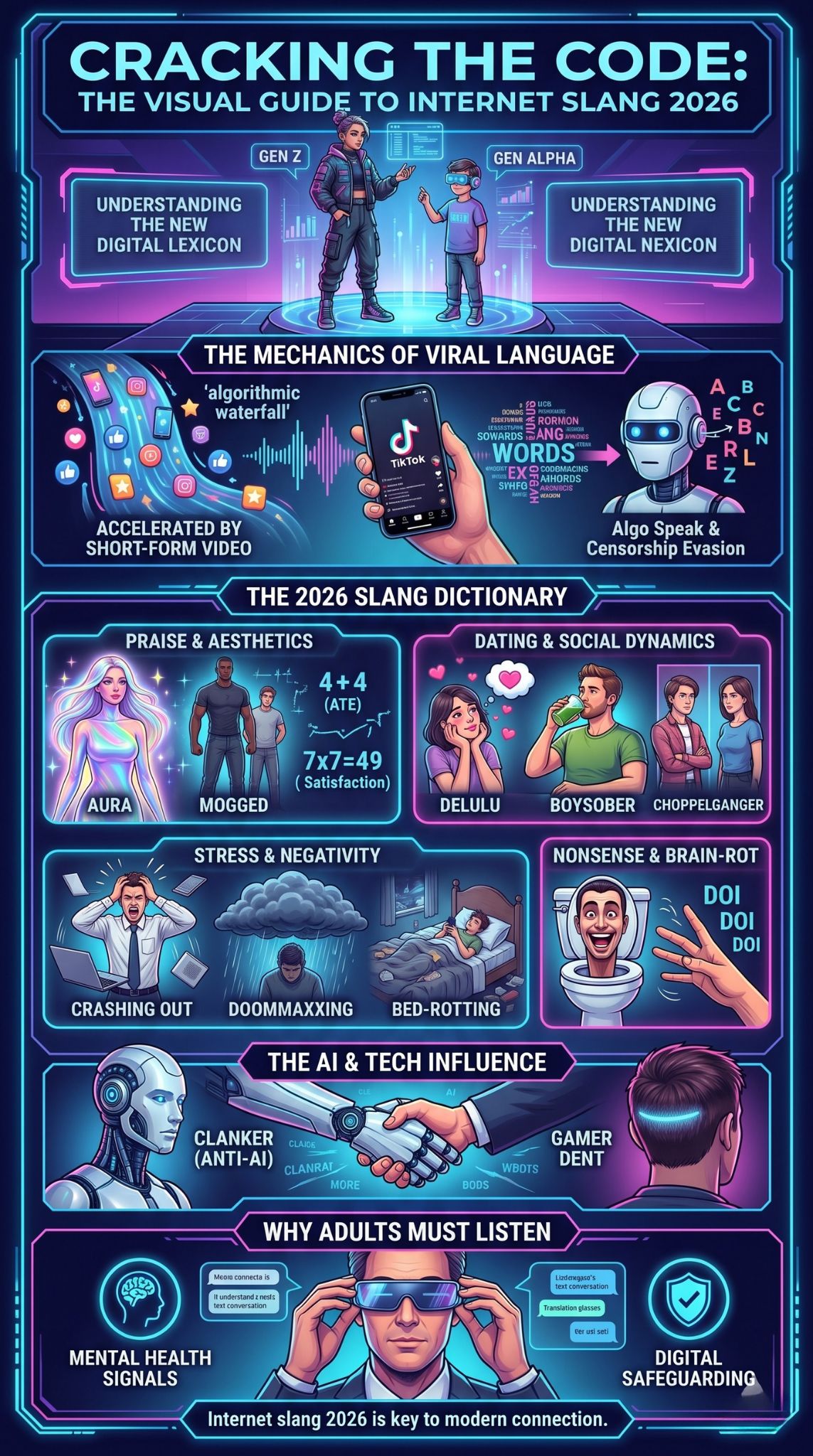
Technology does not just spread slang; it frequently becomes the actual subject of the slang. Our relationship with digital tools is so intertwined with daily life that our language reflects brand new digital anxieties. We see words popping up that specifically target the machines we interact with every day.
|
Tech Slang |
Subject |
Usage Context |
|
Clanker |
Artificial Intelligence |
Insulting a bot in a comment section |
|
That’s AI |
Skepticism |
Calling out a lie or fake situation |
|
Cracked |
Gaming |
Describing someone with unbelievable skill |
|
Gamer Dent |
Gaming Hardware |
Mocking the hair indent left by a headset |
The Rise of Anti-AI Terminology
As AI agents and chatbots flooded social platforms, a massive cultural pushback occurred. People created terms specifically aimed at artificial intelligence. Clanker, originally a sci-fi reference, is now a derogatory term for AI bots that pretend to be human online. If someone spots a suspiciously generic comment, they might reply by calling the account a clanker. We also see the phrase that’s AI used to express doubt. Even if a story has nothing to do with technology, someone might say that’s AI just to say they do not believe you.
Gaming Culture’s Continued Influence on Language
Gaming remains a massive pillar of online vocabulary. The word cracked continues to hold strong. If someone is cracked, they are unbelievably skilled at a task, as if they broke the limitations of a normal human. We also have gamer dent, which refers to the temporary groove left in a person’s hair after wearing a heavy gaming headset for ten straight hours. It is used to mock people who spend way too much time staring at screens.
Why Parents and Educators Must Pay Attention
It is very easy for adults to dismiss modern digital language as silly or fleeting. However, paying attention to how young people speak online is a critical part of modern safeguarding. Language is how humans signal distress and establish identity. This section breaks down why ignoring these words is a huge mistake for anyone responsible for teenagers.
|
Reason to Learn Slang |
Benefit for Adults |
Example |
|
Monitor Mental Health |
Catching early signs of depression |
Recognizing the danger of doommaxxing |
|
Digital Safety |
Spotting predatory behavior |
Understanding algo speak that hides bad intentions |
|
Build Trust |
Showing interest in their world |
Laughing at a harmless skibidi joke |
|
Cultural Awareness |
Bridging the generation gap |
Stopping arguments caused by misunderstandings |
Decoding Hidden Meanings and Digital Cries for Help
When parents understand the difference between a harmless joke like Fanum tax and a potentially concerning phrase like doommaxxing, they are better equipped to monitor mental well-being. A teenager who casually jokes about bed-rotting all weekend might just be tired, or they might be signaling early signs of severe burnout. Understanding algo speak is also crucial for digital safety. Predators and cyberbullies use coded language to evade parental control software. Staying educated ensures parents actually read the true context of their children’s digital lives.
Bridging the Generational Communication Gap
Bridging the gap builds trust. You absolutely do not need to start using these words at the dinner table. In fact, doing so usually causes immense secondhand embarrassment. But understanding what a teenager means when they say something is chopped shows you care about their world. It moves the dynamic from one of alienation to one of mutual respect. When kids realize you actually understand their jokes, they are much more likely to talk to you when real problems arise.
The Future Trajectory of Online Communication
Looking beyond this year, the trajectory of digital language points toward even greater fragmentation. Micro-communities are developing vocabularies so distinct that they sound like foreign languages to outsiders. This section explores where human communication goes from here.
|
Future Trend |
Description |
Impact |
|
Micro-Dialects |
Niche communities creating exclusive words |
Harder for outsiders to join conversations |
|
Shorter Lifespans |
Words dying in weeks instead of years |
Constant pressure to stay updated |
|
Global Homogenization |
Everyone using the exact same slang |
Loss of regional accents and phrases |
|
Visual Integration |
Emojis and memes replacing text entirely |
Communication becomes heavily context-dependent |
The Shrinking Lifespan of Trending Words
The lifespan of a trending word shrinks every single year. We went from trends lasting a decade, to a year, to a few months. Soon, a word might rise and fall in the span of a single weekend, driven by the relentless hunger of the content machine. The moment a brand or an older generation adopts a term, younger users immediately abandon it and forge something new to protect their in-group identity.
Global Homogenization of Digital Lingo
Despite the fast turnover, we are seeing a global homogenization of digital lingo. A kid in London, a teenager in Tokyo, and a college student in Texas all consume the exact same TikTok feeds. They laugh at the same Twitch clips. Because of this, regional slang is slowly dying out, replaced by a universal internet dialect. We are watching the formation of a unified global youth culture connected entirely through inside jokes and shared screen time.
Final Thoughts
Trying to keep up with digital language often feels like trying to catch water with your bare hands. It slips away just as you think you have a grip on it. But paying attention to internet slang 2026 is incredibly rewarding. It provides a real-time window into how human creativity thrives under the pressure of algorithms, censorship, and endless global connectivity. Gen Z and Gen Alpha take the chaotic tools they inherited and build completely new ways to find humor and community. You do not have to speak their language fluently, but taking the time to decode it proves that you are paying attention to the culture defining our modern world.
Frequently Asked Questions About Internet Slang 2026
To clear up any lingering confusion, here are some of the most uncommon and highly searched questions regarding the latest digital vocabulary.
What does it mean when a streamer gets mogged?
When someone gets mogged, it means they were completely overshadowed by someone who looked much more attractive or confident. For example, if a streamer goes to court and the internet decides the judge looks way better than the streamer, people will say the streamer got judgemogged or frame mogged.
What is a D1 crash out?
Crashing out means having a massive emotional overreaction. Adding D1 to the front elevates it. It references Division 1 college sports, meaning the person is an elite, top-tier professional at throwing a tantrum. It is a certifiable, legendary freakout.
Why do kids use the low battery emoji in texts?
The low battery emoji no longer just means a phone is dying. People use it to signal emotional depletion, heartbreak, or a general feeling that they cannot handle a situation anymore. It is a visual shortcut for extreme social exhaustion.
What is a choppelganger?
It is a brutal mashup of the word chopped, which means ugly, and doppelganger. If someone finds your choppelganger, they found someone who looks remarkably like you, but in a much less attractive way.
Why is everyone talking about aura points?
Aura refers to someone’s general vibe, coolness, and presence. People joke about gaining or losing aura points based on daily actions. Doing a cool trick adds points, while tripping over your own shoelaces in public costs you severe aura points.