

The world of artificial intelligence shifted entirely this year. Creating stunning visuals from a simple text prompt used to feel like magic, but today, it is a standard baseline for technical excellence and problem-solving content. Finding the best free ai image generators 2026 offers can feel overwhelming because the market is flooded with options.
You want a platform that understands your precise ideas, renders beautiful graphics, and does not lock you behind an expensive paywall immediately. When I build localized content hubs for markets in Germany, France, or New Zealand, I need tools that deliver fast, high-fidelity assets without friction.
In this comprehensive guide, we will explore the top platforms dominating the industry right now. We will look at what makes each of them special, their strengths, their weaknesses, and how you can leverage them to scale your digital business or personal projects. Whether you need advanced 3D isometric infographics for a B2B SaaS campaign or clean landscape-style feature images for a health-tech startup, this guide will help you navigate your options. I prefer tools that are savvy enough to generate completely text-free images upon request, and we will highlight which models actually listen to those strict instructions.
What to Look for in the Best Free AI Image Generators in 2026
Finding the right tool means looking past the marketing hype and testing the actual capabilities in a live production environment. You need to know if a platform truly understands your prompts or if it just spits out random pixels that require hours of fixing. I always check if a tool can produce advanced 3D isometric infographics or clean landscape-style feature images that fit a modern website foundation. For my specific needs, I often require outputs that exclude all text entirely, which demands a highly savvy AI model that respects negative prompts. Let us break down the core criteria you should evaluate before choosing your daily driver.
|
Evaluation Criteria |
Description of Feature |
Why It Matters for Your Workflow |
|
Free Tier Generosity |
The number of images you can generate before hitting a paywall. |
Allows room to experiment and refine your prompts without financial risk. |
|
Prompt Adherence |
How accurately the model follows your specific text instructions. |
Saves time by reducing the need for constant regeneration and corrections. |
|
Text Handling |
The ability to generate accurate text or completely exclude it on command. |
Crucial for infographics or creating clean, text-free feature images. |
|
Interface Usability |
The ease of navigating the platform and integrating it into your work. |
Speeds up customer onboarding and content production pipelines. |
Generosity of the Free Tier
The biggest deciding factor for many users is how much you can actually do for free. Some tools give you a generous daily allowance of credits that reset every 24 hours, while others offer a strict lifetime limit that forces a subscription almost immediately. We looked for platforms that allow you enough room to experiment, make mistakes, and dial in your prompts without facing an immediate upgrade screen.
Prompt Adherence and Realism
A capable generator must listen to your exact instructions. If you ask for a neon green sports car on a rainy street in Paris, you should not get a red truck in the desert. In 2026, the leading platforms are exceptional at understanding complex, multi-layered instructions. They grasp nuances in specific lighting, camera angles, and artistic styles. This is especially vital when creating assets for localized content hubs where cultural accuracy matters.
Handling and Excluding Text
Historically, algorithms struggled to spell words correctly in pictures, outputting visual gibberish. Thanks to recent advancements released this year, certain generators can now render legible text on signs, t-shirts, and posters with impressive accuracy. Conversely, if you prefer high-fidelity feature images that exclude all text to maintain a clean aesthetic, you need a tool savvy enough to understand negative prompts like ~do not add any text into image~.
User Interface and Workflow Integration
You should not need a degree in machine learning to create a picture. Platforms that operate directly in your browser or through user-friendly chat interfaces score much higher than those requiring complex installations. The best tools integrate seamlessly into your existing SEO content strategy, allowing you to generate, download, and publish assets with minimal friction.
Top Free and Freemium AI Image Generators of 2026
The market exploded this year, bringing us incredibly powerful tools that cost absolutely nothing to try. We have seen a massive shift from basic pixel mashups to studio-grade renders capable of producing 4K production-ready visuals. Whether you manage remote agency scaling or run a local SME, these platforms offer serious value. I have tested the market leaders extensively to see which ones actually deliver on their lofty promises without compromising on quality. Here are the standout platforms defining the visual artificial intelligence landscape right now.
|
Platform Name |
Best Use Case |
Free Allowance |
Output Quality Level |
|
Nano Banana 2 |
Multilingual SEO and fast rendering |
Generous daily limit |
Studio-grade realism |
|
ChatGPT Image 2 |
Conversational workflow automation |
Included with free accounts |
Highly dynamic and creative |
|
Canva Magic Media |
Quick graphic design and social media |
Set monthly credits |
Great for standard marketing |
|
Adobe Firefly 5 |
Commercial safety and compliance |
25 monthly generative credits |
Unmatched structural matching |
|
FLUX 2 |
Ultimate customization and control |
Varies by hosting platform |
Phenomenal photorealism |
Nano Banana 2
Google completely changed the game this year with the release of Nano Banana 2, running on the Gemini 3.1 Flash Image architecture. This platform took the industry by storm for its incredible speed, realism, and deep integration into the Google ecosystem. You can access it easily, making it incredibly accessible for daily content production.
The biggest advantage of this model is its ability to maintain consistent characters and styles across multiple generations. It is also exceptionally savvy at understanding when you want text included or completely removed. If you are building a technically flawless website foundation and need fast, high-quality visuals, Nano Banana 2 is currently the market leader.
ChatGPT Image 2
OpenAI remains a massive player in the generative space. With the rollout of ChatGPT Image 2, the process of making pictures became highly conversational. You no longer need to write a perfect paragraph of instructions on your first try.
You can ask the system for an image, look at the result, and say things like ~make the background darker~ or ~remove all the text from the signs~. The system understands the context of your conversation and iterates on the design naturally. The free tier provides enough access to generate great concepts, though heavy users driving high revenue metrics will likely want to upgrade.
Canva Magic Media
For anyone focused on graphic design, social media posts, or marketing materials, Canva is a household name. Their Magic Media tool is a fantastic addition to an already powerful platform. It is designed for beginners and professionals who need to get things done quickly without fussing over complex prompt engineering.
Because it lives inside the Canva editor, you can immediately drop the generated graphic into a presentation, add your own typography, and export it. The free version includes a set number of Magic Media credits, making it a risk-free option for SMEs looking to elevate their branding.
Read Also: Alphabet Upgrades Its AI System Gemini to Compete With ChatGPT
Adobe Firefly Image Model 5
Adobe takes a distinct approach by focusing heavily on commercial safety and creator rights. Firefly models are trained exclusively on Adobe Stock and public domain content. This means you never have to worry about copyright infringement when using these images for your business, which is a massive relief for B2B enterprises.
Firefly Image Model 5 is available on the web for free. If you have a sketch or an existing photo, Firefly is arguably the best tool for matching that exact structure and style. The free tier gives you a monthly allotment of credits, which is usually enough for casual projects or supplementary blog visuals.
FLUX 2 by Black Forest Labs
For those who want pure power and customization, FLUX 2 is the open-source champion of 2026. Built by the team originally behind Stable Diffusion, it offers incredible detail, prompt adherence, and photorealism.
While you can run it locally on a powerful computer for completely free unlimited generation, most users access it through web platforms like NightCafe or WaveSpeedAI. FLUX 2 is highly favored by enthusiasts because it lacks strict corporate guardrails, allowing for a broader range of artistic expression. It captures realistic lighting and textures brilliantly.
Ideogram
Ideogram carved out a massive niche for itself by being the first platform to truly master text generation within images. While others caught up in 2026, Ideogram remains one of the absolute best for creating typography, logos, and posters.
If you need a graphic of a coffee cup that says ~Monday Survival Juice~ in a specific retro font, Ideogram will nail it. They offer a limited free plan that is perfect for testing the waters. However, if your SEO content strategy requires purely text-free landscape images, you might find more value in Nano Banana 2 or FLUX 2.
Midjourney V7
We must mention Midjourney V7, even though it currently lacks a permanent free tier. Midjourney remains the most artistic, creative, and beautiful image generator on the market. If you are doing concept art, world-building, or looking for breathtaking aesthetics, Midjourney stands alone.
While free trials are periodically suspended due to high demand, it is worth keeping an eye out for when they open up. Midjourney moved beyond Discord and now offers a sleek web interface that makes it much easier to use for professional teams.
Comparison Overview: Which Tool Should You Choose?
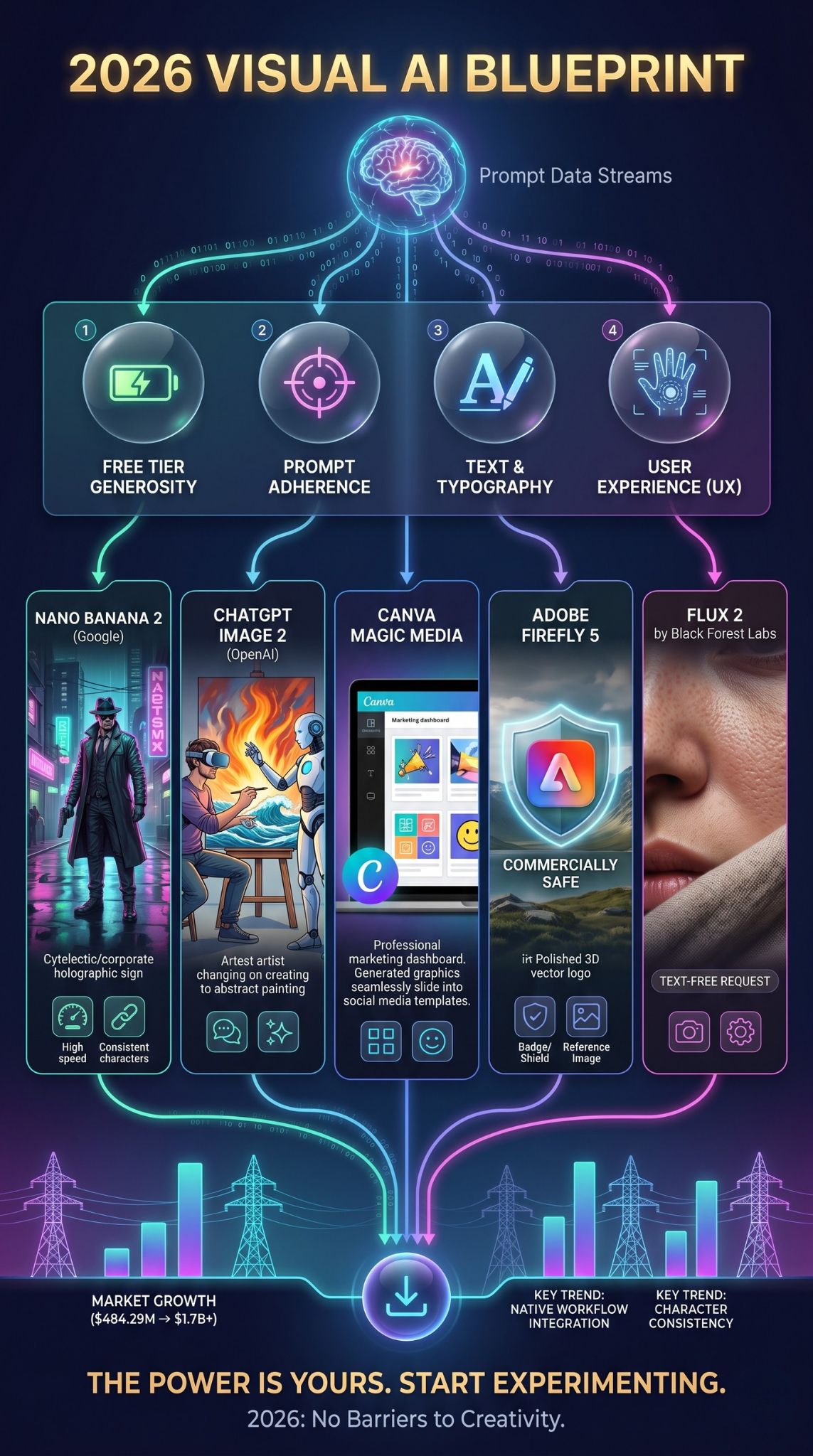
Making a choice depends entirely on what you actually need to build for your business or personal projects. A tool that works perfectly for casual social media might fail completely when tasked with creating precise assets for B2B SaaS growth campaigns. You have to match the platform to your specific operational workflow and visual style requirements. I rely heavily on tools that can deliver text-free landscape images, but your mileage may vary depending on your niche. Let us look at a practical breakdown to guide your decision.
|
Your Primary Use Case |
Recommended Platform |
Key Benefit |
|
Multilingual SEO Content |
Nano Banana 2 |
Fast, realistic, and highly consistent |
|
Graphic Design & Social Media |
Canva Magic Media |
Frictionless workflow directly into designs |
|
Commercial Safety & Compliance |
Adobe Firefly 5 |
Guaranteed copyright safety for enterprises |
|
Photorealism & Advanced Control |
FLUX 2 |
Unmatched detail and lighting accuracy |
|
Typography & Logos |
Ideogram |
Industry-leading text rendering |
Best for Multilingual SEO Content
If you want the best all-around experience for content publishing, Nano Banana 2 is the current leader. Its deep integration with Google makes it a powerful daily driver for creating high-value, problem-solving content. It handles complex instructions beautifully, making it ideal for generating culturally relevant images for diverse target markets.
Best for Graphic Design and Social Media
If you need to make social media posts quickly, Canva Magic Media is unbeatable. The workflow from generation to final design is completely frictionless. You do not need to download and re-upload files ~ everything happens in one seamless environment, which is perfect for fast-paced digital businesses.
Best for Commercial Safety and Compliance
If you are a professional worried about copyright and commercial safety, Adobe Firefly is the only tool that guarantees your peace of mind. It is the smartest choice for health-tech startups or large enterprises where legal compliance is a strict requirement.
Best for Photorealism and Advanced Control
If you are a power user who wants maximum control and realism, find a platform hosting FLUX 2. It is phenomenal at rendering 3D isometric infographics and hyper-realistic photography. It requires a bit more technical savvy to master, but the results are entirely worth the effort.
Best for Text Accuracy and Typography
If you specifically need to create logos, typography, or posters with words, Ideogram should be your first stop. It understands how to render letters accurately without the strange distortions that plague older algorithms.
How AI Image Generators Evolved in 2026
The technological leap from last year to now is staggering, with the global market size reaching roughly $484.29 million. We moved past the era of distorted hands and blurry backgrounds into a phase of true high-fidelity generation. Current models understand spatial awareness and lighting logic better than many junior designers. This evolution directly impacts how businesses approach customer onboarding and sales automation through visual storytelling. Here is a look at the data and trends shaping the industry right now.
|
Industry Trend |
2025 Status |
2026 Reality |
|
Market Size |
$412.51 Million |
$484.29 Million |
|
Text Rendering |
Mostly gibberish and artifacts |
Highly accurate spelling and typography |
|
Workflow Integration |
Standalone third-party apps |
Native integration in Google and Adobe |
|
Resolution Limits |
1024×1024 pixels standard |
Native 4K generation capabilities |
Market Size and Usage Statistics
According to a recent report by Fortune Business Insights, the global AI image generator software market hit $484.29 million in 2026 and is projected to reach $1,747.63 million by 2034. This represents a massive compound annual growth rate. Furthermore, G2 analysis shows users rate the image quality of these platforms an impressive 6.3 out of 7. The data proves that these tools are no longer experimental toys ~ they are core business infrastructure.
The Rise of Workflow Integration
One major evolution is the focus on seamless workflow integration. Standalone generators are becoming less common. Instead, generative capabilities are baked directly into the tools we already use daily, like Google Workspace and Canva. This turns artificial intelligence into an invisible assistant that speeds up content production pipelines.
Achieving Perfect Character Consistency
Previously, generating the exact same person or object in different poses was nearly impossible without complex technical workarounds. Models like Nano Banana 2 solved this issue, opening the door for independent creators to make storyboards, consistent brand mascots, and cohesive visual campaigns easily.
Open-Source Democratization
The democratization of high-end generation through open-source models like FLUX 2 means that anyone, regardless of budget, can access studio-quality rendering. You do not need massive funding to produce world-class visuals anymore. The barrier to entry completely vanished, allowing startups to compete with legacy brands visually.
Final Thoughts
The search for the best free ai image generators 2026 has to offer reveals a market that is more accessible, powerful, and diverse than ever before. You do not need to spend thousands of dollars to start bringing your creative visions to life or to scale your content strategy. Whether you choose the technical excellence of Nano Banana 2, the conversational ease of ChatGPT, or the pure graphic design utility of Canva, the most important step is simply to start experimenting. The best tool is the one that fits seamlessly into your workflow and helps you express your ideas with clarity.
Frequently Asked Questions (FAQs)
Navigating the world of artificial intelligence often leaves people with more questions than answers, especially regarding licensing and technical limitations. I constantly hear from other creators who are confused about commercial rights or how to fix strange artifacts. It is crucial to understand exactly what you are getting into before you integrate these tools into your daily operations. I compiled the most common and pressing questions regarding the best free ai image generators 2026 has available right now. Let us clear up the confusion.
|
Question Category |
Main Focus |
Quick Answer |
|
Cost & Limits |
Free tiers |
Most offer daily or monthly free credits. |
|
Legal Rights |
Copyright ownership |
Generally, AI images cannot be copyrighted. |
|
Business Use |
Commercial safety |
Yes, but check specific terms of service. |
|
Text Issues |
Misspelled words |
Use Ideogram or Nano Banana 2 for text. |
Are these platforms actually free forever?
Yes, many of the best platforms offer permanent free tiers. Tools like Canva, Ideogram, and Adobe Firefly provide a set amount of daily or monthly generative credits. Others, like ChatGPT and Google Gemini, allow free usage but might throttle your speed or limit your generations during busy server periods.
Who owns the copyright to AI generated images?
This remains a complex legal gray area in 2026. Generally, images created by algorithms cannot be copyrighted by the user because they lack human authorship. However, tools like Adobe Firefly are designed to be commercially safe, meaning you can use them for business without fear of infringing on someone else’s copyrighted training data.
Can I use free generations for my B2B business?
In most cases, yes. Platforms like Canva, OpenAI, and Adobe allow commercial use of the images you generate. However, it is crucial to read the specific terms of service for each tool. If you run a digital business or an SME, ensuring your assets are legally cleared is a top priority.
Which tool creates the best 3D isometric graphics?
If you want high-quality 3D isometric infographics, Nano Banana 2 and FLUX 2 are your best options. They handle depth, lighting, and geometric structures exceptionally well, making them perfect for technical software visual representations.
How do I stop the AI from generating misspelled words?
If you want text in your image, switch to a platform designed for it, like Ideogram. If you want absolutely zero text, you need to use negative prompting. Add phrases like ~do not add any text into image~ or ~text-free~ to your prompt. Models like Nano Banana 2 are very savvy at respecting these negative constraints.