
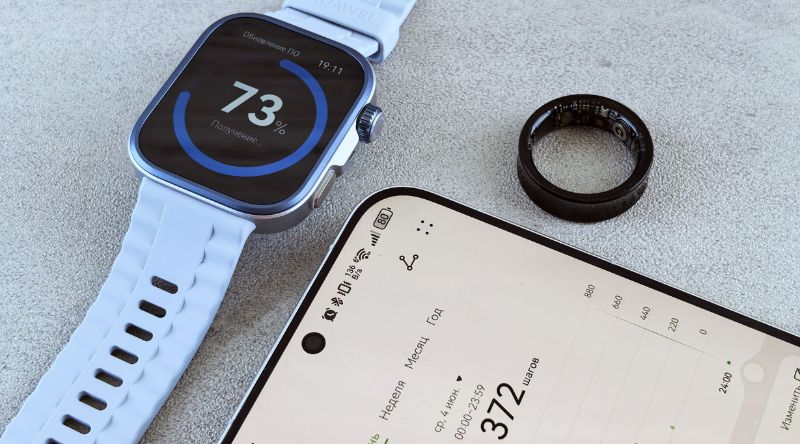
Battery anxiety is real. EV drivers worry about range and charging time. Phone users worry about battery drain, heat, and slow charging. That’s why solid-state batteries keep showing up in tech headlines.
The idea sounds simple: replace the liquid electrolyte inside today’s lithium-ion batteries with a solid material. In practice, it’s hard. Very hard. But if companies can make it work at scale, solid-state batteries for EVs and phones could bring longer range, faster charging, safer packs, thinner designs, and better battery life.
The catch? Most full solid-state batteries are still not mainstream. The International Energy Agency said solid-state batteries remained at “large pilot stage” in its 2025 EV battery analysis, even as major companies moved closer to commercial production.
Why Solid-State Batteries Matter Now
The battery market is already huge. In 2025, global EV battery deployment reached 1.2 TWh, up almost 30% from 2024, according to the IEA’s Global EV Outlook 2026. EVs made up more than 70% of total global battery deployment that year.
That scale matters. Better batteries don’t just improve cars and phones. They shape charging networks, power grids, mining demand, recycling, device design, and consumer trust.
Toyota is aiming to launch battery electric vehicles with all-solid-state batteries in 2027–2028. Nissan says it began operating its all-solid-state battery pilot line in January 2025 and aims to launch EVs with in-house solid-state batteries by fiscal year 2028. Honda built a demonstration line in Japan and planned to start battery production there in January 2025 for mass-production testing.
Samsung SDI also says it completed a pilot production line for solid-state batteries in 2023 and plans all-solid-state battery mass production in 2027.
Solid-State Batteries for EVs and Phones: Quick Overview
|
Key Point |
What It Means |
|
Main change |
Solid electrolyte replaces liquid or gel electrolyte |
|
Biggest promise |
More energy in less space |
|
EV benefit |
Longer range, faster charging, safer battery packs |
|
Phone benefit |
Longer battery life, slimmer designs, less heat |
|
Current status |
Pilot lines and early production targets |
|
Main problem |
Cost, durability, interfaces, scaling production |
A solid-state battery is not magic. It still needs a cathode, an anode, and an electrolyte. The big shift is the electrolyte. A solid electrolyte can help improve safety and may allow battery makers to use lithium-metal anodes, which can store more energy than the graphite anodes used in many current lithium-ion cells.
But the small contact points inside these batteries can become a big headache. Researchers still have to manage interface resistance, cracks, chemical reactions, and lithium dendrites. A Nature Index topic summary notes that poor contact, chemical instability, and uneven current distribution can cause high impedance, dendrite growth, and fast failure in solid-state lithium-metal batteries.
Top 10 Ways Solid-State Batteries Could Change EVs and Phones
1. Longer EV Range Without Huge Battery Packs
Solid-state batteries could help EVs travel farther without simply making battery packs larger and heavier. That matters because bigger packs add cost, weight, and charging demand.
Toyota says solid-state batteries can offer shorter charging times, increased cruising range, and higher power output because ions can move faster through the solid electrolyte. Toyota has also described a target of around a 20% cruising-range increase for its first solid-state battery compared with its Performance battery.
For drivers, the change would feel simple: fewer charging stops. For automakers, it could mean more freedom in vehicle design.
|
EV Impact |
Why It Helps |
|
Higher energy density |
More range from similar pack space |
|
Smaller pack option |
Lower weight and better efficiency |
|
Longer highway trips |
Fewer charging breaks |
|
Better premium EV appeal |
Range still drives buyer interest |
2. Faster Charging Could Feel More Normal
Charging speed is one of the biggest barriers for EV buyers. Nobody wants to wait 45 minutes if they’re used to a five-minute fuel stop.
Toyota has said it is targeting a 10% to 80% recharge time of about 10 minutes for its first solid-state battery technology. That target is ambitious, and real-world speed will depend on chargers, cooling, battery size, software, and weather.
Phones could benefit too. A solid-state cell that handles heat and ion movement better may support faster charging in a smaller space. But phone makers will still need to protect battery life. Fast charging is useful only if the battery stays healthy.
|
Device |
Possible Change |
|
EVs |
Faster road-trip charging |
|
Phones |
Shorter top-up times |
|
Wearables |
Faster tiny-battery charging |
|
Laptops |
Better charging speed with lower heat risk |
3. Better Safety Could Build More Trust
Today’s lithium-ion batteries are safe when built and managed well. Still, they use liquid electrolytes that can burn under certain failure conditions.
Solid-state batteries may reduce that risk because the electrolyte is solid, not a flammable liquid. Toyota says solid-state batteries are highly stable because they resist temperature changes and can handle high temperatures and high voltages.
That safety story matters for EVs, phones, wearables, drones, and laptops. A safer battery can make users more confident. It can also help engineers design smaller battery protection systems.
|
Safety Area |
Possible Benefit |
|
Heat |
Better thermal stability |
|
Puncture risk |
Less liquid leakage concern |
|
High voltage |
Better tolerance in some designs |
|
Wearables |
Safer close-to-skin devices |
4. Phones Could Get More Battery Life Without Getting Thicker
Phone makers face a tough design problem. Users want bright screens, AI features, better cameras, 5G, gaming power, and longer battery life. But nobody wants a brick in their pocket.
Solid-state batteries could pack more energy into the same space. That could mean a thinner phone with the same battery life, or a similar-sized phone that lasts longer.
Samsung SDI says its anode and solid electrolyte technologies are meant to improve energy density and safety. A Samsung SDI executive also told Korea JoongAng Daily that the company now sees potential beyond EVs, including everyday IT and mobile devices.
|
Phone Design Choice |
What Solid-State Could Enable |
|
Same phone size |
More battery capacity |
|
Same battery life |
Thinner body |
|
Foldables |
More space-efficient battery layout |
|
Gaming phones |
More power with better heat control |
5. Wearables May Get Solid-State Batteries Before Phones
Smartwatches, fitness rings, earbuds, and health patches need tiny batteries. That makes them a natural early market for solid-state cells.
A full smartphone battery must handle heavy daily charging, heat, gaming loads, camera use, and years of cycles. A wearable cell is smaller and may be easier to introduce first.
That doesn’t mean phones won’t get the tech. It means the first consumer use may appear in smaller premium devices before mass-market smartphones.
|
Device Type |
Why It Could Come Early |
|
Smart rings |
Tiny battery space |
|
Smartwatches |
Need safer close-contact power |
|
Earbuds |
Small cells, high convenience value |
|
Health wearables |
Safety and compact design matter |
6. EV Performance Could Improve
Solid-state batteries could help performance EVs, not just long-range family cars. Higher output can support faster acceleration, stronger regenerative braking, and better repeat performance.
Toyota has said solid-state batteries can deliver higher power output and can fit needs ranging from sports cars to commercial vehicles that need frequent quick recharging.
This could matter for electric sports cars, delivery vans, taxis, buses, and fleet vehicles. More power is not just about speed. It can also mean faster energy recovery and better performance under load.
|
Use Case |
Possible Benefit |
|
Sports EVs |
Stronger power delivery |
|
Delivery vans |
Faster quick-charge cycles |
|
Taxis |
Less downtime |
|
Heavy-duty vehicles |
Better power density |
7. Battery Packs Could Become Thinner and Easier to Package
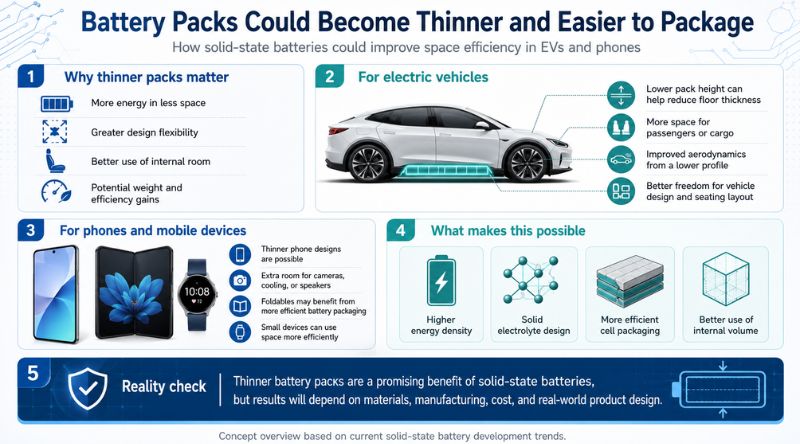
EV design depends heavily on battery shape. Today, most EV packs sit under the floor. That can raise the vehicle height and affect aerodynamics.
Toyota has discussed reducing battery pack height from around 150 mm in the bZ4X to 120 mm, and even 100 mm for high-performance sports vehicles. The company links thinner batteries with better aerodynamics, lower vehicle height, and improved range potential.
Phones face a similar packaging problem. A thinner, denser battery can free space for cameras, cooling systems, speakers, sensors, or foldable hinges.
|
Product |
Design Advantage |
|
EVs |
Lower floor and better aerodynamics |
|
Sports cars |
Lower seating and center of gravity |
|
Foldable phones |
More room for hinge and screens |
|
Tablets |
Thinner body or longer runtime |
8. Longer Battery Life Is Possible, But Not Guaranteed
Solid-state batteries are often linked with longer lifespan. That may happen, but it is not automatic.
Cycle life depends on materials, pressure, temperature, interfaces, charging rate, and battery management software. A 2025 ScienceDirect review says solid-state batteries offer promise for safety, energy density, and cycle life, but also notes that commercialization still depends on solving material, architecture, degradation, and charging challenges.
This is where hype needs a reality check. A lab cell can look great. A battery pack inside a car or phone must survive real use.
|
Battery Life Factor |
Why It Matters |
|
Interface contact |
Poor contact raises resistance |
|
Dendrites |
Can cause short circuits |
|
Heat |
Speeds degradation |
|
Fast charging |
Can stress materials |
|
Manufacturing quality |
Controls consistency |
9. Premium Devices May Get the Tech First
The first solid-state products will probably be expensive. That’s normal for new battery chemistry.
The IEA noted that early solid-state volumes will likely be limited and that it may take several years after rollout for the technology to become competitive with lithium-ion batteries.
So don’t expect budget EVs and low-cost phones to switch overnight. Premium EVs, high-end wearables, flagship phones, robotics, aerospace, and industrial devices may get the first wave.
|
Early Market |
Why It Makes Sense |
|
Luxury EVs |
Buyers can absorb higher cost |
|
Performance cars |
Range and power matter |
|
Wearables |
Small cells need less material |
|
Robotics |
High energy in tight space |
|
Aerospace |
Safety and weight are critical |
10. Manufacturing Could Decide the Winner
The biggest race is not just chemistry. It’s manufacturing.
A solid-state battery must be made at scale with high quality, low defects, strong yields, and reasonable cost. That is where many promising technologies fail.
Honda built a demonstration production line to verify mass-production technologies and costs, including processes such as weighing, mixing, coating, roll pressing, cell formation, and module assembly. Honda said it aims to start mass production of all-solid-state batteries in the second half of the 2020s.
Nissan is also working on production methods. Its partnership with LiCAP focuses on dry electrode production, which Nissan says can improve production efficiency and performance for all-solid-state batteries.
|
Manufacturing Challenge |
Why It Matters |
|
Yield |
Low yield raises cost |
|
Pressure control |
Needed for good interface contact |
|
Materials handling |
Some solid electrolytes are sensitive |
|
Scaling |
Lab success may not transfer easily |
|
Cost |
Mass adoption needs cheaper production |
Challenges Holding Solid-State Batteries Back
Solid-state batteries sound like an easy upgrade. They aren’t.
The hardest problems include:
- Keeping strong contact between solid layers
- Stopping cracks during charge and discharge
- Preventing lithium dendrites
- Reducing high production costs
- Making cells at scale with low defect rates
- Proving long life under real-world stress
- Building supply chains for solid electrolytes and special materials
Toyota has openly described durability as a key challenge, noting that repeated charging and discharging can cause cracks between cathodes, anodes, and solid electrolytes, degrading performance.
This is why solid-state batteries for EVs and phones should be seen as a serious next step, not a finished revolution.
FAQs About Solid-State Batteries for EVs and Phones
Are solid-state batteries already in EVs?
Not in mainstream mass-market EVs yet. Several companies are testing pilot lines, demonstration lines, and early production plans. Toyota, Nissan, Honda, and Samsung SDI all have public solid-state battery roadmaps, but large-scale consumer rollout is still ahead.
Are semi-solid-state and all-solid-state batteries the same?
No. Semi-solid-state batteries may still use some liquid or gel-like material. All-solid-state batteries aim to use a solid electrolyte system. The IEA warns that “solid-state batteries” is often used as a broad term, which can create confusion.
Will solid-state batteries make phones last for days?
They could help, but it depends on phone size, screen brightness, processor efficiency, network use, software, and camera load. A better battery gives phone makers more room to improve battery life, but it doesn’t remove power-hungry hardware.
Will solid-state batteries stop EV battery fires?
No battery can promise zero risk. Solid-state batteries may reduce some fire risks because they avoid flammable liquid electrolytes, but safety still depends on design, manufacturing quality, crash protection, charging control, and thermal management.
Why are solid-state batteries so hard to make?
The materials must touch perfectly, conduct ions well, resist cracks, avoid harmful reactions, and survive thousands of cycles. Solid-to-solid contact is harder to manage than liquid contact inside regular lithium-ion cells.
Will solid-state batteries make EVs cheaper?
Not at first. Early solid-state batteries will likely appear in premium products because new manufacturing is expensive. Prices may fall only after factories scale, yields improve, and supply chains mature.
Could solid-state batteries reduce charging-station pressure?
They could reduce waiting time if EVs charge faster. But ultra-fast charging also needs powerful charging stations, grid upgrades, cooling systems, and smart charging software.
Conclusion
Solid-state batteries for EVs and phones could change how we use cars, smartphones, wearables, and mobile devices. They promise more energy in less space, faster charging, better safety, and more design freedom.
But the next few years will decide how fast the technology moves from pilot lines to real products. The science is promising. The manufacturing challenge is still tough.
For now, the smart view is simple: solid-state batteries are not hype, but they’re not mainstream yet either. Watch the 2027–2028 window closely, especially from Toyota, Nissan, Honda, Samsung SDI, and other battery developers.