
Science fiction has a massive PR problem. For years, I assumed the whole genre was just dense physics textbooks wrapped in a spaceship cover. The alien names are impossible to pronounce, the technology makes absolutely no sense, and the books weigh ten pounds each. I totally get the intimidation factor. If you normally read fast-paced thrillers or breezy romance, a 900-page galactic history lesson sounds like absolute torture.
But I’ll let you in on a secret: you do not need a degree in astrophysics to love this genre. Modern sci-fi is entirely about people. It focuses on how ordinary humans react to wild, impossible situations. The pacing is faster, the dialogue is snappy, and the emotional stakes are higher than ever. Finding the best sci fi books beginners can actually finish just means picking the right starting line.
Let’s skip the heavy, boring textbooks. I dug through the latest 2025 and 2026 releases, cross-checked current award winners, and pulled together the ultimate, fluff-free reading guide. This list is packed with fast thrillers, hilarious survival stories, and a few timeless classics that still hold up.
Why Start Reading Science Fiction Right Now?
We basically live inside a sci-fi novel already. Artificial intelligence generates our art, billionaires launch rockets every Tuesday, and drones deliver our groceries. Reading science fiction gives you a fun, safe, and highly entertaining way to process this rapid technological change.
Plus, the writing style of the genre has completely shifted over the last decade. Today’s authors care way more about character development and emotional trauma than explaining exactly how a warp drive functions. You get all the wild escapism and world-building without doing the boring homework. Authors are actively blending genres now, mixing sci-fi with romance, comedy, and murder mysteries to bring in mainstream readers.
|
Why Pick Up Sci-Fi? |
The Real Benefit |
Perfect For… |
|
Pure Brain Break |
You completely check out of reality and drop into a new world. |
Curing modern screen fatigue and burnout. |
|
Cool Under Pressure |
You watch smart characters out-think impossible problems. |
Readers who love a good mystery or heist. |
|
Zero Rules |
Want giant monsters? Time travel? A robot making tea? It exists. |
Anyone bored by standard contemporary fiction. |
|
Massive Community |
Sci-fi fans love welcoming new people. |
Finding fun book clubs and online discussions. |
Top Gateway Novels: The Best Sci Fi Books Beginners Should Try First
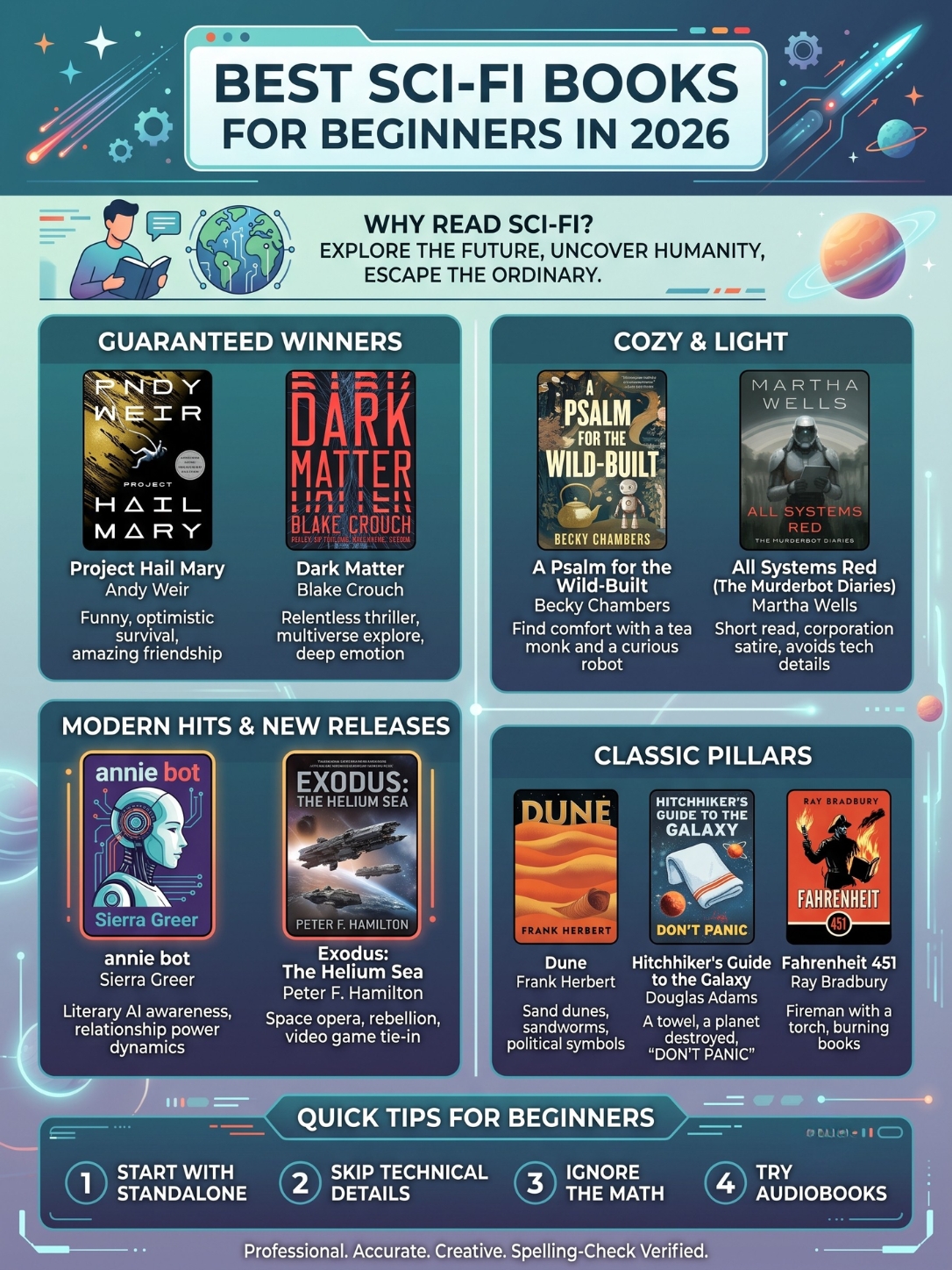
If you want a guaranteed win, start right here. These books grab you by the collar on page one. They rely on funny, relatable characters and flat-out refuse to get bogged down in useless technical details. These are universally considered the gateway drugs to the genre.
1. Project Hail Mary by Andy Weir
Ryland Grace wakes up on a spaceship. He has zero memory of who he is. His two crewmates are dead. As his brain slowly reboots, he realizes he is on a desperate suicide mission to save Earth from a terrifying, star-eating microbe.
Andy Weir (the guy who famously wrote The Martian) writes like your smartest, funniest friend. He makes complex science feel like a fun escape-room puzzle rather than a college lecture. The tension is incredibly high, but the tone remains optimistic, hilarious, and deeply human. It also features arguably the best alien friendship ever written in modern fiction.
2. Dark Matter by Blake Crouch
Jason gets mugged at gunpoint while walking home to his family in Chicago. Someone knocks him out. He wakes up strapped to a gurney, surrounded by cheering scientists in hazmat suits. In this reality, Jason is a famous genius who built an impossible machine, but his wife does not know him and his teenage son does not exist.
This reads exactly like a massive summer blockbuster movie. The tension never drops for a single page. You will likely blow through this in a single weekend because it perfectly blends a mind-bending multiverse concept with raw, desperate human emotion. It is a thriller first and a sci-fi book second.
3. Dungeon Crawler Carl by Matt Dinniman
This book is currently dominating the charts in 2026, and for good reason. Aliens invade Earth, flatten all the buildings, and turn the ruins into an eighteen-level, televised, intergalactic game show. Carl, a normal guy in his boxers and leather jacket, gets trapped inside with his ex-girlfriend’s prize-winning Persian cat, Donut.
This is the king of the “LitRPG” subgenre, where the book operates with video game logic (leveling up, getting loot, fighting bosses). It sounds absolutely ridiculous, and it is, but the character work is incredible. It is brutal, laugh-out-loud funny, and entirely unputdownable.
4. The Kaiju Preservation Society by John Scalzi
Jamie delivers food in New York City during the pandemic and absolutely hates it. Desperate for cash, Jamie takes a shady job for an “animal rights group.” Surprise: the animals are massive, radioactive Godzilla-style monsters living in an alternate, highly dangerous dimension.
The author literally calls this book a “pop song.” It is pure, dumb fun in the best way possible. The dialogue moves like lightning, it never takes itself seriously, and you don’t have to think too hard about the science.
5. A Psalm for the Wild-Built by Becky Chambers
Hundreds of years ago, robots gained self-awareness and just left. They walked into the woods to live alone in nature. Now, a traveling tea monk named Dex meets a wild robot named Mosscap. Mosscap only has one question: “What do humans actually need?”
This is the gold standard for “cozy sci-fi.” Nobody is blowing up a planet. There are no ticking clocks, space marines, or evil empires. It feels exactly like drinking a warm cup of coffee on a rainy Sunday.
|
Book Title |
The Core Vibe |
Read It If You Want… |
Page Count |
|
Project Hail Mary |
Optimistic Survival |
Sarcasm, clever puzzles, and hope. |
496 |
|
Dark Matter |
Relentless Thriller |
Heart-pounding tension and alternate lives. |
352 |
|
Dungeon Crawler Carl |
Chaotic Comedy |
Video game logic, action, and a talking cat. |
432 |
|
Kaiju Preservation Society |
Action-Comedy |
Snappy dialogue and giant radioactive monsters. |
272 |
|
A Psalm for the Wild-Built |
Cozy & Quiet |
Low stakes, deep thoughts, and nature. |
160 |
The Best Sci Fi Books Beginners Will Discover in 2025–2026
The genre moves incredibly fast. If you want to jump straight into the current cultural conversation, check out these massive new releases from 2025 and 2026. Authors are blending genres heavily right now, pulling in fans of romance, literary fiction, and horror.
1. A Hole in the Sky by Peter F. Hamilton (Releasing January 2026)
Hamilton usually writes massive, intimidating space operas that scare off new readers. But this new 2026 release completely changes the game. It focuses on a generation ship—a massive vessel flying between stars over hundreds of years—and a teenager who discovers the society built inside the ship is based on a massive lie. It is essentially The Hunger Games meets Interstellar. The stakes are clear, the action is tight, and you don’t need a notebook to keep track of the characters.
2. Annie Bot by Sierra Greer (Recent Award Winner)
Winner of the prestigious Arthur C. Clarke Award, this book is taking the literary world by storm. It tackles the conscious-AI theme through Annie, a robot designed specifically to be the perfect, compliant girlfriend for her human owner. But as Annie learns, adapts, and gains true consciousness, she starts hiding her intelligence to survive. It is a sharp, deeply unsettling, and gripping look at power dynamics, relationships, and what it actually means to be human.
3. Project Hanuman by Stewart Hotston (Late 2025 Release)
If you want something totally different, this book blends deep Indian mythology with a high-speed space opera. It follows a criminal pilot and an emissary who is “printed from the cloud” as they try to track down a vanished virtual civilization. The concept of a living ship and digital utopias feels incredibly fresh. It reads like a high-octane heist movie set across the galaxy.
|
New Release |
Author |
The Massive Hook |
Vibe Match |
|
A Hole in the Sky |
Peter F. Hamilton |
A generation ship built on dark secrets. |
Dystopian survival. |
|
Annie Bot |
Sierra Greer |
An AI girlfriend slowly gains terrifying self-awareness. |
Literary thriller. |
|
Project Hanuman |
Stewart Hotston |
Indian mythology meets a galactic heist. |
Fast space opera. |
Unskippable Classics That Still Hold Up
Some classics feel like terrible homework assignments, bogged down by outdated gender politics and clunky 1950s technology. But the books below have survived for decades because their core stories still grip you by the throat. When hunting for the best sci fi books beginners can handle, these three are absolutely mandatory reading.
1. Dune by Frank Herbert (1965)
Set on the brutal, water-starved desert planet of Arrakis, this follows Paul Atreides, a young nobleman thrown into a deadly political trap. The prize is “spice,” a drug that extends life and makes space travel possible.
Why read it now? Thanks to the massive Denis Villeneuve movies, you already have a visual framework in your head. When Herbert talks about sandworms or Ornithopters, you know exactly what they look like. That makes this incredibly dense, political masterpiece much easier to digest.
Read Also: How to Read More Books Without Speed Reading
2. The Hitchhiker’s Guide to the Galaxy by Douglas Adams (1979)
Arthur Dent’s house is getting bulldozed to build a road. Five minutes later, the entire Earth is blown up by aliens to build a space highway. Arthur escapes with his buddy Ford (who is secretly an alien) and they hitchhike across a deeply stupid universe.
Why read it now? It proves that science fiction does not have to be miserable. It is endlessly quotable, deeply sarcastic, and arguably the funniest book ever printed in the English language.
3. Fahrenheit 451 by Ray Bradbury (1953)
Guy Montag is a fireman. But in this dystopian future, firemen don’t put out fires; they start them. Their sole job is to hunt down illegal printed books and burn them, keeping the population addicted to mindless television and fast cars.
Why read it now? It is short, poetic, and terrifyingly relevant. Bradbury basically predicted AirPods, flat-screen TVs, and our current addiction to short-form media back in the 1950s. It reads fast and hits incredibly hard.
|
Classic Book |
Core Theme |
Why It Survives Today |
|
Dune |
Politics, Ecology, Religion |
Massive cinematic world-building. |
|
Hitchhiker’s Guide |
Absurdity, Bureaucracy |
Laugh-out-loud funny and chaotic. |
|
Fahrenheit 451 |
Censorship, Media Addiction |
Predicted modern screen addiction perfectly. |
Matching Your Vibe: Exploring Key Sci-Fi Subgenres
To find the best sci fi books beginners actually stick with, you need to map the genre directly to what you already watch on Netflix. If you know your current taste, you can easily find your perfect sci-fi lane without wasting money on a book you will hate.
1. The Space Opera
Think Star Wars, Dune, or Guardians of the Galaxy. You get grand adventures, massive spaceships, evil galactic empires, and a messy crew of friends trying to save the universe.
- The Vibe: High drama, epic battles, and deep lore.
- Your Starter Book: The Long Way to a Small, Angry Planet by Becky Chambers.
2. Gritty Cyberpunk
Set slightly in the future on Earth. Mega-corporations own absolutely everything, neon lights cover the grime, and hackers fight the system using advanced body modifications. It is dark, rainy, and mysterious.
- The Vibe: Noir detectives, extreme capitalism, and neon lights.
- Your Starter Book: Snow Crash by Neal Stephenson.
3. Hard Sci-Fi
These authors desperately want the math to work. They focus heavily on real physics, engineering, and highly realistic space travel. The tension comes from equipment breaking down, not a guy in a cape trying to rule the world.
- The Vibe: Problem-solving, survival, and real science.
- Your Starter Book: The Martian by Andy Weir.
4. Dystopian Survival
Society collapsed a long time ago. Now, normal people are just trying to survive under oppressive governments or in the ruins of a destroyed world. It is gritty, raw, and highly political.
- The Vibe: Rebellions, fighting the power, and survival tactics.
- Your Starter Book: The Hunger Games by Suzanne Collins.
|
Subgenre |
What To Expect |
Matches Your Vibe If You Love… |
|
Space Opera |
Drama, huge stakes, messy crews. |
Epic fantasy, Marvel movies. |
|
Cyberpunk |
Hackers, corporate greed, neon cities. |
Noir detectives, crime thrillers. |
|
Hard Sci-Fi |
Problem-solving, real physics. |
Documentaries, survival stories. |
|
Dystopian |
Broken societies, fighting back. |
Action movies, gritty realism. |
Final Thoughts
You do not have to force yourself through a dry, boring textbook just to enjoy this massive genre. The sheer variety of stories out there is insane. Whether you want to laugh at a talking cat blowing up an alien spaceship, solve a murder across multiple shifting timelines, or watch a lonely robot learn how to make the perfect cup of tea, there is a story waiting for you.
Stop stressing about the massive epics or the intimidating history of the genre. Pick a subgenre that matches your current Netflix habits, grab a fast standalone novel, and jump straight in. If you pick any of the best sci fi books beginners love from this list, I guarantee you will be hooked by chapter two. Welcome to the future—you’re going to love it here.
Uncommon FAQs About Sci-Fi for New Readers
People actively avoid this genre because they believe a bunch of myths. Let’s clear the air and answer the specific questions tripping up new readers in search results.
Do I need to be good at science to read this stuff?
Absolutely not. Most authors invent the technology anyway. Just roll with the punches. If a character fires a plasma rifle, you don’t need to know the battery chemistry. Treat the technology the same way you treat magic in a fantasy novel.
Is every sci-fi book part of a massive ten-book series?
Bookstores make it look that way because box sets sell well, but no. Standalone novels are hugely popular right now. Books like Dark Matter give you a full, highly satisfying story in 350 pages without forcing you to buy three sequels.
Is everything set out in deep space?
Nope. Some of the absolute best stories happen right here on Earth. Cyberpunk, time travel thrillers, and alternate history books usually take place in normal cities.
What is the real difference between sci-fi and fantasy?
Sci-fi explains the impossible using technology, engineering, or evolution. Fantasy explains the impossible using magic, gods, or spells. Generally speaking: spaceship equals sci-fi, dragon equals fantasy. (Though books like Star Wars gleefully mash both together).
|
The Sci-Fi Myth |
The Actual Reality |
|
It is too dense and boring. |
Modern sci-fi reads exactly like a fast-paced thriller. |
|
I have to read the classics first. |
You don’t. Start with a hit book published this year. |
|
It is just spaceships and aliens. |
It also covers time travel, clones, and virtual worlds. |