
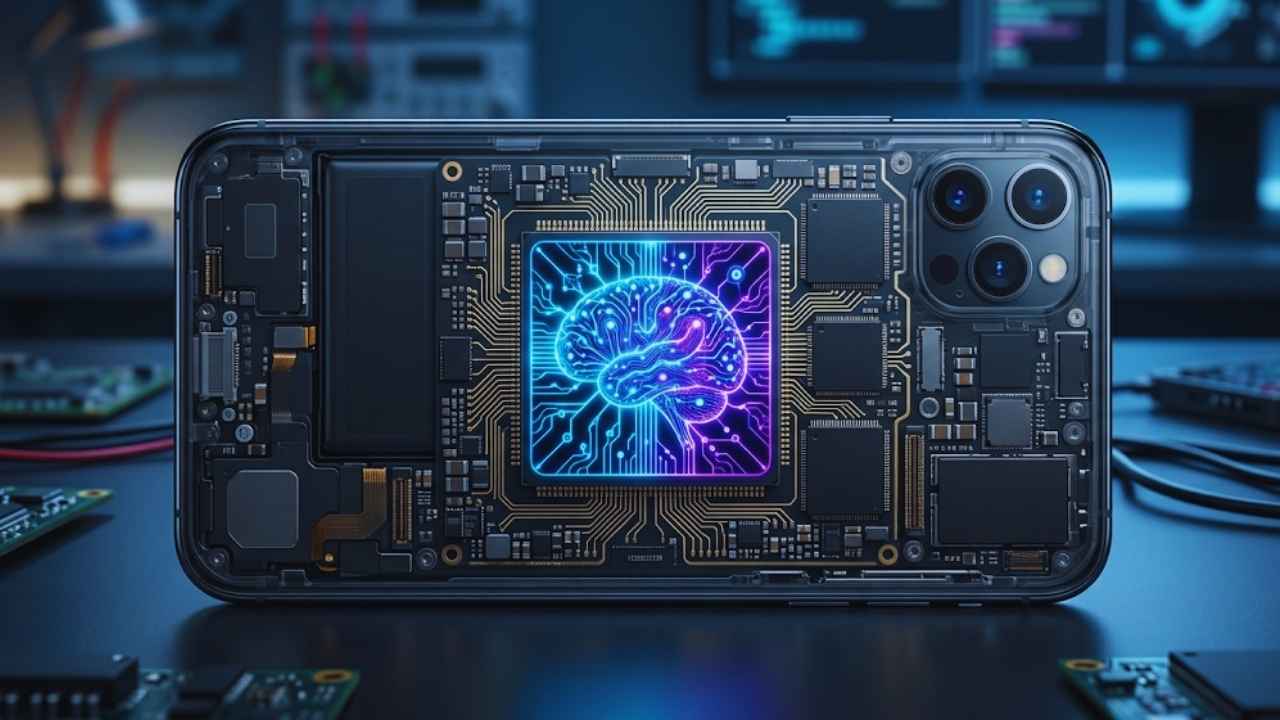
Ever wonder how your phone translates a menu in real time without a wireless connection? Or how it turns a blurry, pitch-black night into a crisp photo? It feels like magic, but it is not. It is physical hardware. For a long time, standard processors did all the heavy lifting. Today, your smartphone has a dedicated brain built strictly for artificial intelligence.
If you are trying to figure out what is npu in phone hardware, you just found the engine driving modern mobile technology. An NPU, or Neural Processing Unit, handles the complex math required for machine learning right inside your pocket. It is the exact reason your phone actually feels smart. Instead of sending your personal data to a remote cloud server to figure out what you just said, this chip processes it locally.
I notice the difference every single time I dictate a text message. The words appear instantly. Zero lag. Let’s break down how this tech works, why it matters for your daily phone use, and how it completely changes the future of mobile devices.
The Core Answer: What Is NPU in Phone Architecture?
To understand how an NPU works, you need to look inside your phone’s main brain. Engineers call this the System on a Chip, or SoC for short. Think of the SoC as a busy office building with entirely different departments doing different jobs. For decades, the CPU acted as the general manager, handling everything in a strict sequence. It opens your email, runs the operating system, and manages background tasks. Next door sits the GPU, the graphics department that renders your mobile games and draws the user interface. So, where exactly does the NPU fit in? The NPU acts as the AI specialist.
When people ask me what is npu in phone architecture doing differently than a CPU, I always point to parallel processing. Machine learning requires thousands of simultaneous, repetitive calculations, specifically matrix math. If you force a standard CPU to do this, it chokes. It drains your battery rapidly and makes the phone uncomfortably hot to the touch. An NPU mimics the human brain’s neural networks, doing one specific job better and more efficiently than any other component on the board.
We measure this raw processing power in TOPS, or Trillion Operations Per Second, which calculates how many matrix multiply-accumulate operations the chip handles simultaneously. High precision tasks use 32-bit floating-point math, but mobile AI thrives on 8-bit or 4-bit integer operations to save power while delivering lightning-fast inference.
Read Also: iPhone 17 vs Samsung Galaxy S26: Which to Buy in 2026?
|
Processor Component |
Primary Role in the Phone |
Method of Processing Data |
AI Power Efficiency Level |
|
CPU |
Manages the operating system and opens applications. |
Sequential processing (one task at a time). |
Extremely Low |
|
GPU |
Renders 3D graphics, high-resolution video, and games. |
Parallel processing (many visual tasks at once). |
Moderate |
|
NPU |
Runs artificial intelligence and neural network models. |
Matrix math processing (massive parallel data). |
Highly Efficient |
How Your Camera Actually Computes Photos?
The easiest way to see this specialized technology in action is to simply open your camera app. Modern smartphone cameras do not just capture light through a physical lens anymore. They actively compute the image using something we call computational photography, and it relies entirely on the Neural Processing Unit. Think about taking a photo in a dimly lit restaurant. Ten years ago, you got a dark, grainy, completely useless picture. Today, Night Mode kicks in automatically.
When you tap the shutter, the camera does not just take one picture. It captures multiple frames at different exposure levels in a fraction of a second. The NPU analyzes all those frames instantly, aligning them to remove the shake from your hands. It scrubs out the ugly digital noise and merges the frames into a single, bright photo. The NPU also handles semantic segmentation, a fancy engineering term for understanding exactly what sits in the camera frame. When you point your phone at a landscape, the NPU instantly identifies the sky, the grass, and the people.
It then applies specific color tweaks to each element individually. It makes the sky bluer without turning the people’s skin blue, executing all of this in real time before you even press the shutter button. This hardware also powers heavy-duty editing tricks, like generating a flawless background when you remove an unwanted photobomber from your vacation pictures.
|
Smartphone Camera Feature |
How the Dedicated NPU Makes It Work |
What Happens Without an NPU |
|
Night Mode Photography |
Aligns multiple frames and boosts lighting instantly. |
Photos stay pitch dark, grainy, and blurry. |
|
Portrait Mode Blur |
Uses depth mapping to separate the subject perfectly. |
Relies strictly on lens optics, causing poor edge detection. |
|
Real-Time Scene Detection |
Recognizes skies or food to adjust contrast automatically. |
Applies flat, standard color processing to everything. |
|
Magic Eraser Tools |
Generates a flawless background when removing objects. |
Leaves awkward smudges or glitchy pixels behind. |
Why NPUs Save Your Battery and Protect Your Privacy
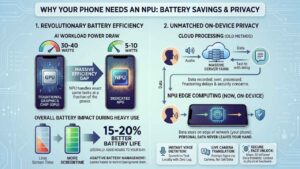
The benefits go far beyond making your social media feed look professional. The NPU quietly manages the most frustrating aspects of owning a smartphone, specifically aggressive battery drain and your personal privacy. Let’s look at battery life first. Recent hardware tests in 2026 show that shifting an AI workload from a traditional graphics chip to a dedicated NPU reduces power consumption drastically. Running heavy AI tasks on a GPU pulls 30 to 40 watts of power.
An NPU handles the exact same task using just 5 to 10 watts. This massive efficiency gap translates to 15 to 20 percent better battery life during heavy use, literally adding hours of screen time to your day. Then there is the privacy aspect. A few years ago, if you asked a voice assistant a simple question, your phone recorded your audio, sent it to a massive server farm, processed it, and sent the text back. This caused frustrating delays and made people extremely nervous about who was listening to their conversations.
Understanding what an NPU in phone specifications usually means understanding edge computing. This means speech-to-text, live translation, and predictive typing happen entirely on your device. The data stays on the edge of the network, meaning your phone, rather than going to the cloud. Your personal data never leaves your hand. Because NPUs use so little battery, they allow your phone to remain always aware without dying by noon.
|
Key Feature Benefit |
How the NPU Improves the User Experience |
User Data Security Level |
|
Adaptive Battery Management |
Learns app habits to restrict background power drain. |
Stays perfectly secure directly on your device. |
|
Instant Voice Dictation |
Processes speech-to-text locally with absolute zero lag. |
Stays perfectly secure directly on your device. |
|
Live Camera Translation |
Translates foreign signs via camera without cell data. |
Stays perfectly secure directly on your device. |
|
Secure Face Unlock |
Maps 3D infrared facial data instantly for security. |
Locked purely inside the physical hardware components. |
The 2026 Hardware War: Apple, Qualcomm, and MediaTek
Not every manufacturer calls this chip an NPU, which definitely makes buying a new phone a confusing experience. Different brands build custom neural processors, give them flashy marketing names, and battle aggressively for the top spot in speed rankings. As we push through 2026, the mobile hardware war has reached a boiling point. Qualcomm currently dominates a huge chunk of the premium Android market with its Snapdragon 8 Elite Gen 5 processor.
This flagship chip crosses the 4 million point mark in benchmark tests, relying on its Hexagon Processor to deliver incredible on-device AI efficiency. MediaTek fights back fiercely with its Dimensity 9500 series, a processor that utilizes an advanced AI Processing Unit to run complex language models natively. This chip makes mid-range and high-end phones dramatically faster at AI generation and multitasking. Meanwhile, Apple continues to refine its in-house silicon with the A19 Pro chip.
Apple focuses intensely on memory bandwidth, allowing the Apple Neural Engine to access system memory at blazing speeds. This means the latest iPhones run advanced Apple Intelligence features directly on the device with absolutely zero cloud lag. Google also remains a massive player with its Tensor G5 processor, leaning on the Tensor Processing Unit to deliver the smartest call screening and photo editing tricks on the market.
|
Leading Chipset Brand |
Custom NPU Brand Name |
Signature Artificial Intelligence Strength |
Found In These Devices |
|
Qualcomm (Snapdragon) |
Hexagon Processor |
Real-time translation and massive Generative AI. |
High-end Androids from Samsung and OnePlus. |
|
MediaTek (Dimensity) |
MediaTek APU |
Heavy language model processing and multitasking. |
Mid-range to premium high-end Android phones. |
|
Apple (A-Series Silicon) |
Apple Neural Engine |
Flawless FaceID security and Cinematic Video processing. |
Flagship iPhones and premium iPads. |
|
Google (Tensor Series) |
Tensor Processing Unit |
Real-time call screening and complex photo editing. |
The Google Pixel smartphone series. |
Generative AI and the Future of Your Smartphone
For years, NPUs operated quietly in the background. But with the massive explosion of Generative AI, the NPU now sits front and center in every smartphone commercial on television. People want artificial intelligence that writes their emails, summarizes long web articles, and creates images from text prompts. Right now, most of these tools rely heavily on massive cloud servers. The ultimate goal for tech companies is to run these Large Language Models locally on your phone. We already see this happening with lightweight models seamlessly integrated into mobile operating systems.
When you search for what is npu in phone technology online, you will inevitably see the acronym TOPS. TOPS stands for Trillion Operations Per Second, a raw metric showing exactly how many math calculations the NPU handles simultaneously. To run a massive language model locally without melting your phone’s battery, you need raw power. Today, modern mobile chips push past 40 to 45 TOPS, allowing them to rival full-sized desktop computers in AI processing.
The industry is rapidly moving toward Agentic AI. Instead of just answering a trivia question, a local AI agent powered by your phone’s NPU will soon open an app, navigate the messy interface, book a flight, and send a confirmation text to your friend, all without you lifting a single finger.
|
Artificial Intelligence Era |
The Main Focus of the Technology |
Reliance on Cloud Servers |
Required NPU Power (TOPS) |
|
The Past Decade |
Simple voice commands and basic photo detection. |
Very High (processed almost entirely on servers). |
Low (1 to 10 TOPS). |
|
The Present Day |
Computational photography and fast edge dictation. |
Medium (hybrid cloud and device approach). |
Mid (15 to 35 TOPS). |
|
The Near Future |
Autonomous on-device agents and instant image generation. |
Low (processed entirely on your local device). |
Ultra-High (45 TOPS or more). |
Final Thoughts
The smartphone industry hit a serious ceiling with raw speed a long time ago. A flagship phone from three years ago opens basic apps almost exactly as quickly as a brand-new model. The real battleground today is artificial intelligence, and the physical hardware fighting that battle is the neural processing unit. Hopefully, this guide breaks down exactly what an NPU is in phone design and why you should care. It is the specialist chip keeping your private data entirely out of the cloud.
It makes your photos look professional in terrible lighting, and it fiercely protects your battery life by doing heavy lifting at low wattages. As we move into an era where our phones generate text, summarize massive documents, and act as autonomous personal agents, the NPU is no longer just a nice bonus feature on a spec sheet. It is the absolute most critical piece of hardware inside your device.
Frequently Asked Questions (FAQs) About What is NPU in Phone
Can I upgrade the NPU in my phone?
No. The NPU physically sits on the exact same silicon die as the CPU and GPU. You can’t snap it out and swap it like a desktop computer graphics card. If you want a faster NPU, you have to buy a newer smartphone entirely.
Does a faster NPU mean my apps load faster?
Not really. Basic app loading speeds rely on the CPU, your storage drive speed, and your RAM. The NPU only accelerates tasks tied directly to machine learning. It makes applying a complex photo filter lightning fast, or transcribes your voice notes instantly, but it won’t make Chrome or Safari open any quicker.
Are NPUs causing phone prices to rise?
Yes and no. The actual silicon chip scales normally in price. However, running on-device AI requires a massive amount of working memory. Because the NPU demands space to hold AI models in active memory, manufacturers now pack 12GB to 16GB of RAM into modern phones. That forced memory upgrade slowly drives up the retail price of flagship devices.
Why do laptops suddenly have NPUs too?
While mobile phones used NPUs for years to save battery life, laptops are just catching up. Brands like Intel, AMD, and Qualcomm now bake NPUs directly into laptop chips. This push comes largely from Microsoft, which requires a powerful NPU to run local Windows Copilot features without killing the laptop’s battery in an hour.