

Most people don’t stop reading because they hate books. They stop because reading never gets a real place in the day.
It stays vague. “I should read more.” Nice thought. Weak plan.
That sentence doesn’t tell you when to read. It doesn’t tell you what to read. And it definitely doesn’t help when you’re tired, busy, or stuck in a scrolling loop at midnight.
To build a reading habit, you need something more reliable than motivation. You need a small routine that fits your normal life. You need books you actually want to open. And you need a backup plan for the days when your brain says, “Not today.”
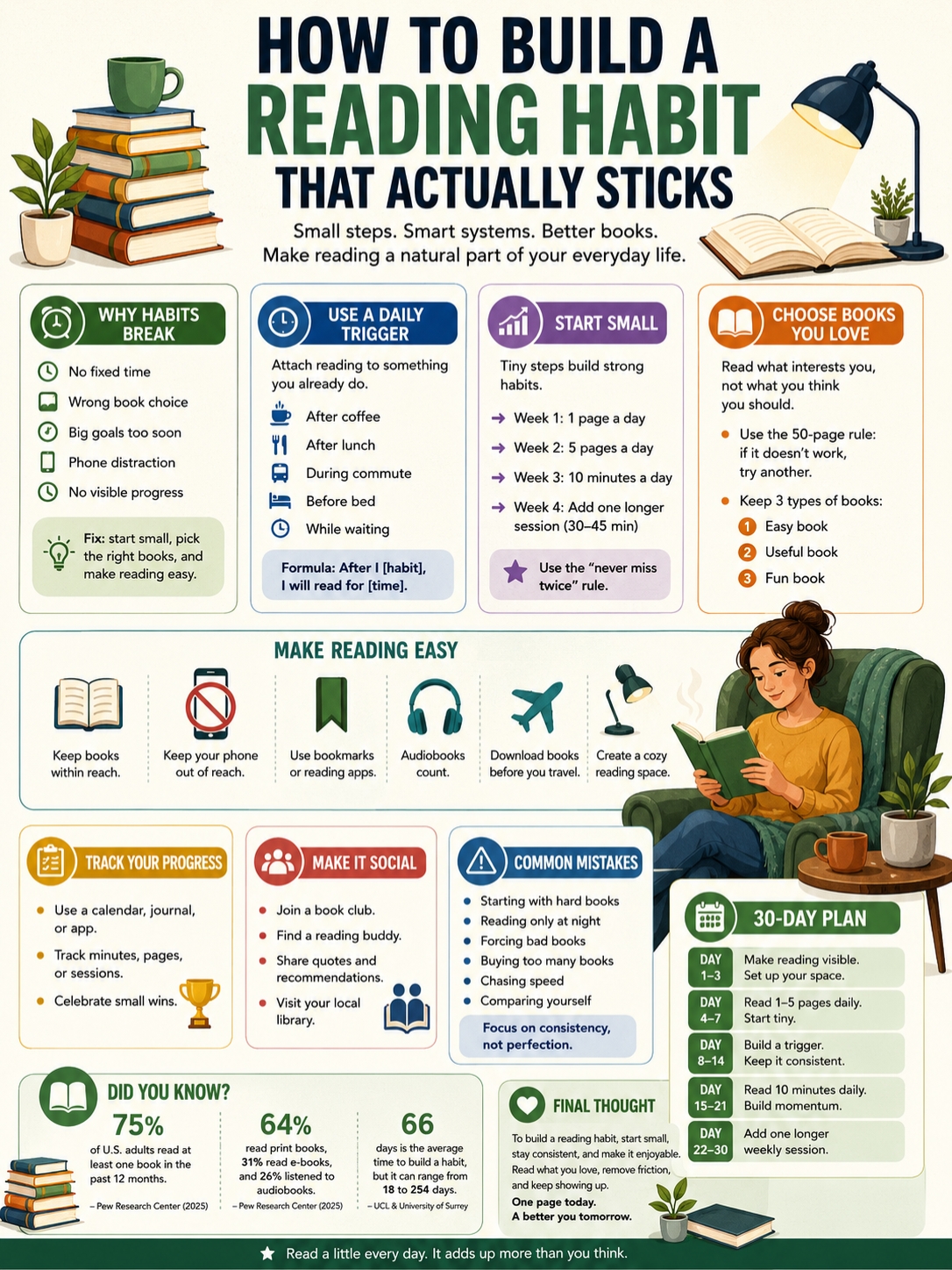
The good news? Reading is still very much alive. Pew Research Center found that 75% of U.S. adults read all or part of at least one book in the previous 12 months. Print books remain the top format, but e-books and audiobooks are now common too. That gives you more options. You don’t have to read the way someone else reads. You just have to find the format you’ll come back to.
Why Reading Habits Break So Easily
|
Common Problem |
What Usually Happens |
Better Fix |
|
No fixed time |
Reading depends on mood |
Attach reading to an existing routine |
|
Wrong book choice |
Reading feels like work |
Pick books that match your taste |
|
Big goals too soon |
You quit after missing days |
Start with 5–10 minutes |
|
Phone distraction |
Scrolling wins |
Keep your phone out of reach |
|
No visible progress |
The habit feels unrewarding |
Track pages, minutes, or sessions |
A reading habit usually breaks because it asks too much too soon.
You may start with a strong promise: “I’ll read one hour every night.” That sounds good on paper. But real life doesn’t care. One late workday, one family issue, one bad night’s sleep, and the plan falls apart.
That doesn’t mean you lack discipline. It means the habit was too heavy.
Habit research from University College London found that new habits took 66 days on average to become automatic. But that average doesn’t tell the whole story. The actual range was much wider, from 18 to 254 days. So no, reading may not feel natural after one week. That’s normal.
The first month is not about proving you’re a serious reader. It’s about making reading easy enough to repeat.
Stop waiting to feel motivated
Motivation is nice when it shows up. But it won’t show up every day.
A cue works better.
A cue is a small trigger that tells your brain, “This is reading time.” It could be coffee, lunch, your commute, or bedtime. Once the cue stays the same, reading becomes easier to repeat.
Don’t judge the habit too early
If reading still feels like effort after ten days, don’t quit. Your brain is still learning the routine.
Keep the target small. Keep the cue steady. Let the habit grow quietly.
How to Build a Reading Habit with a Clear Daily Trigger
|
Daily Trigger |
Reading Routine |
Why It Works |
|
After morning coffee |
Read 5 pages |
Starts the day calmly |
|
During your commute |
Listen to an audiobook |
Uses travel time well |
|
After lunch |
Read for 10 minutes |
Gives your brain a reset |
|
Before bed |
Read one chapter |
Replaces late-night scrolling |
|
While waiting |
Read on your phone or Kindle |
Turns spare minutes into reading time |
The easiest way to build a reading habit is to stop deciding every day.
Pick one clear moment.
Use this simple line:
After I [existing habit], I’ll read for [small amount of time].
For example:
- After I make tea, I’ll read 5 pages.
- After lunch, I’ll read for 10 minutes.
- After I get into bed, I’ll read one chapter.
- After I sit on the bus, I’ll listen to an audiobook.
- After dinner, I’ll read before opening social media.
This works because you’re not trying to build a routine from scratch. You’re attaching reading to something you already do.
Pick one reading window first
Don’t try to read at five different times right away. That creates too many decisions.
Start with one window:
- Morning, if your mind feels fresh.
- Lunch, if you need a screen break.
- Commute, if you travel often.
- Evening, if your home gets quiet after dinner.
- Bedtime, if you want to replace scrolling.
Bedtime works well for many people. A randomized study called The Reading Trial found that reading a book in bed before sleep improved sleep quality compared with not reading in bed.
That doesn’t mean bedtime is perfect for everyone. If you fall asleep after two lines, move your reading earlier. The best time is the time you can repeat.
Start So Small That Skipping Feels Silly
|
Starter Goal |
Best For |
Daily Time Needed |
|
1 page |
Very busy beginners |
2–3 minutes |
|
5 pages |
New or returning readers |
5–10 minutes |
|
10 pages |
Steady progress |
10–20 minutes |
|
20 pages |
Confident readers |
20–40 minutes |
|
30 minutes |
Deep reading sessions |
Flexible |
A reading habit should feel almost too easy at the start.
That may sound wrong. Most people want a bold goal. They want to read 50 books a year. They want to finish a huge novel. They want to become “a reader” fast.
But big goals can create pressure. Pressure makes you avoid the book.
So start with one page.
One page keeps the habit alive on bad days. It also removes your best excuse: “I don’t have time.” Almost everyone has time for one page.
Once you’re consistent, increase the target slowly.
Read Also: Best Thriller Books That Will Keep You Up at Night
A simple four-week reading plan
Week 1: Read 1 page a day
Your only job is to open the book.
Week 2: Read 5 pages a day
Now you’re building rhythm.
Week 3: Read for 10 minutes a day
A timer works better when page length varies.
Week 4: Add one longer session
Pick one day for 30–45 minutes of relaxed reading.
This plan helps you build a reading habit without turning it into another chore.
Use the “never miss twice” rule
Missing one day is normal. Life happens.
Missing two days is where the habit starts to slip.
If you skipped yesterday, read one page today. Don’t restart the whole plan. Don’t punish yourself. Just return to the book.
That small return matters more than a perfect streak.
Choose Books You Actually Want to Read
|
Reader Type |
Best Starting Choice |
Avoid at First |
|
Busy professional |
Short nonfiction or essays |
Dense theory books |
|
Returning reader |
Short novels |
Huge classics |
|
Anxious reader |
Comfort reads |
Heavy topics before bed |
|
New reader |
Fast-paced stories |
Books chosen only for status |
|
Skill learner |
Practical guides |
Overly broad books |
A boring book can ruin a new reading habit.
Many people pick books they think they “should” read. Then they feel guilty when they don’t finish them. That guilt makes reading feel like homework.
Don’t do that to yourself.
Read what pulls you in.
That could be:
- a thriller
- a romance
- a sports biography
- a business book
- a memoir
- a graphic novel
- a short story collection
- a practical self-improvement book
- an audiobook
- a book connected to your favorite movie, show, or hobby
Interest matters. The National Literacy Trust found that young readers felt more motivated when reading material matched their interests, connected to films or TV series they liked, or gave them freedom to choose. Adults aren’t exactly the same, but the lesson still fits: people read more when they care about the material.
Use the 50-page rule
If a book isn’t working after 50 pages, pause it.
For shorter books, use 20 pages.
You don’t have to finish every book you start. Quitting the wrong book can save your reading habit.
The goal isn’t to force your way through a dull book. The goal is to keep reading.
Keep three types of books nearby
A strong reading routine needs options.
Try keeping these three types of books close:
- An easy book for tired days.
- A useful book for learning.
- A fun book for momentum.
When one book feels slow, switch to another instead of stopping completely.
Make Reading Easier Than Scrolling
|
Friction Point |
Simple Fix |
|
Book is not nearby |
Keep it beside your bed, desk, or sofa |
|
Phone distracts you |
Put it across the room |
|
You forget to read |
Use a daily calendar mark |
|
Book feels too hard |
Keep a lighter backup book |
|
You lose your place |
Use a bookmark or reading app |
|
You travel often |
Use audiobooks or e-books |
If your book is in a drawer and your phone is in your hand, your phone will probably win.
That doesn’t mean you’re lazy. It means your phone is easier.
So make reading easier.
Put a book where your hand naturally goes. Keep your e-reader charged. Download audiobooks before travel. Place a book on your pillow in the morning so it waits for you at night.
Pew’s 2025 reading data shows why flexible formats matter. In the previous 12 months, 64% of U.S. adults read a print book, 31% read an e-book, and 26% listened to an audiobook. Audiobook use has more than doubled since 2011.
So don’t get stuck on one format. Use what works.
Audiobooks count
Some people treat audiobooks like cheating. They’re not.
If listening helps you read while walking, cooking, cleaning, or commuting, use it. The goal is not to impress anyone. The goal is to spend more time with books, stories, and ideas.
Keep your phone out of reach
You don’t need a dramatic digital detox.
Start smaller:
- Put your phone in another room for 10 minutes.
- Turn on Do Not Disturb.
- Read a physical book at night.
- Move social apps off your home screen.
- Use an e-reader instead of your phone when possible.
Your space should make the right action easier.
Track Progress Without Making Reading Feel Like Homework
|
Tracking Method |
Best For |
Simple Rule |
|
Calendar X mark |
Daily consistency |
Mark read or not read |
|
Reading journal |
Reflection |
Write one sentence |
|
Reading app |
Stats lovers |
Track pages or minutes |
|
Book list |
Motivation |
Keep finished books visible |
|
Sticky note |
Beginners |
Add one note per session |
Tracking helps when it gives you a small reward.
But don’t let tracking become another task. You don’t need long reviews. You don’t need five metrics. You don’t need to turn every book into a school report.
Pick one simple method.
A good option: write the date and one short line after each reading session.
Example:
July 5 — Read 8 pages. Strong chapter on focus.
That’s enough.
Track minutes, not only books
Book counts can mislead you.
A 120-page book and a 700-page book are not the same. So if you only track finished books, you may rush or feel behind for no good reason.
Try tracking time instead:
- 10 minutes a day
- 70 minutes a week
- 300 minutes a month
This makes progress feel more flexible. It also keeps you focused on the habit, not just the finish line.
Celebrate small wins
Finished a chapter? Mark it.
Read three days in a row? Notice it.
Chose reading over scrolling? That counts.
A reading habit grows faster when your brain sees reading as a reward, not a punishment.
Make Reading Social When Motivation Drops
|
Social Method |
How It Helps |
|
Book club |
Adds structure and accountability |
|
Reading buddy |
Makes progress visible |
|
Family reading time |
Builds a shared routine |
|
Online reading group |
Gives recommendations |
|
Library visits |
Makes reading feel active |
Reading is quiet, but it doesn’t have to be lonely.
Pew found that only 7% of U.S. adults had taken part in a book club in the previous 12 months. So book clubs are not the norm. Still, they can help if you like structure and discussion.
You don’t need a formal book club either.
Try a lighter version:
- Read the same book with one friend.
- Send one quote each week.
- Ask coworkers what they’re reading.
- Join a library challenge.
- Share a monthly reading list.
- Read quietly with a partner for 20 minutes.
A little social pressure can help. It makes reading feel less like a private task and more like a shared habit.
Be careful with public goals
Public goals can motivate you. They can also backfire.
Don’t announce, “I’m going to read 100 books this year” unless that kind of pressure helps you.
Say this instead:
“I’m reading 10 minutes a night this month.”
That sounds doable because it is.
Common Mistakes That Stop a Reading Habit
|
Mistake |
Why It Hurts |
Better Choice |
|
Starting with hard books |
Creates early resistance |
Start with easy wins |
|
Reading only at night |
Fails when you’re tired |
Add a backup slot |
|
Forcing bad books |
Kills interest |
Quit faster |
|
Buying too many books |
Creates guilt |
Read from a small shortlist |
|
Chasing speed |
Reduces enjoyment |
Focus on consistency |
|
Comparing yourself |
Makes reading feel competitive |
Track your own progress |
The biggest mistake is making reading feel like a performance.
You don’t need to read 100 books a year. You don’t need to start with classics. You don’t need a perfect morning routine. You don’t need two quiet hours and a beautiful chair by the window.
A reading habit sticks when it fits your actual life.
Avoid the “fresh start” trap
People often wait for Monday. Or New Year. Or vacation. Or a quieter season.
But life rarely gets perfectly quiet.
Read one page today. That’s the start.
Don’t compare your pace
Some people read 50 books a year. Some read five. Both can have a real reading habit.
Ask a better question:
Am I reading more than I did before?
If yes, you’re moving in the right direction.
A 30-Day Plan to Build a Reading Habit
|
Days |
Main Goal |
Action |
|
1–3 |
Make reading visible |
Put books in easy places |
|
4–7 |
Start tiny |
Read 1–5 pages daily |
|
8–14 |
Build a trigger |
Read after one fixed habit |
|
15–21 |
Increase gently |
Read 10 minutes daily |
|
22–30 |
Add depth |
Try one longer weekly session |
Here’s a simple plan you can start tonight.
Days 1–3: Set up your space
Pick one book. Put it where you’ll see it.
Good places include:
- bedside table
- desk
- sofa
- work bag
- dining table
- phone home screen if you use an e-book app
Remove one major distraction. Put your phone across the room. Turn off notifications. Keep the book closer than the screen.
Days 4–7: Read one page daily
No pressure. No big target.
Just open the book.
If you read more, great. If not, one page still counts.
Days 8–14: Attach reading to a cue
Choose one cue:
- after coffee
- after lunch
- after prayer
- after dinner
- before bed
- during commute
Repeat it daily.
Days 15–21: Move to 10 minutes
Set a timer.
Stop when it ends, unless you want to continue. This keeps reading light and predictable.
Days 22–30: Add one deeper session
Pick one day for a longer session.
Make tea. Sit somewhere comfortable. Put the phone away. Read for 30–45 minutes.
By day 30, you may not feel like a lifelong reader yet. That’s okay. You’ll have something better: proof that reading can fit into your life.
Final Thoughts
|
Key Idea |
What to Remember |
|
Start tiny |
One page counts |
|
Use triggers |
Same cue, same action |
|
Choose better books |
Interest beats guilt |
|
Remove friction |
Make books easier than phones |
|
Stay flexible |
Print, e-book, and audio all count |
To build a reading habit, stop chasing the perfect routine.
Start with the smallest repeatable action.
Read one page after coffee. Listen to an audiobook on your commute. Keep a novel beside your bed. Quit books that make you avoid reading. Track your progress, but don’t turn reading into another pressure game.
The habit sticks when reading feels useful, enjoyable, and easy to return to.
You don’t need more guilt. You need a routine that respects your energy, schedule, and taste.
Start today with one page. Tomorrow, do it again.
FAQs About Building a Reading Habit
|
Question |
Quick Answer |
|
How long should I read daily? |
Start with 5–10 minutes |
|
Is reading before bed good? |
Often, yes, especially with print books |
|
Should I finish every book? |
No, quit books that block the habit |
|
Do audiobooks count? |
Yes, if you’re engaged |
|
How many books should I read yearly? |
Pick a realistic number, not a showy one |
How long does it take to build a reading habit?
There is no fixed number. The popular “21 days” idea is too simple. UCL’s habit research found an average of 66 days, but the timeline varied widely. Some habits formed faster. Others took much longer.
So don’t panic if reading still feels new after a few weeks.
What is the best time of day to read?
The best time is the time you can repeat.
Morning works well if you want focus. Lunch works well if you need a break from screens. Bedtime works well if you want to replace scrolling.
Test one time for two weeks before changing it.
Is it better to read one book at a time or several?
Both can work.
One book is better if you get distracted easily. Several books work if you like matching books to your mood.
A good mix is one light book, one useful book, and one slower book.
Why do I get sleepy when I read?
You may be reading only when you’re already exhausted.
Try reading earlier in the day. Sit upright. Choose a more engaging book. If bedtime reading helps you sleep, that’s still useful.
Can I build a reading habit if I have a short attention span?
Yes.
Start with short chapters, essays, comics, graphic novels, or audiobooks. Use a five-minute timer. Don’t force long sessions too early.
Attention improves with practice, but the start should feel easy.
What should I do if I haven’t read a book in years?
Choose a short, fast book.
Avoid heavy classics at first unless you truly want them. Your first goal is to finish something enjoyable and rebuild confidence.
Are e-books worse than print books for building a habit?
Not really.
Print books may work better at night because they reduce screen temptation. E-books are useful because they travel well and let you read anywhere.
Choose the format that removes friction.