

Self-help books get a bad name, and honestly, some of them deserve it.
You know the type. Big promises. Loud advice. Endless talk about success, mindset, and becoming your “best self” by next Monday.
That kind of book can feel fake fast.
But not every self-help book is like that. The best self help books don’t shout at you. They don’t shame you. They don’t pretend life gets fixed with one morning routine and a gratitude journal.
The good ones feel practical. They help you understand your habits, thoughts, time, money, work, and relationships a little better. They give you language for things you’ve felt but couldn’t explain. They give you small moves you can actually try.
And people are still reading them. Pew Research Center reported in 2026 that 75% of U.S. adults had read a book in some format during the previous 12 months. Print remained the most popular format, followed by e-books and audiobooks.
So the issue isn’t whether books still matter. They do.
The real question is this: which books are worth your time?
|
Good Self-Help Books |
Cheesy Self-Help Books |
|
Give clear tools |
Give vague motivation |
|
Respect real problems |
Promise quick fixes |
|
Use grounded ideas |
Lean on slogans |
|
Encourage steady practice |
Push perfection |
|
Help you think clearly |
Make you feel broken |
What Makes a Self-Help Book Worth Reading?
A useful self-help book should pass one simple test.
Can you use one idea from it this week?
That’s it.
The book doesn’t need to change your whole life. It doesn’t need to answer every deep question. It just needs to help you see one problem more clearly and take one better step.
The strongest self-help books usually do a few things well:
- They focus on a real problem.
- They give practical advice.
- They don’t blame you for everything.
- They respect that change takes time.
- They come from real research, therapy models, reporting, coaching, or lived experience.
This matters because self-help is a crowded shelf. Some books are thoughtful and useful. Others are just motivational noise with a nice cover.
For mental health books, the bar should be even higher. CBT-based and ACT-based books can help many readers build useful coping skills. But books are not therapy. They can support you, but they can’t diagnose you or replace professional help when symptoms are serious.
|
What to Check |
Why It Matters |
|
Author background |
Expertise matters, especially in mental health |
|
Main promise |
Big promises are often a warning sign |
|
Practical steps |
You need something you can try |
|
Tone |
Good advice should not shame you |
|
Evidence |
Research-backed ideas are usually safer |
Best Self Help Books That Feel Practical, Not Cheesy
The books below don’t all solve the same problem. That’s a good thing.
Real life is not one problem. Sometimes you need better habits. Sometimes you need less anxiety. Sometimes you need boundaries, focus, money sense, or a healthier way to think about time.
These are some of the best self help books for readers who want depth without the cringe.
|
Book |
Best For |
Why It Works |
|
Atomic Habits |
Habits and routines |
Simple system for behavior change |
|
The Happiness Trap |
Overthinking and anxiety |
Practical ACT-based tools |
|
Feeling Good |
Negative thoughts |
CBT-style exercises |
|
Self-Compassion |
Harsh self-talk |
Research-backed emotional skills |
|
Deep Work |
Focus |
Clear rules for attention |
|
Four Thousand Weeks |
Time pressure |
Honest look at limits |
|
Set Boundaries, Find Peace |
People-pleasing |
Direct scripts and examples |
|
Designing Your Life |
Career direction |
Uses design thinking |
|
Essentialism |
Priorities |
Helps you cut noise |
|
The Psychology of Money |
Money behavior |
Calm, story-driven advice |
1. Atomic Habits by James Clear
Atomic Habits is popular for a reason. It’s clear, practical, and easy to use.
James Clear doesn’t tell you to change your whole life overnight. He focuses on small habits, better systems, and the tiny choices that shape your days.
The main idea is simple: small actions compound. You don’t rise to your goals. You fall to your systems.
That line works because it feels true. Most people don’t fail because they lack dreams. They fail because their daily setup works against them.
This book is best for readers who want to:
- Build a workout habit
- Read more
- Write consistently
- Reduce bad habits
- Create a better routine
The advice is simple but not shallow. Clear explains how to make good habits obvious, attractive, easy, and satisfying. He also shows how to make bad habits harder.
Why it’s not cheesy: it gives you a system, not a pep talk.
2. The Happiness Trap by Russ Harris
If you hate “just be positive” advice, this book is a relief.
The Happiness Trap is based on Acceptance and Commitment Therapy, often called ACT. The book’s main point is blunt: chasing happiness all the time can make you miserable.
That sounds strange at first. But it makes sense.
When you treat every bad feeling as a problem to fix, you spend your life fighting normal human emotions. Anxiety, sadness, fear, and doubt don’t disappear because you repeat a nice quote.
Russ Harris teaches readers how to notice thoughts without obeying them. He also shows how to move toward your values even when your mood isn’t perfect.
This book is best for:
- Overthinking
- Anxiety
- Emotional avoidance
- Feeling stuck in your head
- Living more by values than feelings
Why it’s not cheesy: it doesn’t promise constant happiness. It teaches you how to live better with uncomfortable feelings.
3. Feeling Good by David D. Burns
Feeling Good is an older book, but it still holds up because it gives readers real tools.
The book helped bring cognitive behavioral therapy, or CBT, to everyday readers. It teaches you how to spot distorted thoughts and challenge them.
These patterns include:
- All-or-nothing thinking
- Mind reading
- Fortune-telling
- Labeling yourself
- Emotional reasoning
- Ignoring the positive
Most of us do these things without noticing. We don’t say, “I’m using a cognitive distortion.” We just think, “I messed up, so I’m useless.”
That’s where the book helps. It gives you a way to slow down and question your thoughts instead of believing every harsh thing your mind says.
This book is best for:
- Negative self-talk
- Low mood
- Shame spirals
- Harsh thinking patterns
- Readers who like structured exercises
One important note: this book is not a replacement for therapy or medical care. If someone has severe depression, trauma, or suicidal thoughts, they need professional support.
Why it’s not cheesy: it gives techniques, not slogans.
4. Self-Compassion by Kristin Neff
Some people hear “self-compassion” and think it means making excuses.
That’s not what this book teaches.
Kristin Neff explains self-compassion as a skill. It means treating yourself with care when you fail, struggle, or feel inadequate. It also means remembering that struggle is part of being human.
This sounds simple. It isn’t always easy.
Many people use self-criticism as fuel. They think being hard on themselves keeps them sharp. Sometimes it works for a while. Then it turns into burnout, shame, or fear of trying.
Self-Compassion offers another path. You can be responsible without being cruel to yourself.
This book is best for:
- Perfectionism
- Shame
- Burnout
- Harsh self-talk
- People who are kind to others but brutal to themselves
Why it’s not cheesy: it doesn’t tell you that you’re perfect. It teaches you to stop treating yourself like an enemy.
5. Deep Work by Cal Newport
Most of us know our attention is under attack.
Emails. Notifications. Social media. Group chats. News alerts. Meetings that should have been emails.
Deep Work is for people who want their focus back.
Cal Newport defines deep work as distraction-free focus on a hard task. That could mean writing, coding, studying, planning, designing, researching, or solving a complex problem.
The book’s argument is simple: deep focus is rare, and that makes it valuable.
This book is best for:
- Writers
- Students
- Founders
- Developers
- Researchers
- Knowledge workers
- Anyone drowning in distractions
Newport’s advice is direct. Block focused time. Reduce shallow work. Build rituals. Protect attention like it matters.
Because it does.
Why it’s not cheesy: it reads more like a serious work manual than a motivational book.
6. Four Thousand Weeks by Oliver Burkeman
Most productivity books tell you how to get more done.
Four Thousand Weeks asks a better question: what if doing more is the problem?
The title refers to the rough number of weeks in an 80-year life. That sounds dark, but the book is strangely calming.
Oliver Burkeman reminds readers that time is limited. You can’t do everything. You can’t optimize your way out of being human. And no app, planner, or productivity hack will remove the need to choose.
This book is best for:
- Productivity guilt
- Time anxiety
- Burnout
- Overloaded professionals
- People tired of hustle culture
The book doesn’t make you feel lazy for having limits. It helps you accept them.
Why it’s not cheesy: it doesn’t promise control. It gives you a more honest way to think about time.
7. Set Boundaries, Find Peace by Nedra Glover Tawwab
Boundary advice can get vague fast.
This book doesn’t.
Nedra Glover Tawwab explains what boundaries are, why people struggle with them, and how to say what needs to be said. The writing is clear. The examples feel real. The scripts are useful.
That matters because boundaries are not just ideas. They happen in awkward conversations.
You may need to tell a family member you can’t keep helping. You may need to tell a friend you need space. You may need to tell your boss your workload is not sustainable.
This book is best for:
- People-pleasing
- Family pressure
- Work overload
- Guilt after saying no
- Difficult friendships
- Relationship stress
Why it’s not cheesy: it gives you language you can actually use.
8. Designing Your Life by Bill Burnett and Dave Evans
Feeling stuck is frustrating. Feeling stuck and thinking you need one perfect life plan is worse.
Designing Your Life takes the pressure down.
Bill Burnett and Dave Evans use design thinking to help readers test life and career ideas. Instead of asking, “What is my one true purpose?” they ask you to build options and run small experiments.
That’s a much kinder way to think.
You don’t need to solve your whole future in one weekend. You can try things. Talk to people. Notice what gives you energy. Build small prototypes before making big moves.
This book is best for:
- Career change
- Students
- Mid-career confusion
- Creative blocks
- People with too many options
Why it’s not cheesy: it turns life planning into testing, not guessing.
9. Essentialism by Greg McKeown
Essentialism is for people who say yes too often.
Yes to extra projects. Yes to meetings. Yes to favors. Yes to plans they don’t want. Yes to work that doesn’t matter.
Then they wonder why they’re exhausted.
Greg McKeown’s main idea is “less, but better.” The book pushes readers to separate what truly matters from everything else.
That sounds obvious. But it’s hard in real life because many nonessential things come dressed as urgent things.
This book is best for:
- Busy professionals
- Managers
- Parents
- Founders
- People with too many commitments
Why it’s not cheesy: it gives you permission to stop treating every request like a priority.
10. The Psychology of Money by Morgan Housel
This isn’t a classic self-help book, but it belongs here.
Money affects stress, freedom, relationships, and self-worth. A smart money book can change how you make choices.
The Psychology of Money does not give hot stock tips. It does not promise fast wealth. It focuses on behavior.
Morgan Housel writes about patience, risk, ego, envy, luck, and knowing what “enough” means. The book is easy to read because it uses short stories instead of dry finance lessons.
This book is best for:
- Money anxiety
- Beginner investors
- Long-term thinking
- People who compare too much
- Readers who hate technical finance books
Why it’s not cheesy: it is calm, clear, and realistic.
How to Choose the Right Book for Your Real Problem
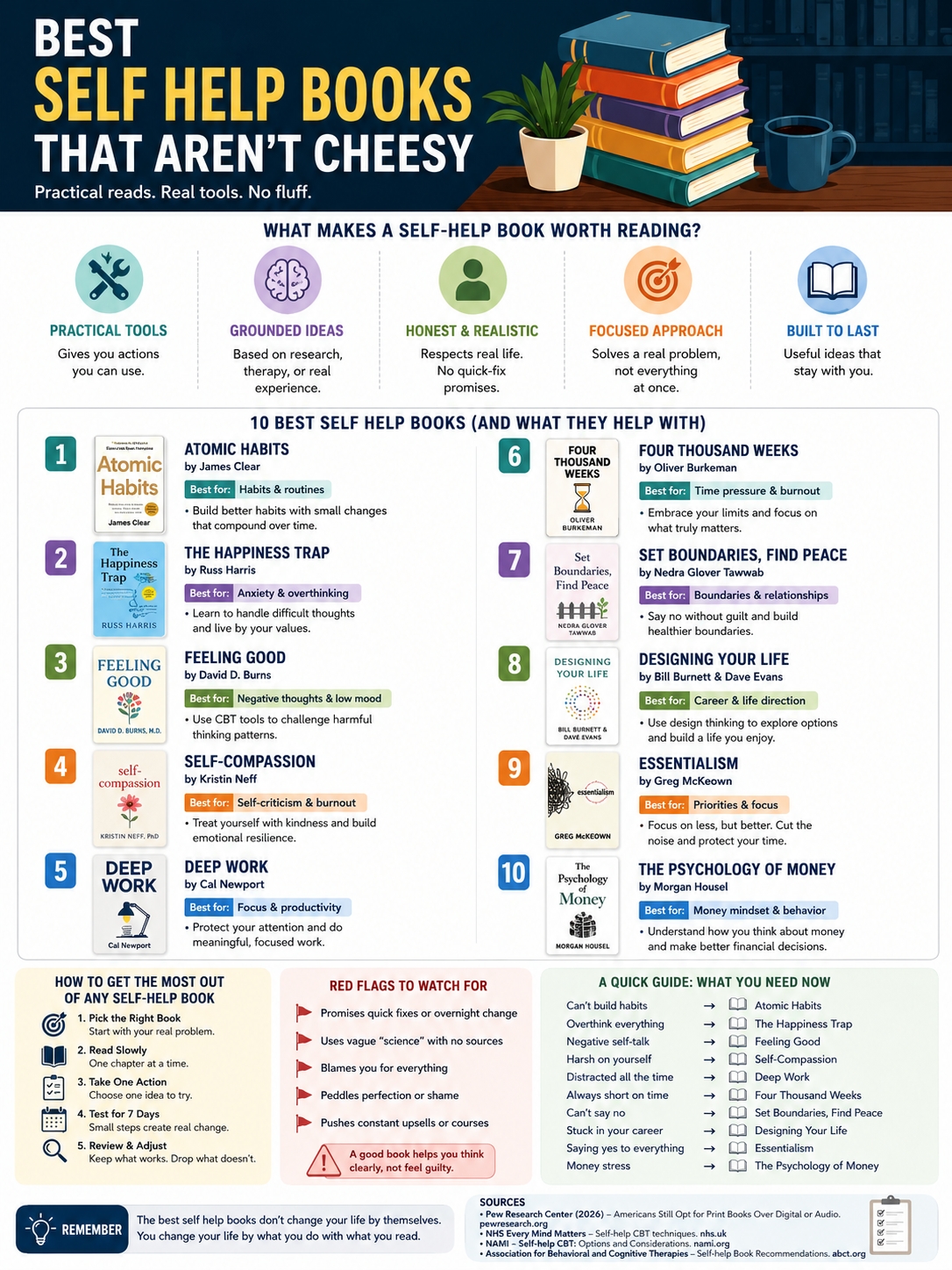
Don’t start with the most famous book.
Start with the problem that keeps showing up in your life.
A habit book won’t fix grief. A money book won’t teach boundaries. A productivity book won’t heal shame. The right book depends on what you need now.
|
If You Struggle With |
Start With |
Why |
|
Staying consistent |
Atomic Habits |
Builds simple systems |
|
Overthinking |
The Happiness Trap |
Helps you handle thoughts differently |
|
Low mood patterns |
Feeling Good |
Teaches CBT-style tools |
|
Self-criticism |
Self-Compassion |
Builds a kinder inner voice |
|
Distraction |
Deep Work |
Protects focus |
|
Time pressure |
Four Thousand Weeks |
Challenges productivity panic |
|
Saying no |
Set Boundaries, Find Peace |
Gives boundary language |
|
Career confusion |
Designing Your Life |
Encourages experiments |
|
Too many commitments |
Essentialism |
Helps cut nonessential work |
|
Money stress |
The Psychology of Money |
Explains money behavior |
Here’s a simple way to choose:
- Name your current problem in one sentence.
- Pick one book that matches that problem.
- Read slowly.
- Test one idea for seven days.
- Don’t buy five more books before trying the first one.
That last point matters.
Reading self-help can become another way to avoid action. Buying another book feels productive. Highlighting another chapter feels productive. But change starts when you try something in real life.
The best self help books should move you from “That makes sense” to “I can try this today.”
How to Read Self-Help Without Getting Stuck
Most people read self-help too passively.
They highlight everything. They nod along. They save quotes. Then they move on and forget most of it.
A better method is simple: read less and test more.
|
Common Reading Habit |
Better Approach |
|
Highlighting too much |
Write down only 3 useful ideas |
|
Reading too fast |
Pause after each chapter |
|
Starting many books |
Finish one before starting another |
|
Waiting for motivation |
Turn advice into small actions |
|
Copying the author’s whole system |
Adapt the idea to your life |
Try this:
- Read one chapter.
- Write one useful idea.
- Turn it into one tiny action.
- Try it for a week.
- Review what happened.
For example:
- After Atomic Habits, put your walking shoes beside the door.
- After Deep Work, block one phone-free work session.
- After Set Boundaries, Find Peace, write one sentence you can use to say no.
- After The Psychology of Money, define what “enough” means for one spending habit.
- After Self-Compassion, notice one harsh thought and answer it like you would answer a friend.
Self-help books are not magic. They work when you turn ideas into practice.
Red Flags: How to Spot a Cheesy Self-Help Book
Bad self-help often sounds confident but empty.
It makes huge claims. It blames you for everything. It turns complex problems into slogans. It offers certainty where real life needs nuance.
|
Red Flag |
Why It’s a Problem |
|
“This works for everyone” |
People have different lives and needs |
|
“Just think positive” |
It ignores real pain and context |
|
“Science proves…” with no source |
Research becomes decoration |
|
“Successful people always…” |
Anecdotes turn into fake rules |
|
“If you fail, you didn’t want it enough” |
It adds shame instead of support |
|
Constant course upsells |
The book may be a sales funnel |
Be careful with books that promise:
- A perfect life
- Fast wealth
- Total confidence
- Constant happiness
- Effortless success
- One universal morning routine
A good book should leave you clearer, not smaller.
It may challenge you. It may make you uncomfortable. But it should not make you feel defective for being human.
Final Thoughts
The best self help books don’t need to be loud.
They don’t need cheesy quotes. They don’t need fake urgency. They don’t need to promise that your whole life will change by Monday morning.
A strong book gives you one clean insight and one useful next step.
Read Atomic Habits if you need better systems. Read The Happiness Trap if your thoughts keep pulling you around. Read Feeling Good if you want CBT-style tools for negative thinking. Read Self-Compassion if your inner voice is harsh. Read Deep Work if distraction is eating your day. Read Four Thousand Weeks if productivity advice makes you feel worse. Read Set Boundaries, Find Peace if saying no feels impossible.
|
Best Overall Pick |
Best Use |
|
Atomic Habits |
Habits and consistency |
|
The Happiness Trap |
Anxiety and overthinking |
|
Deep Work |
Focus and serious work |
|
Four Thousand Weeks |
Time pressure and burnout |
|
Set Boundaries, Find Peace |
People-pleasing and relationships |
You don’t need to become a self-help addict.
You need one honest problem, one useful book, and one small action you can repeat.
That’s where real change starts.
Uncommon FAQs About the Best Self Help Books
Readers often search for the same thing in different ways. They don’t just want a list. They want to know which books are useful, which ones are safe, and which ones won’t waste their time.
|
FAQ Theme |
Why Readers Ask It |
|
Usefulness |
People want to know if self-help works |
|
Therapy limits |
Readers need safe expectations |
|
Reading order |
Too many choices feel overwhelming |
|
Non-cheesy picks |
Many readers distrust the genre |
|
Action steps |
People want results, not only book lists |
Are self-help books actually useful?
Some are. Some aren’t.
Books based on CBT, ACT, habit science, attention management, boundary work, or financial behavior tend to be more practical than books built only on motivation.
The key is to use the book. Don’t just read it. Try one idea and see what changes.
Can self-help books replace therapy?
No.
A book can teach skills. It can help you reflect. It can make you feel less alone. But it can’t diagnose you, understand your full history, or respond to your needs in real time.
For everyday stress, habits, and mild struggles, a good book can help. For trauma, severe depression, suicidal thoughts, addiction, abuse, or serious anxiety, professional support is safer.
What is the least cheesy self-help book for beginners?
Atomic Habits is the safest starting point for most readers. It is practical, simple, and easy to apply.
If your main issue is overthinking, start with The Happiness Trap. If you feel crushed by productivity pressure, start with Four Thousand Weeks.
What self-help book should I read if I hate hustle culture?
Start with Four Thousand Weeks. Then read Essentialism.
Both books push back against the idea that your worth depends on doing more.
What is the best self-help book for people-pleasing?
Set Boundaries, Find Peace is a strong choice.
It explains why boundaries feel hard and gives you clear language for saying no, asking for space, and handling guilt.
Should I read more than one self-help book at a time?
Usually, no.
Read one. Try one idea. Give it a week. Too much advice at once can turn into noise.
What self-help books are best for mental health?
For general mental-health skills, The Happiness Trap, Feeling Good, and Self-Compassion are strong starting points.
Use them with care, though. They can support mental health, but they are not a replacement for professional care when symptoms are serious.
Are older self-help books still worth reading?
Yes, if the ideas still hold up.
Feeling Good remains useful because CBT-style tools are still widely used. Just read older books with context. No single book is perfect.