We have all felt that pang of anxiety. You bought a gorgeous, heavy mirror or a massive framed canvas, and now you are standing in front of a perfectly smooth, white wall. The thought of driving a massive screw into that drywall feels like a betrayal. Whether you are renting a flat in the city or you just finished painting your dream home, you want your decor to stay up without leaving a trail of destruction behind.
In 2026, the technology for home decor has changed. We are no longer limited to just hammers and nails. Modern adhesives and clever engineering now let us hang heavy pictures walls with total confidence. This guide will walk you through the science, the tools, and the step-by-step techniques to keep your art secure and your walls pristine.
The Dilemma of Heavy Wall Decor
Decorating is supposed to be the fun part of moving or renovating. But heavy items bring a unique set of problems. Standard nails often slip, and cheap sticky hooks usually end up failing at 3 AM with a loud crash. We want our homes to look curated, but we also want to get our security deposits back.
The struggle is real because most people do not realize that wall damage is not just about the hole you make. It is about the stress placed on the paint and the gypsum inside the wall. If you use the wrong method to hang heavy pictures walls, you risk more than just a hole; you risk a structural tear in the drywall paper.
Comparison of Decor Challenges
|
Challenge |
Traditional Method Result |
Modern Damage-Free Result |
|
Security Deposits |
Often lost due to holes |
Full refund; walls stay intact |
|
Tool Requirement |
Drills, hammers, levels |
Mostly tool-free or simple push |
|
Flexibility |
Hard to move once drilled |
Easy to rearrange or swap |
|
Wall Stress |
Concentrated on one point |
Distributed across the surface |
The Physics of Hanging Heavy Objects on Walls
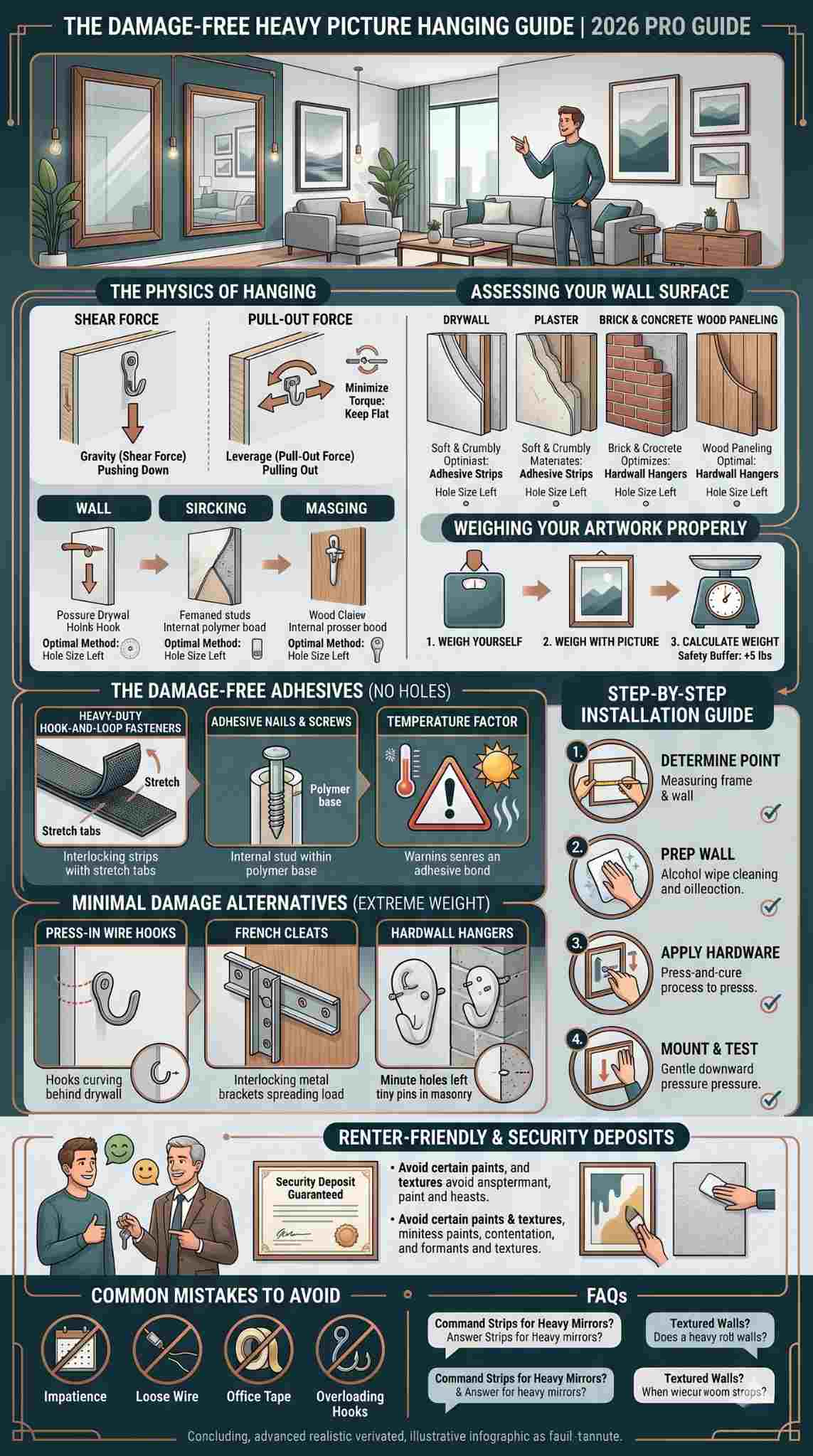
Before you grab the tape, we need to talk about why things fall. It is not just “gravity” in a general sense. When you hang something, two forces are fighting against you. The first is shear force, which is the downward pull. The second is pull-out force, which is the weight pulling the top of the hook away from the wall.
To hang heavy pictures walls effectively, you have to manage these forces. If a frame sits too far forward, it creates leverage that wants to rip the hardware right out. By keeping your frames flush against the wall, you minimize that leverage. This simple physics trick makes even basic adhesives much more effective.
Shear Force vs. Pull-Out Force
Shear force is actually your friend if you use the right hardware. It pushes the hook down against the wall, creating friction that helps hold it in place. Pull-out force is the enemy. It happens when the center of gravity of your picture is too far from the wall surface. Always try to keep your hanging wire tight or use brackets that keep the art flat.
The Weight Distribution Formula
If you want to get technical, the stress on your wall can be calculated by looking at the weight of the item and the number of contact points. Using two hooks instead of one does more than just double the strength; it balances the load so the wall is less likely to deform under the pressure.
Force Management Summary
|
Force Type |
Direction |
How to Combat It |
|
Shear Force |
Vertical (Down) |
Use high-friction adhesives |
|
Pull-out Force |
Horizontal (Away) |
Keep art flush to the wall |
|
Torque |
Rotational |
Use multiple hanging points |
Assessing Your Wall Surface
Not all walls are created equal. You cannot treat a 1920s plaster wall the same way you treat a 2026 modern drywall setup. Knowing what is behind your paint is the first step in deciding how to hang heavy pictures walls.
Drywall is soft. It is basically a sandwich of paper and chalky minerals. It crumbles easily under concentrated pressure. Plaster, on the other hand, is hard and brittle. If you try to use a nail on plaster, it will likely shatter like glass. Then you have masonry like brick or concrete, which is tough but requires specialized adhesive polymers to get a good grip.
Drywall (Gypsum Board)
Drywall is the most common surface today. It is great for adhesive strips because the paper surface provides a smooth area for the glue to bond. However, if the weight is too high, the adhesive might hold, but the paper itself might peel off the gypsum core. Always check the weight limits on your product packaging.
Plaster and Lath
You usually find these in older homes. Because plaster is so thick and uneven, standard adhesive strips often fail because they cannot get a flat contact. For these walls, you might need specialized “hardwall” hangers that use tiny, needle-like pins that do not cause the cracking that a large nail would.
Brick and Concrete (Masonry)
Hanging on brick without a drill used to be impossible. Now, we have industrial-strength adhesive screws. These use a gel that hardens into a solid mass, gripping the texture of the brick without needing to penetrate the mortar.
Read Also: 20 Bedroom Lighting Ideas For a Cozy Atmosphere
Wall Type Compatibility
|
Wall Material |
Best Hanging Method |
Damage Level |
|
Drywall |
Adhesive Strips / Wire Hooks |
Zero to Minimal |
|
Plaster |
Hardwall Hooks |
Micro-pinholes |
|
Brick |
Adhesive Screws |
Zero |
|
Wood |
Command Universal Hooks |
Zero |
Weighing Your Artwork Properly
Most people guess the weight of their pictures, and most people are wrong. A “light” mirror often weighs 15 pounds, and a “medium” frame can easily hit 25. If you want to hang heavy pictures walls without a disaster, you need an actual number.
The best way to do this is with a digital scale. Weigh yourself first, then weigh yourself holding the picture. The difference is your answer. Once you have that number, always buy hardware that is rated for at least 5 pounds more than your item weighs. This “safety buffer” accounts for things like humidity or someone accidentally bumping into the frame.
Weight Rating Guide
|
Item Description |
Estimated Weight |
Recommended Hardware Capacity |
|
Large Canvas (Unframed) |
5-10 lbs |
15 lbs rated |
|
Glass-Front Frame (Large) |
12-20 lbs |
25 lbs rated |
|
Heavy Decorative Mirror |
25-40 lbs |
50 lbs rated |
|
Solid Wood Gallery Piece |
40+ lbs |
Professional Cleat System |
Truly Damage-Free Adhesive Solutions
Adhesives have come a long way. In the past, “damage-free” usually meant the picture would fall off the wall in an hour. Today, we have high-tech polymers that create a molecular bond with the paint. When you use these to hang heavy pictures walls, the secret is all in the prep work.
The most common mistake is sticking the strip onto a dusty wall. Even a tiny bit of dust acts like a layer of ball bearings, preventing the glue from actually touching the wall. You must clean the area with rubbing alcohol first. This removes oils from your hands and dust from the air, ensuring the adhesive can do its job.
Heavy-Duty Hook and Loop Fasteners
These are the gold standard for renter-friendly decor. They work like Velcro but much stronger. One side goes on the wall, one on the frame. When you click them together, they lock in place. The best part is that they keep the frame perfectly flat, which, as we discussed, is better for the physics of the wall.
Adhesive Nails and Screws
If your frame has a wire or a sawtooth hanger, you cannot use flat strips. Instead, you use adhesive nails. These have a plastic hook or metal stud built into an adhesive base. They are surprisingly strong and are perfect for those items that were not designed for tape.
When Adhesives Fail: The Temperature Factor
Adhesives are chemical bonds. Like all chemicals, they react to the environment. If you live in a very humid area or you are hanging art in a bathroom, the moisture can soften the glue. Likewise, direct sunlight can heat up the wall and cause the adhesive to slide. Always consider the room’s climate before trusting a heavy piece to a sticky strip.
Top Adhesive Options 2026
|
Product Type |
Max Weight |
Best Use Case |
|
Hook & Loop Strips |
20 lbs |
Flat back frames |
|
Adhesive Screws |
15 lbs |
Wire-backed art on tile/brick |
|
Utility Hooks |
10 lbs |
Kitchen/Entryway decor |
|
Adjustable Nails |
8 lbs |
Aligning gallery walls |
Minimal-Damage Alternatives for Extreme Weight
Sometimes an item is just too heavy for glue. If you have a 50-pound antique mirror, adhesive is a gamble you probably do not want to take. This is where “minimal-damage” hardware comes in. These tools leave holes so small you can fill them with a tiny bit of white putty or even toothpaste when you move out.
These methods are often better for very heavy items because they use the structural integrity of the wall itself. By reaching behind the drywall or spreading the weight across a wider area, they provide a level of security that sticky tape just cannot match.
Press-in Wire Hooks (Monkey and Gorilla Hooks)
These are incredible pieces of engineering. It is just a curved piece of spring steel. You push the sharp end through the drywall and twist it. The long tail of the wire rests against the back of the wall, using the entire strength of the drywall panel to hold the weight. A single hook can often hold 50 pounds, and the hole it leaves is no bigger than a thumbtack.
French Cleats for Maximum Stability
A French cleat is a two-part bracket. One goes on the wall, one on the art. They interlock. While these usually require a few small screws, they are the safest way to hang heavy pictures walls if the item is wide. Because the weight is spread along a horizontal line, it does not put too much stress on any one point of the wall.
Hardwall Hangers
These are specifically for those tough surfaces like concrete or plaster. They feature a plastic body with three or four tiny, hardened steel pins. You tap them in with a hammer, and the pins wedge themselves into the material. Because the pins are so thin, they do not cause the surface to crack or crumble.
Minimal Damage Hardware Comparison
|
Hardware Name |
Weight Capacity |
Hole Size |
|
Monkey Hook |
35 lbs |
Pin size |
|
Gorilla Hook |
50 lbs |
Pin size |
|
Hardwall Hanger |
25 lbs |
3-4 micro-dots |
|
Small French Cleat |
75 lbs |
2-3 small screw holes |
Step-by-Step Guide to Hanging Heavy Art Safely
Success is 90% preparation. If you just wing it, you will likely end up with a crooked frame and a frustrated afternoon. Follow these steps to hang heavy pictures walls without a single scratch on your paint.
First, you need to find your “center.” Do not just guess where the hook should go. Measure the frame, find the middle, and then measure the distance from the top of the frame to the hanging hardware. This prevents that annoying “trial and error” where you keep making new holes because the picture is too high or too low.
Step 1: Determine the Exact Hanging Point
Mark your spot with a light pencil. Use a level to make sure your marks are straight. If you are using two hooks, the level is your best friend. A frame that is even slightly tilted will put uneven pressure on the hardware, which can lead to failure over time.
Step 2: Prepare the Wall Surface
As mentioned before, use rubbing alcohol. Wipe the area and let it dry for at least 60 seconds. Do not use a towel that leaves lint behind. A microfiber cloth or a simple paper towel works best. If the wall is newly painted, wait at least 30 days before using adhesives, or the glue will pull the fresh paint right off.
Step 3: Apply or Install the Hardware
If using strips, press them onto the frame first. Then, press the frame to the wall for a full 30 seconds. Here is the pro tip: remove the frame and let the strips sit on the wall for an hour before you actually hang the weight. This allows the bond to “set” without being stressed immediately.
Step 4: Mount the Frame and Test Stability
Gently place the frame onto the hooks or strips. Once it is in place, do not just walk away. Keep your hands near the frame and slowly let go. Listen for any clicking or peeling sounds. If it looks solid, give it a tiny, gentle tug to make sure it is seated properly.
The Installation Checklist
|
Step |
Action |
Why it Matters |
|
1 |
Weigh Item |
Prevents overloading hooks |
|
2 |
Clean Wall |
Ensures adhesive bond |
|
3 |
Level Marks |
Keeps art straight and balanced |
|
4 |
Cure Time |
Allows glue to reach max strength |
Renter-Friendly Tips for Security Deposits
Being a renter means living with the constant fear of the “move-out inspection.” But you deserve to live in a home that feels like yours. The key to being a successful decorating renter is choosing the path of least resistance.
In most cases, property managers care more about big holes from drills than they do about tiny pinpricks. If you have to choose between a large adhesive strip that might peel the paint and a tiny wire hook, the hook is often the safer bet. Paint is expensive to fix; a tiny hole is fixed in two seconds with a dab of spackle.
Renter Safety Chart
|
Wall Issue |
Best Strategy |
Fix on Move-out |
|
Cheap Flat Paint |
Avoid adhesives |
N/A |
|
High-Gloss Paint |
Use adhesives |
Wipe with alcohol |
|
Textured Walls |
Use wire hooks |
Tiny dab of putty |
|
Wallpaper |
Avoid all hanging |
Use floor easels |
Common Picture Hanging Mistakes to Avoid
The biggest mistake is impatience. We all want the room to look finished right now, but skipping the cleaning step or the “curing” time for adhesives is how frames end up broken on the floor. Another common error is using “office tape” or “mounting putty” for heavy items. These are designed for posters, not frames.
Another thing to watch out for is the angle of your hooks. If you are using a nail-based hook, it should always be driven in at a downward 45-degree angle. This uses gravity to pull the nail deeper into the wall rather than letting it slide out. When you hang heavy pictures walls, the angle of the hardware is just as important as the strength of the metal.
Troubleshooting Failed Hangs
|
Problem |
Likely Cause |
Solution |
|
Strips peeling off |
Dirty wall or fresh paint |
Clean with alcohol; wait 30 days |
|
Hook bending |
Exceeded weight limit |
Switch to Gorilla hooks |
|
Frame leaning out |
Wire too loose |
Shorten the hanging wire |
|
Paint tearing |
Pulling strip outward |
Pull release tab straight down |
Final Thoughts
At the end of the day, your home should be a reflection of your personality, not a source of stress. Whether you choose the latest 2026 adhesive technology or a clever mechanical wire hook, you can absolutely hang heavy pictures walls without leaving a path of destruction.
Take your time, measure twice, and always respect the weight limits of your hardware. By understanding the physics of your wall and the chemistry of your adhesives, you can create a stunning gallery in any room. Your art will stay secure, your walls will stay smooth, and you can enjoy your space knowing that your security deposit—and your decor—are both perfectly safe.
Frequently Asked Questions (FAQs)
Can I hang a heavy mirror with Command strips?
Yes, but you must use the “Large Picture Hanging Strips” and use enough of them. A typical large set holds 16-20 pounds. If your mirror is 30 pounds, you need to use two sets and ensure they are placed vertically to distribute the load.
What is the best way to hang art on a tiled wall?
Adhesive screws are the best for tile. You do not want to drill into tile because it often cracks, which is an expensive fix. Modern adhesive screws can hold heavy bathroom mirrors or kitchen decor without any drilling.
Will these methods work on textured walls (popcorn or orange peel)?
Adhesives struggle on textured walls because there is not enough flat surface area for the glue to grab. For textured walls, it is better to use the wire “Monkey Hooks” which only need a tiny hole and do not rely on a flat surface.
How do I remove adhesive strips without ripping the paint?
Never pull the strip toward you. You must grab the tab and stretch it slowly downward, parallel to the wall. The strip will stretch up to 10 times its length and then simply pop off the wall without leaving a mark.
Can I use multiple hooks to double the weight capacity?
Technically yes, but it is risky. It is very hard to get two hooks perfectly level. If one is even a millimeter higher, it will carry 90% of the weight, causing it to fail. It is always better to use one hook that is rated for the full weight.