
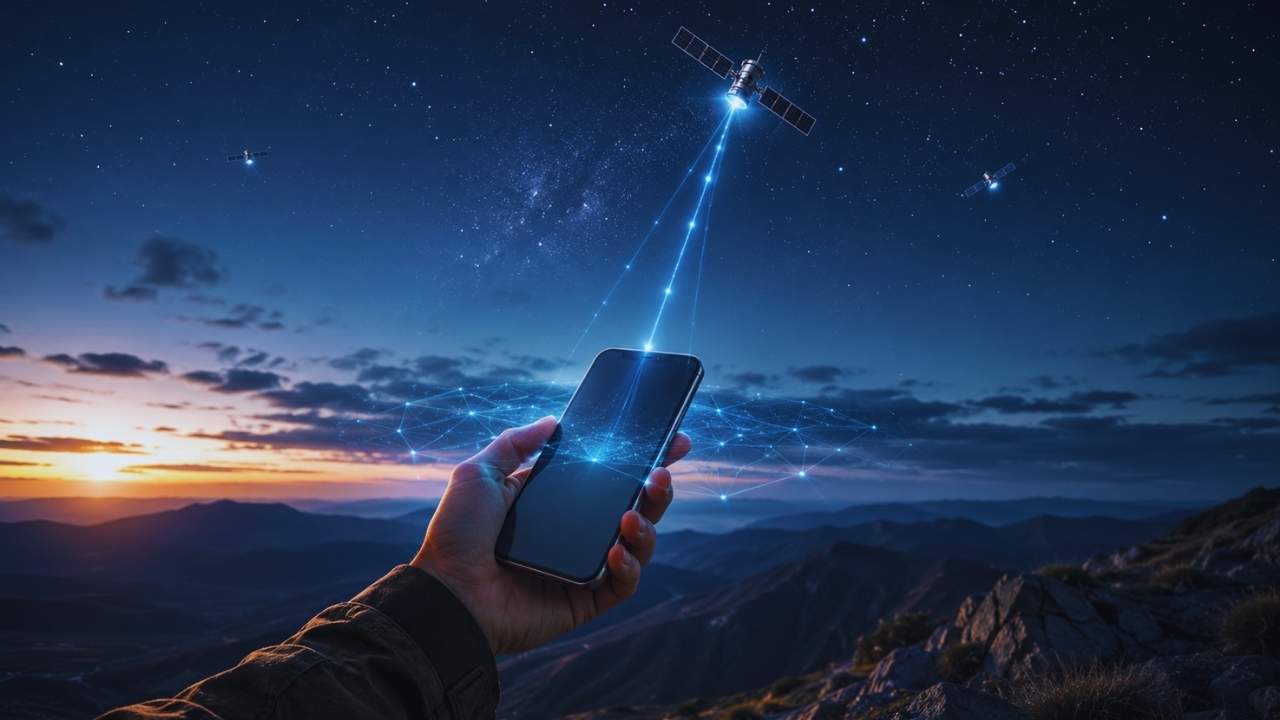
I remember holding an old-school satellite phone about ten years ago. It weighed a ton, had a massive plastic antenna, and cost over a thousand bucks. Back then, getting a signal from space was strictly reserved for billionaire yacht owners, extreme mountaineers, and the military.
But the tech world moves insanely fast. Today, you can hike into the deepest part of a national forest, miles away from a cell tower, and send a text using the exact same smartphone you already have in your pocket. No special dish. No expensive hardware.
If you are trying to figure out exactly how satellite phone internet works in 2026, you have hit on one of the biggest engineering leaps of our time. The industry calls it direct-to-cell technology, and it is reshaping global connectivity. The global market for this tech just hit billions this year, driven by a massive push to close the digital divide. I am going to walk you through the physics of how your standard phone talks to the stars, the exact 2026 capabilities of networks like Starlink and AST SpaceMobile, and why this shift matters so much for the future of communication.
What Is Direct-to-Cell Technology Anyway?
Bypassing the Ground Tower
When you fire up a video or send a text, your phone usually talks to a physical cell tower located a few miles away. That ground tower grabs your radio waves and pushes them into an underground fiber-optic network. That system works flawlessly in cities and along highways, but it fails instantly when the terrain gets tough. You cannot cheaply build steel towers in the middle of the ocean, deep in a rocky canyon, or across vast deserts. Direct-to-cell technology completely flips the script by moving the base stations into the sky.
Instead of anchoring a tower in the dirt, telecommunications companies fly these satellites in low Earth orbit, roughly 200 to 500 miles up. Thanks to recent tech standardizations, specifically the 3GPP Release 17, your phone does not even need special hardware to connect. The standard Non-Terrestrial Network protocols allow your everyday smartphone to automatically switch to a satellite when terrestrial signals vanish. It literally just thinks it found a really tall, highly efficient local cell tower.
|
Infrastructure Feature |
Ground-Based Networks |
Space-Based Networks |
|
Tower Location |
Steel structures anchored on land |
Low Earth Orbit (LEO) satellites |
|
Distance to Phone |
1 to 5 miles |
200 to 500 miles |
|
Required Device |
Standard smartphone |
Standard smartphone |
|
Core Standard |
Standard 4G/5G protocols |
3GPP Release 17 NTN standards |
|
Primary Advantage |
High capacity for dense cities |
Global coverage in remote locations |
Putting the Hardware Burden on Space
To truly understand how satellite phone internet works, you have to look at where the hardware heavy lifting happens. A standard iPhone or Android transmits a tiny, weak signal, pushing out barely 0.2 to 2 watts of power from a microscopic internal antenna. Because your phone cannot shout any louder, the satellite has to do all the work. The newest satellites carry massive, highly sensitive phased-array antennas that act like giant catchers mitts in space.
When your phone whispers a radio signal into the sky, these massive orbital panels catch it. The satellite acts just like a flying cellular modem, processing the data and blasting it down to a ground station that plugs into the global internet. Engineers call these “bent-pipe payloads,” and they are specifically designed to handle everything from SOS emergency signaling to standard IoT sensor tracking without rapidly draining your phone battery.
|
Hardware Component |
The Problem Addressed |
The Engineering Solution |
|
Smartphone Antenna |
Too weak to reach space reliably |
Kept standard to maintain consumer costs |
|
Satellite Arrays |
Need to catch faint ground signals |
Unfolding panels measuring thousands of square feet |
|
Onboard Processing |
Standard data takes too long to route |
Satellites act as flying modems to process data instantly |
|
Device Battery |
Space searches drain phone power |
Optimized NTN chips prevent battery drain |
|
Ground Stations |
Space data needs an internet link |
Downlinks connect satellites directly to global fiber networks |
The Physics: Bridging a 500-Mile Gap
Overcoming Distance and Signal Loss
Sending a text message 500 miles straight up is incredibly hard because radio waves lose their energy fast. A signal traveling to space deals with nearly 200 times the distance of a standard ground connection. To fix this, space engineers build massive “ears” in orbit. The shift from traditional geostationary orbits down to low Earth orbit reduced signal latency from a sluggish 600 milliseconds down to a snappy 20 to 40 milliseconds.
But to capture the weak signals, you need physical size. AST SpaceMobile recently launched their next-generation BlueBird satellites, which feature commercial antenna arrays that unfold to over 2,400 square feet. That is literally larger than most single-family homes, floating in orbit. These giant panels exist for one single reason: to catch the incredibly faint radio waves coming from your pocket while minimizing data packet loss.
|
Physics Challenge |
Traditional Satellite Fix |
Modern Direct-to-Cell Fix |
|
Signal Distance |
Placed satellites 22,000 miles away |
Flies satellites under 500 miles away |
|
Latency / Lag |
Accepted 600+ millisecond delays |
Achieved 20 to 40 millisecond response times |
|
Antenna Size |
Forced consumers to buy bulky dishes |
Put 2,400-square-foot antennas on the satellite |
|
Connection Type |
Required clear, stationary alignment |
Connects dynamically while you walk or drive |
|
Power Output |
Required high-wattage external batteries |
Works perfectly with your phone’s internal battery |
Beating the Doppler Effect and Timing
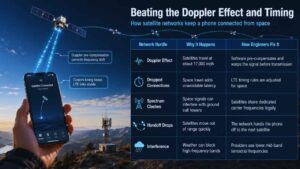
Satellites do not sit still; they scream across the sky at roughly 17,000 miles per hour. This insane speed creates a massive Doppler effect, shifting the frequency of the radio waves just like the pitch of a speeding police siren changes as it passes you. If engineers did not step in, your phone would just hear scrambled noise. They solve this with “Doppler Pre-Compensation,” where the satellite tracks your location and intentionally warps its outgoing frequency so it bends back to normal by the time it hits your phone.
Additionally, standard mobile networks expect fast responses and will drop your connection if a ping takes too long. Space networks use custom software that hacks the standard LTE protocol, adjusting the timing rules so the network does not panic over the extra milliseconds. Navigating the spectrum sharing rules with agencies like the FCC has been tough, but these software fixes finally made commercial rollouts possible this year.
|
Network Hurdle |
Why It Happens |
How Engineers Fix It |
|
Doppler Effect |
Satellites travel at 17,000 mph |
Software warps the signal before transmission |
|
Dropped Connections |
Space travel adds unavoidable latency |
Network timing rules are rewritten for space |
|
Spectrum Clashes |
Space signals hit ground cell towers |
Satellites legally share dedicated carrier frequencies |
|
Handoff Drops |
Satellites fly out of range quickly |
Networks seamlessly pass you to the next satellite |
|
Interference |
Weather blocks high-frequency bands |
Providers use lower mid-band terrestrial frequencies |
The Major Players Dominating 2026
Starlink and T-Mobile Pushing Boundaries
The space race for mobile connectivity is moving at breakneck speed, with SpaceX making massive waves through its T-Mobile partnership. Right now, Starlink has its direct-to-cell service live, handling texts and basic apps seamlessly when you wander off the grid. However, they are not stopping at basic coverage.
Earlier this year, SpaceX announced they are targeting peak download speeds of 150 Mbps per user for their next-generation service. To pull that off, they filed to launch an additional 15,000 satellites into Very Low Earth Orbit, scaling up from their current fleet. While their current network sits around 4 Mbps—perfect for emergencies and WhatsApp—hitting that 150 Mbps threshold will transition Starlink from a simple safety net into a legitimate cellular broadband competitor.
|
Starlink Metric |
Current 2026 Status |
Future Targets |
|
Partner Carrier |
T-Mobile (T-Satellite) |
Expanding globally |
|
Average Speed |
Roughly 4 Mbps per user |
Targeting 150 Mbps per user |
|
Constellation Size |
Hundreds of direct-to-cell units |
Planning 15,000 VLEO satellites |
|
Supported Apps |
SMS, WhatsApp, basic maps |
Full broadband, AI, video streaming |
|
Hardware Used |
V2 Mini Satellites |
Next-generation Starship payloads |
AST SpaceMobile Launching Giants
While Starlink relies on launching thousands of smaller satellites, AST SpaceMobile builds absolute giants and is hitting major milestones this year. They successfully launched their BlueBird 8, 9, and 10 satellites in June 2026, followed quickly by BlueBirds 11, 12, and 13 in August.
Partnering with telecom heavyweights like AT&T and Verizon, AST SpaceMobile recently achieved peak download speeds of 98.9 Mbps directly to standard smartphones. They manufacture these massive 2,400-square-foot arrays almost entirely in-house. With each successful launch from Cape Canaveral, they get closer to their ultimate goal of providing continuous global broadband. They are proving that you do not need thousands of satellites if you build them large enough to handle massive data throughput directly.
|
AST SpaceMobile Updates |
Launch Details & Specs |
|
BlueBird 7 |
Launched April 2026 via Blue Origin New Glenn |
|
BlueBird 8, 9, 10 |
Launched June 2026 via SpaceX Falcon 9 |
|
BlueBird 11, 12, 13 |
Launched August 2026 to expand the constellation |
|
Antenna Size |
2,400 square feet per satellite |
|
Recorded Peak Speed |
98.9 Mbps to unmodified smartphones |
Global Adoption and Dual-Mode Devices
The push for space-based internet is a global phenomenon, with the Global mobile Suppliers Association identifying over 275 publicly announced partnerships between terrestrial operators and satellite vendors by mid-2026. In places like China, manufacturers are taking a unique approach by releasing dual-mode terminals. Brands like Huawei and Xiaomi are building flagship phones that actively support both terrestrial cellular and dedicated satellite communications.
When ground coverage vanishes, these phones seamlessly switch to satellite mode for location sharing and emergency assistance. This global ecosystem is heavily supported by chipmakers like Qualcomm and MediaTek, who are now baking Release 17-compliant basebands right into their everyday consumer chips, ensuring the tech becomes standard in all future smartphones.
|
Global Adoption Trend |
Details and Impact |
|
Operator Partnerships |
Over 275 deals signed across 101 countries |
|
Dual-Mode Phones |
Huawei and Xiaomi leading integrated hardware approaches |
|
Chipset Integration |
Qualcomm and MediaTek building NTN-ready basebands |
|
Market Driver |
Closing the digital divide in underserved remote regions |
|
Standardization |
3GPP protocols unifying space and ground networks |
What Can You Actually Do on Space Networks Today?
Phase 1: Texting and Emergency SOS
If you are wondering exactly how satellite phone internet works for your daily life right now, we are sitting firmly in the texting and SOS phase. The emergency and safety services segment currently accounts for the largest share of the direct-to-cell market. Because a single satellite beam covers a huge footprint on the ground, thousands of users have to share the available data capacity.
Text messages and SOS pings require incredibly tiny amounts of data, making them highly reliable even with weak signals. Whether you are texting a tow truck from a deserted highway or pinging emergency services from a stranded boat, basic messaging works flawlessly. This “bent-pipe” data transfer is lightweight, keeps satellite costs low, and ensures your phone battery does not die during an actual emergency.
|
Phase 1 Capabilities |
Real-World Application |
Performance Level |
|
SMS / Texting |
Sending standard messages off-grid |
Highly reliable and fast |
|
Emergency SOS |
Contacting first responders |
Built natively into many new phones |
|
Location Sharing |
Pinging GPS coordinates to family |
Seamless background operation |
|
IoT Telemetry |
Tracking shipping containers globally |
Requires very little bandwidth |
|
Battery Impact |
Searching for signal during emergencies |
Optimized to prevent rapid draining |
Phase 2: Voice Calls and True Broadband
Voice calls require a continuous, uninterrupted stream of data, and the industry is actively crossing this hurdle right now. With latency dropping to manageable levels, voice calls over apps like WhatsApp are completely viable. The audio currently uses narrowband codecs, so it sounds slightly compressed, but you completely avoid those terrible delays that ruined older satellite phone calls.
As AST SpaceMobile and Starlink push toward their 100 to 150 Mbps targets, the market is shifting from narrowband data directly into cellular broadband. Experts predict that within the next two years, checking social media, browsing heavy websites, and streaming video straight from space will become entirely normal for anyone traveling outside city limits.
|
Phase 2 & 3 Goals |
Expected Capabilities |
Current 2026 Status |
|
Voice Calling |
Standard phone calls without noticeable lag |
Live in select beta markets |
|
Rich Messaging |
Sending photos and voice notes |
Operational on networks like Starlink |
|
Web Browsing |
Loading standard internet pages |
Improving as more satellites launch |
|
Video Streaming |
Watching HD content off-grid |
The primary target for 2027 upgrades |
|
Business Applications |
Remote cloud access for field workers |
Testing via high-speed broadband targets |
Real-World Impact: Why This Changes Everything
Wiping Out Dead Zones and Aiding Disasters
It is easy to shrug off satellite internet if you live in a big city with perfect 5G, but for millions of people globally, this tech is a literal lifesaver. Direct-to-cell effectively kills the “No Service” indicator, completely changing how we handle outdoor safety. When massive earthquakes or floods hit, ground-based cell towers snap in half or lose power immediately.
Direct-to-cell technology means stranded victims and emergency crews can communicate instantly to coordinate rescue efforts without waiting for temporary towers. Furthermore, because this tech bypasses local ground infrastructure entirely, it acts as an uncensorable bridge to the outside world, protecting human rights by allowing citizens to communicate during government-enforced internet blackouts.
|
Real-World Scenario |
How Direct-to-Cell Solves It |
Overall Impact |
|
Natural Disasters |
Bypasses destroyed local cell towers |
Critical for coordinating immediate rescues |
|
Outdoor Recreation |
Connects hikers and climbers off-grid |
Massive reduction in missing persons |
|
Rural Communities |
Reaches areas where towers are too expensive |
Bridges the global digital divide |
|
Government Blackouts |
Connects directly to space, avoiding local blocks |
Protects free speech and coordination |
|
Aviation / Maritime |
Provides continuous coverage across oceans |
Ensures safety outside terrestrial limits |
Industrial and Remote Connectivity
The impact of standardizing how satellite phone internet works stretches far beyond consumer cell phones; it is revolutionizing global industry. Businesses operating in areas where cellular infrastructure is thin are jumping on this tech for real-time monitoring. Maritime shipping companies are using IoT-NTN connections to monitor temperature and humidity in pharmaceutical cold chains while ships cross the Pacific.
In agriculture, sensors connected via space monitor herd health and pasture conditions hundreds of miles away from the nearest town. Energy companies use it to inspect long-distance pipelines crossing uninhabited regions, transmitting operational data to AI systems for instant leak detection. By removing the need for expensive, dedicated satellite dishes, entire industries can digitize remote operations at a fraction of the cost.
|
Industrial Application |
How It Uses Satellite Connectivity |
Business Benefit |
|
Maritime Shipping |
Real-time tracking of cold-chain cargo |
Prevents spoilage of sensitive goods |
|
Precision Agriculture |
Remote soil and herd monitoring sensors |
Optimizes yields in massive rural farms |
|
Energy & Pipelines |
AI-based leak detection in remote areas |
Prevents environmental disasters |
|
Fleet Telematics |
Tracking trucks across desert highways |
Improves logistics and driver safety |
|
Remote Field Work |
Cloud access for geologists and engineers |
Eliminates the need for expensive sat-phones |
You might wonder why this took so long to hit the market. It wasn’t just the physics; it was the paperwork. The regulatory landscape for broadcasting signals from space directly to phones is incredibly complex.
Telecommunications agencies like the FCC in the US and Ofcom in the UK are just now figuring out how to let satellites share terrestrial mobile spectrum without causing harmful interference to ground towers. The convergence of new 3GPP Non-Terrestrial-Network (NTN) standards is finally allowing smartphones to connect directly to satellites using universal protocols. This single standard is what allowed the market to scale up so aggressively this year.
Final Thoughts
The days of holding your phone up in the air, hoping to catch a stray bar of signal, are officially over. Understanding how satellite phone internet works reveals one of the most impressive hardware leaps we have seen this decade. Engineers managed to bend the rules of orbital mechanics and radio frequencies just so we do not have to buy extra gear.
With giants like AST SpaceMobile launching massive arrays and SpaceX pushing the limits of data density, this infrastructure is scaling incredibly fast. Today, it might just be a simple text message letting a loved one know you made it safely to camp. Tomorrow, it will be a high-speed video call from the middle of the ocean. The direct-to-cell revolution proves the sky is not the limit anymore—it is just where we put the cell towers now.
Frequently Asked Questions (FAQs) About How Satellite Phone Internet Works
Do I need to download a special app to use satellite phone internet?
Nope. For commercial services like T-Mobile’s T-Satellite or Globe Telecom, the connection happens on the network level. You just look at the top corner of your screen. Instead of “5G,” you will see a little satellite icon. You open your standard messaging app and type normally.
Will direct-to-cell satellite internet work inside my house?
Generally, no. Satellite signals have a really hard time punching through dense materials like concrete walls, metal roofs, and thick tree canopies. You need a relatively clear view of the open sky to connect.
Does bad weather knock out the connection?
Heavy rain and dense cloud cover can degrade the signal slightly. But standard text messaging handles bad weather much better than high-bandwidth data. If it is pouring rain, your text will likely still go through fine.
Is searching for a satellite draining my phone battery faster?
When your phone loses a traditional cell tower, it cranks up its internal radio power to search for a signal, which kills your battery fast. But when it seamlessly locks onto a satellite network, it behaves normally. It uses a bit more juice than sitting next to a local tower, but it will not drain your battery instantly.
Can I browse YouTube via direct-to-cell?
Not quite yet. Right now, the networks prioritize texts, voice apps, and essential maps. Full broadband speeds capable of handling video streaming are the primary goal for 2027 and 2028 as more massive satellites hit orbit.