
Olivia Rodrigo didn’t win people over by sounding perfect. She did it by sounding painfully honest. That’s the real pull behind olivia rodrigo songwriting. Her songs feel like someone opened a notebook, wrote down the ugly truth, then somehow turned it into a hook you can’t stop singing.
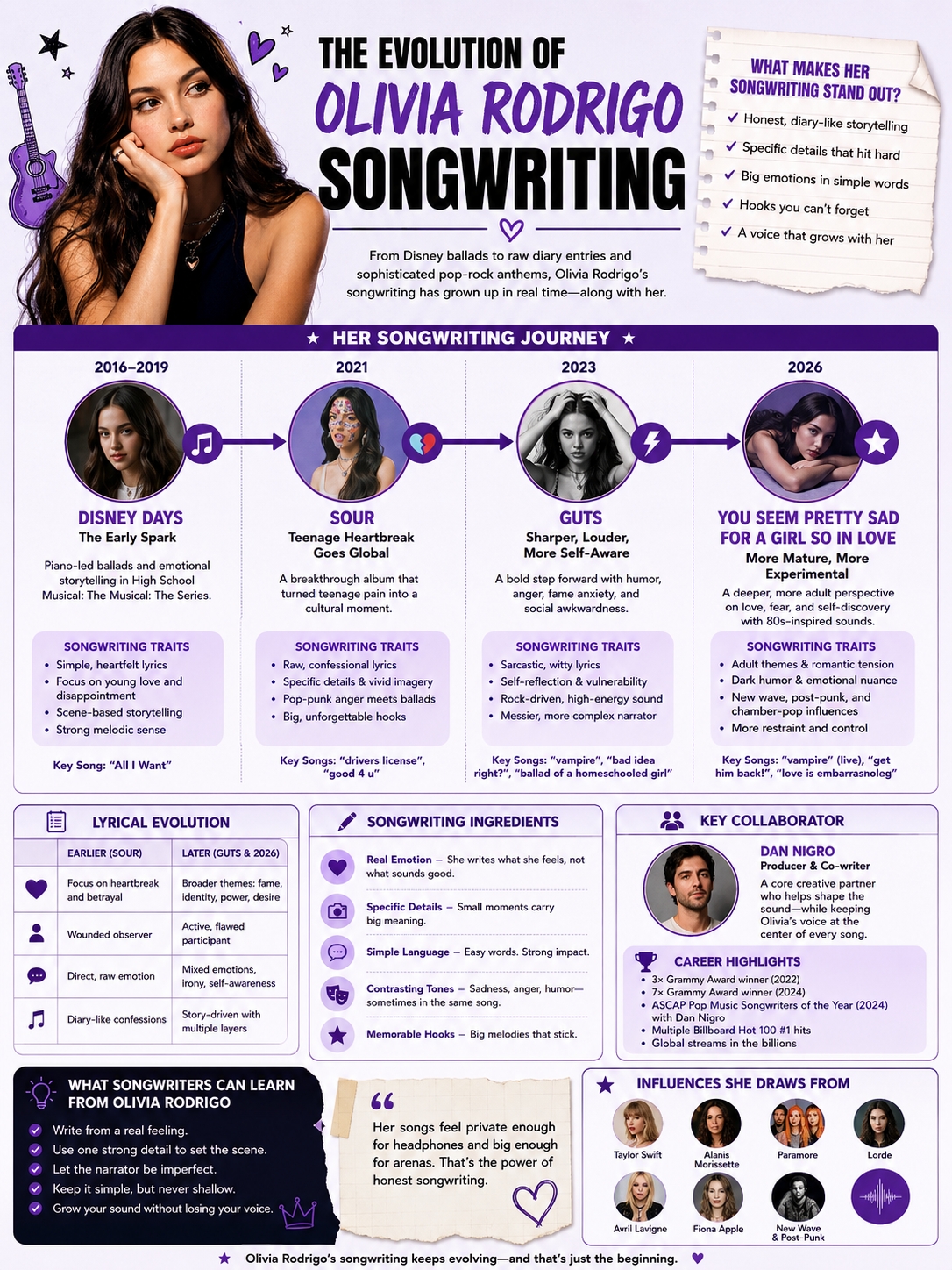
She started with soft Disney-era ballads. Then SOUR made heartbreak feel huge, messy, and cinematic. GUTS brought sharper jokes, louder guitars, and a more self-aware kind of anger. By her 2026 era, Rodrigo sounded less like a teen trying to survive heartbreak and more like a young adult trying to understand love, fame, fear, and herself.
That growth is what makes her writing so interesting. She didn’t abandon the emotional diary style that made her famous. She sharpened it. She added humor. She added bite. She let herself look flawed. And that made the songs feel even more real.
From Disney Ballads to a Real Songwriter’s Voice
|
Early Stage |
What Stood Out |
Why It Mattered |
|
Disney era |
Piano-led emotional songs |
Showed her natural feel for melody |
|
“All I Want” |
Simple words, big feelings |
Helped define her early voice |
|
Pre-SOUR writing |
Personal scenes and clear emotion |
Made her songs easy to connect with |
|
Acting background |
Dramatic timing |
Gave her songs a scene-like quality |
Before “drivers license” broke the internet, Rodrigo had already shown signs of the writer she would become. “All I Want,” from High School Musical: The Musical: The Series, was a clear early moment.
It was not flashy. It didn’t hide behind complicated language. That was the strength.
The song sounded like a young person trying to make sense of disappointment while the feeling was still fresh. You could hear the hurt, the doubt, and the quiet question underneath it all: Why does this keep happening to me?
That kind of emotional directness became Rodrigo’s signature.
Her Early Songs Worked Because They Felt Unfiltered
Rodrigo’s early style had a few clear traits:
- short, plain lines
- piano-first arrangements
- strong emotional focus
- clear romantic conflict
- a diary-like voice
- melodies that carried the sadness without overdoing it
She never sounded like she was trying to impress other songwriters. She sounded like she was trying to say the thing out loud before she lost the nerve.
That matters. A lot of pop songs talk about heartbreak. Rodrigo made heartbreak feel like a scene. There was always a room, a road, a car, a memory, or a small detail that pulled the listener in.
SOUR Turned Teenage Heartbreak Into a Global Pop Story
|
SOUR Trait |
How It Changed Her Writing |
Why Fans Connected |
|
Heartbreak focus |
The album stayed close to one emotional wound |
It felt honest and unified |
|
Specific details |
Small images carried big feelings |
Listeners could picture the pain |
|
Pop-punk anger |
Hurt became loud and sarcastic |
It gave the album energy |
|
Confessional tone |
Songs felt private |
Fans trusted the emotion |
|
Big choruses |
Feelings became easy to sing |
The songs spread fast |
SOUR was not just a successful debut. It was a full emotional world. Rodrigo built the album around heartbreak, jealousy, betrayal, insecurity, and comparison. She did not soften teenage pain to make it sound more mature. She let it be dramatic.
That is why the album worked.
Teenage heartbreak often feels huge because, at that age, it is huge. You don’t have years of distance yet. You don’t have a calm adult voice in your head saying, “This will pass.” Rodrigo wrote from inside that storm.
“drivers license” is the cleanest example. A driver’s license should feel like freedom. In the song, it becomes proof of loneliness. That is smart writing. She takes one normal life moment and loads it with heartbreak.
“drivers license” Made Small Details Feel Massive
The song does not need a complicated story. The power comes from the details.
A car ride. A suburb. A place where someone else should have been sitting. A dream that now feels pointless.
That is a major reason olivia rodrigo songwriting connects so quickly. She does not write feelings in the abstract. She gives them objects. She gives them places. She gives them a physical shape.
“good 4 u” Proved She Could Write With Teeth
Then came “good 4 u,” and Rodrigo showed a different side.
This was not soft heartbreak. It was bitter, fast, and sarcastic. The song had pop-punk energy, but the real punch came from the writing. It captured that ugly feeling when someone seems fine after hurting you, while you’re still falling apart.
That emotional contrast gave Rodrigo more range. She was not just the girl at the piano. She could also turn rage into a hook.
Influence, Credits, and the Pressure Around Her Early Success
|
Topic |
What Happened |
How It Shaped the Conversation |
|
Public comparisons |
Listeners heard links to older pop and rock songs |
Her influences became part of her image |
|
Songwriting credits |
Some credits were added after release |
Her process faced public scrutiny |
|
Fast fame |
Every lyric became a talking point |
Her writing was examined closely |
|
Artistic growth |
She kept developing her own voice |
Later songs sounded more confident |
Rodrigo’s rise came with a lot of attention. Some of it was praise. Some of it was pressure. And some of it came from the songwriting-credit debates around SOUR.
“deja vu” later added credits for Taylor Swift, Jack Antonoff, and St. Vincent. “good 4 u” later added Hayley Williams and Josh Farro of Paramore. These updates became a major part of the discussion around Rodrigo’s early career.
That could have boxed her in. Instead, it seems to have pushed her to become more careful and more distinct.
Influence is normal in pop music. Every young songwriter absorbs the music they grew up loving. The question is what happens next. Rodrigo’s next move mattered because she had to prove that her voice could stand on its own.
By GUTS, it did.
She Learned How to Use Influence Without Disappearing Into It
On SOUR, the influences were easy to hear. There were hints of pop-punk, singer-songwriter ballads, teen drama, and classic breakup pop.
On GUTS, those influences felt more blended. The songs still had echoes of older rock and pop, but they sounded more like Olivia Rodrigo. The sharpness was hers. The emotional timing was hers. The awkward jokes were hers.
That is growth. She was not only showing what inspired her. She was turning those influences into her own language.
GUTS Made Her Funnier, Louder, and More Self-Aware
|
GUTS Shift |
What Changed |
Why It Worked |
|
More humor |
The lines became sharper and more sarcastic |
Pain felt more human |
|
More self-blame |
She was not always the victim |
The writing felt more grown-up |
|
Louder guitars |
The sound had more bite |
It matched the emotional chaos |
|
Fame anxiety |
She wrote from inside public pressure |
The themes became wider |
|
Social awkwardness |
Embarrassment became part of the story |
The songs felt painfully real |
GUTS was where Rodrigo stopped sounding like a breakout artist and started sounding like someone with a real body of work.
The album still had heartbreak. Of course it did. But it also had panic, fame, desire, self-sabotage, revenge fantasies, and social embarrassment. That gave the songs more texture.
The biggest change was humor.
Rodrigo became much funnier on GUTS, but not in a light way. Her jokes had bruises under them. She used humor the way people often use it in real life: to cover embarrassment, soften anger, or admit something uncomfortable without saying it too plainly.
Read Also: Top 20 Latin Music Hits Dominating Charts in 2026
“vampire” Showed More Control
“vampire” is dramatic, but it doesn’t fall apart. It builds.
The song starts wounded, then grows into accusation. Rodrigo sounds hurt, angry, and disgusted, but the writing stays focused. That control is what makes the song hit.
It also shows how her subject matter had grown. She was not only writing about a breakup. She was writing about power. Who has it. Who uses it. Who gets drained by it.
“ballad of a homeschooled girl” Captured Real Embarrassment
One of Rodrigo’s best skills is writing embarrassment.
Not cute embarrassment. Not movie embarrassment. Real embarrassment. The kind that makes you replay one awkward moment in your head for days.
“ballad of a homeschooled girl” works because it turns social panic into a full song. That was a smart move. It pushed Rodrigo beyond romance and into identity, awkwardness, and the exhausting job of being seen.
Olivia Rodrigo Songwriting Became More Character-Driven
|
Earlier Writing |
Later Writing |
|
The narrator feels wronged |
The narrator also questions herself |
|
The emotion is direct |
The emotion is more mixed |
|
The focus is heartbreak |
The focus expands to fame, desire, shame, and power |
|
The tone is raw |
The tone is sharper and more layered |
|
The listener asks, “Who hurt her?” |
The listener asks, “What is she learning?” |
The biggest change in Rodrigo’s lyrics is not just maturity. It is complexity.
On SOUR, the speaker often sounded heartbroken and betrayed. That made sense. The album lived inside the first shock of pain.
On GUTS, the speaker became messier. She could be angry, petty, funny, embarrassed, reckless, and self-aware in the same song. That made her more interesting.
By her 2026 material, Rodrigo’s writing leaned even more into mixed feelings. Love did not sound simple. Wanting someone came with fear. Romance had anxiety under it. Sadness came with humor. Anger came with self-criticism.
That is where olivia rodrigo songwriting gets stronger. She no longer writes only about what happened to her. She writes about what it reveals.
Her Best Narrators Are Not Perfect
Rodrigo’s later writing works because she lets the narrator look bad sometimes.
That takes guts. It is easy to write yourself as the person who was hurt. It is harder to admit you were jealous, needy, dramatic, or wrong.
But that honesty makes the songs feel more adult. Real people do not feel one clean emotion at a time. Rodrigo’s newer writing understands that.
Dan Nigro Helped Shape the Sound Without Hiding Her Voice
|
Creative Area |
Rodrigo’s Strength |
Nigro’s Role |
|
Lyrics |
Personal voice and emotional detail |
Helps frame the song |
|
Melody |
Direct, memorable lines |
Builds shape and momentum |
|
Production |
Keeps emotion at the center |
Adds texture and drama |
|
Genre mix |
Moves between ballad, pop, and rock |
Helps blend the sounds |
|
Album identity |
Provides the emotional core |
Helps turn it into a complete record |
Rodrigo’s work with Dan Nigro has been central to her sound. Their partnership helped shape the mix of piano ballads, pop hooks, rock guitars, and theatrical emotional turns.
The key is that the production usually does not bury the writing. Even when the guitars get loud, the lyric stays in front. That is important because Rodrigo’s songs live or die by the line.
A pause can matter. A sudden guitar hit can matter. A quiet verse can make the chorus feel bigger. Rodrigo and Nigro often use space well, which gives her words room to land.
The Songs Still Sound Like Her
That is the most important part.
Strong production can make a song sound expensive. Strong songwriting makes it feel personal. Rodrigo’s best songs have both.
The sound may change from album to album, but the emotional voice stays clear.
Her 2026 Era Sounds More Adult and Less Afraid to Stretch
|
2026 Direction |
What Changed |
Why It Matters |
|
More adult romance |
Love is explored while it is happening |
The writing has more tension |
|
Darker humor |
Sadness comes with wit |
The songs avoid flat melodrama |
|
Wider sound |
New wave and post-punk colors appear |
Her music feels less boxed in |
|
More restraint |
She does not always rush to the emotional explosion |
The craft feels stronger |
|
Bigger themes |
Love, fear, fame, obsession, and self-worth mix together |
The songs feel more layered |
By 2026, Rodrigo had moved into a more adult phase. Her newer work did not simply repeat the SOUR and GUTS formula. It kept the emotional honesty but changed the angle.
Earlier Rodrigo often wrote from the wreckage after love went wrong. In the 2026 era, she seemed more interested in love while it was still happening. That is a different kind of tension.
It is not just, “You broke my heart.” It is, “Why does wanting this make me feel so scared?”
That shift gives the writing more room. The songs can hold hope and dread at the same time. They can sound romantic and uneasy. They can be catchy without feeling simple.
She Is Not Just the Breakup Girl Anymore
Rodrigo will probably always be linked to heartbreak. That is not a problem. Many great songwriters return to the same emotional territory again and again.
The difference is that heartbreak is no longer the whole story. It is the doorway.
Through it, she writes about power, shame, growing up, public image, desire, self-respect, and the weird pressure of being young while millions of people watch.
That is a much bigger canvas.
Why Olivia Rodrigo’s Lyrics Hit Gen Z So Hard
|
Connection Point |
Why It Works |
|
Plain language |
The songs are easy to enter |
|
Specific images |
The feelings feel real |
|
Big hooks |
The emotion becomes memorable |
|
Flawed narrators |
The songs feel human |
|
Humor and anger |
Sadness does not become boring |
|
Online-age anxiety |
She captures comparison, pressure, and public self-awareness |
Rodrigo writes feelings people often hate admitting.
Jealousy. Shame. Neediness. Social panic. The fear that someone moved on faster than you. The embarrassment of caring too much. The anger of knowing you are not over it yet.
She does not make those feelings pretty. That is why they work.
Her writing also fits the emotional world of Gen Z. This is a generation raised around public comparison, online speculation, screenshots, fan theories, and constant self-display. Rodrigo writes from that pressure without turning her songs into internet slang.
That is hard to do.
Her details feel modern, but her songcraft is classic. Clear verses. Big choruses. Strong emotional turns. A voice you believe.
What Songwriters Can Learn From Olivia Rodrigo
|
Lesson |
Rodrigo’s Example |
How Writers Can Use It |
|
Start with a real feeling |
Her songs often begin with emotional pressure |
Write from a clear wound or question |
|
Use small symbols |
Cars, rooms, parties, and memories carry meaning |
Make abstract feelings concrete |
|
Keep language simple |
Her best lines are easy to understand |
Choose clarity over decoration |
|
Show ugly emotions |
Jealousy and shame appear often |
Do not polish away the truth |
|
Let the narrator be flawed |
Later songs admit insecurity and bad choices |
Make the voice feel human |
Rodrigo’s writing is a good reminder that simple does not mean shallow.
Her best songs are not packed with fancy words. They are packed with clear emotional choices. She knows what the feeling is. She knows where to place it. She knows when to let the line breathe.
New writers can learn a lot from that.
Start with the exact feeling. Put it inside a real scene. Use one detail that carries the weight. Let the narrator be imperfect. Then build a chorus that people can feel before they fully explain it.
That is the trick behind strong pop writing.
Final Thoughts
|
Key Point |
Why It Matters |
|
Her voice grew fast |
Each album shows a clear new stage |
|
She kept her emotional core |
The songs still sound honest |
|
Her writing became sharper |
Humor and self-awareness added depth |
|
Her themes expanded |
She writes about more than heartbreak now |
|
Her craft improved |
The songs feel tighter and more controlled |
The story of olivia rodrigo songwriting is really the story of a young writer growing up in public.
She began with soft, direct ballads. SOUR turned heartbreak into a global pop language. GUTS made her sharper, funnier, and more chaotic in the best way. Her 2026 work pushed her into a more adult space, with more tension, more restraint, and a wider sound.
Her gift is clarity. She can take a complicated feeling and make it sound simple without making it weak. That is rare.
Rodrigo’s songs feel private enough for headphones and big enough for arenas. That is why they travel so far. And that is why she is not just one of the biggest pop stars of her generation. She is one of its most interesting songwriters.
Uncommon FAQs About Olivia Rodrigo Songwriting
|
Question |
Quick Answer |
|
Does Olivia Rodrigo write her own songs? |
Yes, often with Dan Nigro as a key collaborator |
|
What makes her writing different? |
Simple language, sharp details, and emotional honesty |
|
How did SOUR and GUTS differ? |
GUTS became funnier, louder, and more self-aware |
|
Is she pop or rock? |
She is a pop songwriter with strong rock influence |
|
What changed by 2026? |
Her writing became more adult, layered, and experimental |
Does Olivia Rodrigo write her own songs?
Yes. Rodrigo is credited as a songwriter across her major work. She often writes with Dan Nigro, who has been one of her most important creative partners.
What makes Olivia Rodrigo’s songwriting different?
She uses simple words, but she chooses sharp emotional details. Her songs often feel like diary entries, but they are built with strong pop structure.
How did SOUR and GUTS differ lyrically?
SOUR focused on heartbreak, jealousy, betrayal, and teenage pain. GUTS added fame anxiety, social awkwardness, self-blame, desire, humor, and louder rock energy.
Why do people compare Olivia Rodrigo to older artists?
Her music pulls from pop, pop-punk, alt-rock, and singer-songwriter traditions. Listeners often hear echoes of artists like Taylor Swift, Paramore, Alanis Morissette, Avril Lavigne, Lorde, and Fiona Apple.
Did the songwriting credit controversies hurt her growth?
They brought pressure and scrutiny, but they did not stop her. If anything, her later work sounds more confident and more clearly her own.
Why does she write so much about heartbreak?
Heartbreak is her main emotional starting point. But over time, she has used it to explore bigger ideas: pride, shame, fame, power, insecurity, and self-worth.
What changed most in her 2026 songwriting?
The perspective changed. She moved beyond writing only about love after it ends. She started writing more about love while it is happening, with all the fear and pressure that comes with it.