The lights cut out. The microwave stops halfway through heating food. One room goes dark while the rest of the house works fine.
Most people know what comes next: “Go flip the breaker.”
That sounds simple. And yes, sometimes it is. But before you reset tripped breaker switches, it helps to pause for a moment. A breaker does not trip for no reason. It trips because something on that circuit pulled too much power, shorted out, overheated, or created a safety risk.
That small switch inside your electrical panel may be protecting your wiring from damage. It may also be stopping a bigger problem before it turns dangerous.
The safe fix is not hard. You just need to know what to check first, how to reset the breaker the right way, and when to leave it alone.
This guide walks you through the process in plain English.
What a Tripped Circuit Breaker Is Really Telling You
|
Key Point |
What It Means |
|
Breaker trips |
The circuit shut off to protect your home |
|
Common cause |
Too many devices running on one circuit |
|
Serious cause |
Short circuit, ground fault, arc fault, or damaged wiring |
|
First safe step |
Turn off or unplug devices before resetting |
|
Big warning sign |
The same breaker keeps tripping |
A circuit breaker works like a guard for your home’s wiring. It watches how much electrical current flows through a circuit. When the current gets too high, the breaker shuts the circuit off.
That may feel annoying in the moment. But it is a safety feature, not a random failure.
A breaker may trip because of:
- Too many appliances running at once
- A damaged cord or plug
- A faulty appliance
- A short circuit
- A ground fault near moisture
- Loose or damaged wiring
- A worn-out breaker
The most common reason is overload. For example, a space heater, hair dryer, and microwave can pull a lot of power. If they share the same circuit, the breaker may shut off to prevent overheating.
But not every trip is harmless. A breaker that trips again and again needs attention.
Electrical fire data makes this point clear. NFPA’s 2026 home electrical fire tables estimate an annual average of 46,652 home electrical fires in the U.S. during 2020-2024. USFA’s 2023 estimate for residential electrical malfunction fires lists 23,700 fires, 305 deaths, 800 injuries, and about $1.5 billion in losses.
Those numbers do not mean every tripped breaker is an emergency. They do mean you should treat repeat trips with respect.
Before You Reset Tripped Breaker Switches, Check for Danger
|
What You Notice |
What You Should Do |
|
Burning smell |
Do not reset the breaker |
|
Smoke or sparks |
Leave the area and call emergency help if needed |
|
Wet panel or wet floor |
Do not touch the panel |
|
Warm outlet or melted plug |
Stop using that circuit |
|
Buzzing or crackling panel |
Call a licensed electrician |
|
Breaker trips again |
Leave it off and get help |
Before you touch the electrical panel, look around the room that lost power.
Use your senses. Do you smell burning plastic? Do you see smoke? Did an outlet spark? Does a plug feel hot? Is there water near the breaker panel?
If anything feels wrong, do not reset the breaker.
That one decision matters. A burning smell, hot outlet, or buzzing panel can point to overheating, arcing, or a loose connection. Resetting the breaker may send power back into a faulty circuit.
Stop and call a licensed electrician if you notice:
- Smoke
- Sparks
- Burn marks
- Melted plastic
- A hot outlet
- A hot breaker
- Buzzing from the panel
- Crackling sounds
- A wet electrical panel
- A breaker that feels loose
Also, never tape or hold a breaker in the ON position. A breaker must be free to trip. Blocking it removes the protection it gives your home.
How to Reset a Tripped Breaker Safely
|
Step |
What to Do |
Why It Helps |
|
1 |
Turn off or unplug devices |
Reduces the load on the circuit |
|
2 |
Open the electrical panel |
Lets you find the tripped breaker |
|
3 |
Look for the switch out of line |
Tripped breakers often sit in the middle |
|
4 |
Push it fully OFF first |
Clears the trip position |
|
5 |
Push it back ON |
Restores power if the problem is gone |
|
6 |
Add devices back slowly |
Helps you find the cause |
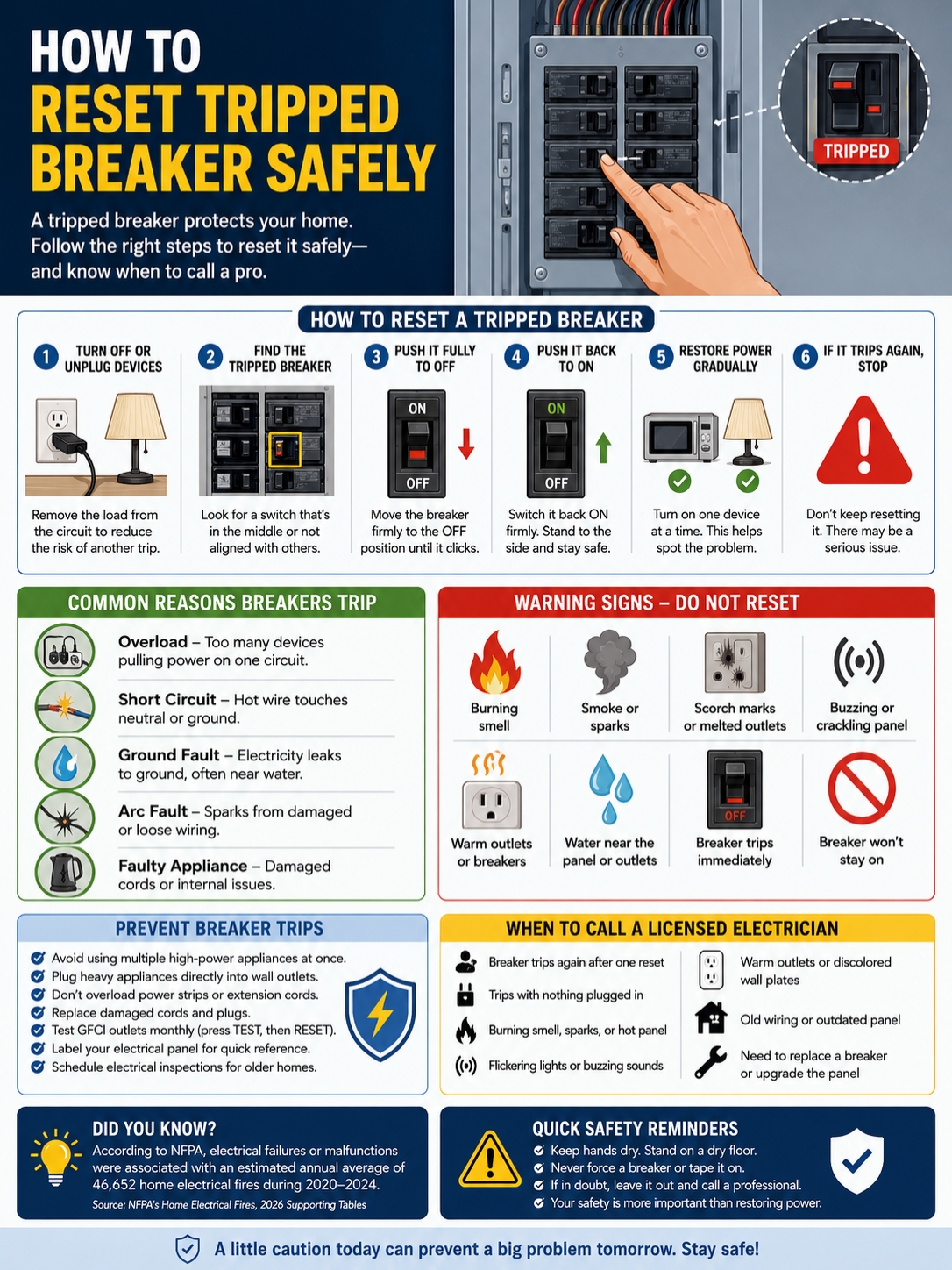
Here is the safe way to reset tripped breaker switches at home.
1. Turn off or unplug devices first
Go to the area that lost power. Turn off lights and unplug devices.
Pay extra attention to items that use a lot of power, such as:
- Space heaters
- Microwaves
- Toasters
- Hair dryers
- Air fryers
- Electric kettles
- Portable air conditioners
- Vacuum cleaners
- Power tools
- Gaming PCs
This step is easy to skip, but it matters. If the circuit tripped because of overload, it may trip again as soon as you reset it.
2. Find the tripped breaker
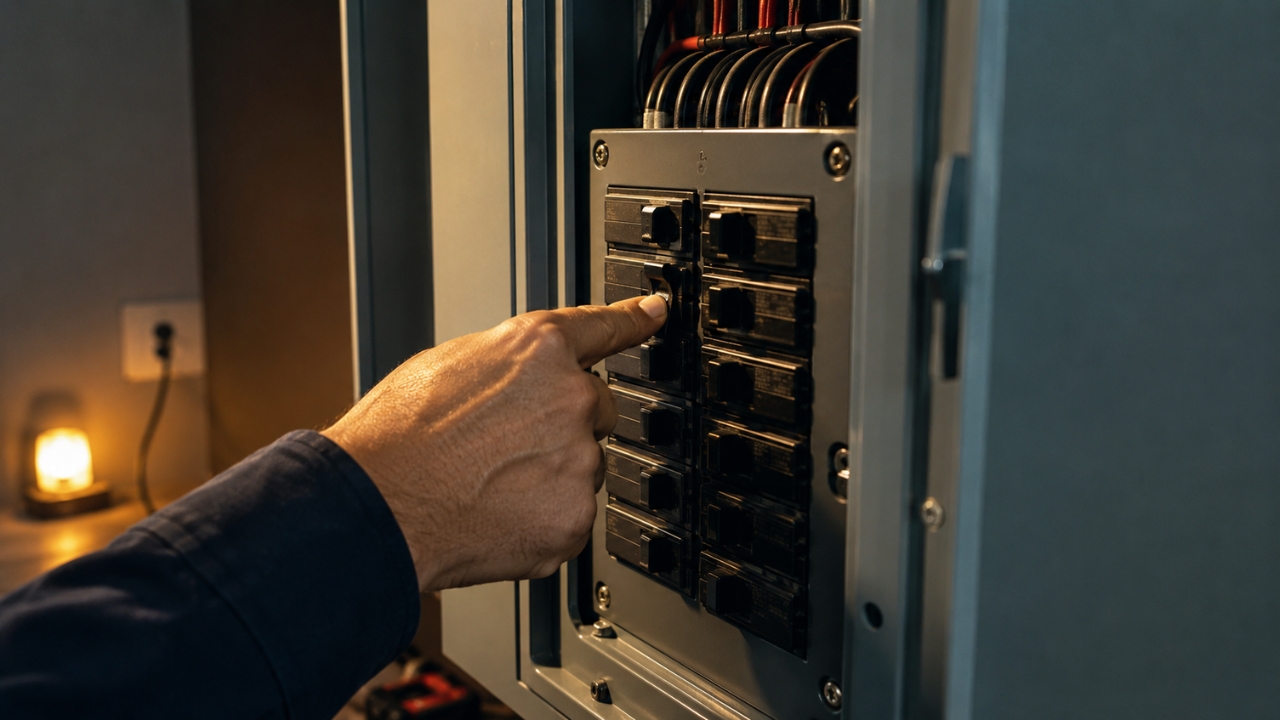
Open the electrical panel door.
A tripped breaker may look different from the others. It may be fully OFF, or it may sit halfway between ON and OFF. Some breakers also show a red or orange trip marker.
If your panel is labeled, look for the room or area that lost power. If the labels are old or unclear, you may need someone to stand in the room and tell you when power returns.
3. Push the breaker fully OFF
This is the step many people miss.
Do not just push the breaker toward ON. Most breakers need to move fully to the OFF position first. Push it firmly until it clicks.
4. Switch it back ON
Now push the breaker firmly back to ON.
Stand slightly to the side of the panel. Keep your hands dry. Make sure the floor is dry. Do not touch the panel if there is moisture nearby.
If the breaker stays ON, power should return.
5. Turn devices back on one at a time
Do not plug everything back in at once.
Turn on one item. Wait a few seconds. Then try the next one.
If the breaker trips when one appliance turns on, that appliance may be faulty, damaged, or too heavy for that circuit.
What to Do If the Breaker Trips Again
|
What Happens |
Possible Cause |
Best Move |
|
Trips right away |
Short circuit or ground fault |
Leave it off |
|
Trips after one appliance starts |
Faulty appliance or overload |
Stop using that appliance |
|
Trips with everything unplugged |
Wiring or breaker problem |
Call an electrician |
|
Trips every day |
Overloaded or unsafe circuit |
Get it inspected |
|
Will not reset |
Active fault or bad breaker |
Do not force it |
A breaker that trips once after heavy appliance use may not be a major problem.
A breaker that trips again is different.
You can reset a breaker once after unplugging devices and checking for danger. But if it trips again, stop. Do not keep flipping it back on.
Here is a simple rule:
- One trip: Unplug devices and reset once.
- Second trip: Stop using that circuit.
- Immediate trip: Leave the breaker off and call an electrician.
Repeated resets can make a hidden electrical problem worse. They can also heat wires behind the wall, damage devices, or raise the risk of fire.
A breaker is not being stubborn. It is warning you.
Common Reasons Circuit Breakers Trip
|
Cause |
What You May Notice |
Example |
|
Overload |
Trips when many devices run together |
Heater plus microwave |
|
Short circuit |
Pop, spark, or burning smell |
Damaged cord or outlet |
|
Ground fault |
Trips near water or damp areas |
Bathroom or outdoor outlet |
|
Arc fault |
Random trips, buzzing, damaged wiring |
Loose or worn wire |
|
Faulty appliance |
Trips with one device |
Old fridge or hair dryer |
|
Bad breaker |
Trips for no clear reason |
Worn breaker or panel issue |
Circuit overload
This is the everyday cause.
An overload happens when one circuit carries more electricity than it should. Think of it like asking one small road to handle too much traffic.
A bedroom circuit may handle lights, chargers, a fan, and a TV. Add a space heater and a hair dryer, and the breaker may trip.
The fix is simple: reduce the load. Use fewer high-power devices at the same time. Move one device to another circuit if possible.
Read Also: How to Clean an Oven Without Harsh Chemicals
Short circuit
A short circuit is more serious.
It can happen when a hot wire touches a neutral wire or another unsafe path. The current jumps quickly, and the breaker shuts off fast.
Warning signs include:
- A loud pop
- A spark
- A burning smell
- Black marks near an outlet
- A damaged cord
- Breaker trips instantly
If you suspect a short circuit, do not reset the breaker again. Leave it off and call an electrician.
Ground fault
A ground fault happens when electricity leaks away from its normal path. This is especially dangerous around water.
Common areas include:
- Bathrooms
- Kitchens
- Laundry rooms
- Garages
- Basements
- Outdoor outlets
- Pool or patio areas
This is why GFCI protection matters in damp locations. It helps reduce shock risk.
Faulty appliance
Sometimes the wiring is fine. The appliance is the troublemaker.
If the breaker trips every time you use one device, stop using that device. It may have a damaged cord, weak motor, or internal fault.
Do not keep testing it. Repair or replace it.
GFCI, AFCI, and Standard Breakers: Know the Difference
|
Device |
Where You See It |
What It Protects Against |
How You Reset It |
|
Standard breaker |
Main electrical panel |
Overload and short circuit |
OFF, then ON |
|
GFCI outlet |
Bathroom, kitchen, garage, outdoor areas |
Electric shock from ground faults |
Press RESET button |
|
GFCI breaker |
Main electrical panel |
Ground fault shock risk |
OFF, then ON |
|
AFCI breaker |
Main electrical panel |
Fire risk from arcing |
OFF, then ON |
|
Dual-function breaker |
Main electrical panel |
Arc faults and ground faults |
OFF, then ON |
Sometimes the breaker is not the only thing that tripped.
If an outlet is dead but the breaker looks fine, check for a GFCI outlet nearby. These outlets have TEST and RESET buttons.
You often find them in:
- Bathrooms
- Kitchens
- Garages
- Basements
- Laundry rooms
- Outdoor areas
One GFCI outlet can also protect other outlets down the line. So a tripped GFCI in one spot may shut off power somewhere else.
AFCI breakers work differently. They help detect arcing, which can happen when wires or connections are damaged. Arcing can create heat and raise fire risk.
GFCI and AFCI devices do different jobs. GFCIs reduce shock risk. AFCIs help reduce fire risk from arcing.
If an AFCI breaker keeps tripping, do not ignore it. It may be catching a real problem.
How to Stop Breakers From Tripping Again
|
Prevention Tip |
Why It Works |
|
Avoid running heavy appliances together |
Prevents overload |
|
Plug space heaters into wall outlets only |
Reduces overheating risk |
|
Do not overload power strips |
Power strips do not add circuit capacity |
|
Replace damaged cords |
Helps prevent shorts |
|
Test GFCI outlets |
Confirms shock protection works |
|
Label the breaker panel |
Makes future resets safer |
|
Inspect older wiring |
Finds hidden issues early |
The best breaker reset is the one you never need to do.
A few simple habits can help.
Spread out high-power devices
Do not run several heavy appliances on the same circuit.
For example, avoid using these together if they share one circuit:
- Microwave
- Toaster
- Air fryer
- Electric kettle
- Space heater
- Hair dryer
Heat-making appliances use a lot of power. Use one at a time when you can.
Be careful with space heaters
Space heaters are one of the biggest overload risks in many homes.
Plug them straight into a wall outlet. Do not use a power strip. Do not use an extension cord unless the heater manufacturer clearly allows it and the cord is properly rated.
Keep space heaters away from:
- Curtains
- Bedding
- Rugs
- Paper
- Furniture
- Clothes
And turn them off when you leave the room.
Stop overusing extension cords
Extension cords are temporary. They are not a long-term wiring solution.
Replace any cord that has:
- Cracks
- Fraying
- Exposed wire
- Loose plug blades
- Melted plastic
- Burn marks
- A warm or hot feel during use
If you need extension cords every day, your home may need more outlets or a circuit upgrade.
Label your electrical panel
A clear panel label saves time and stress.
Use simple labels like:
- Kitchen outlets
- Refrigerator
- Bedroom lights
- Bathroom GFCI
- Living room
- Garage outlets
- Laundry
- HVAC
Old labels are often wrong. Update them when you figure out what each breaker controls.
When You Should Call a Licensed Electrician
|
Warning Sign |
Why You Need Help |
|
Breaker trips again right away |
Possible short or ground fault |
|
Breaker trips with nothing plugged in |
Possible wiring fault |
|
Burning smell |
Possible overheating |
|
Warm outlet or breaker |
Unsafe electrical condition |
|
Buzzing panel |
Possible loose connection |
|
Scorch marks |
Possible arcing or heat damage |
|
Old wiring |
Higher risk of hidden problems |
|
Breaker replacement needed |
Panel work can be dangerous |
Some electrical jobs are not worth the DIY risk.
Call a licensed electrician if:
- The breaker will not stay ON
- It trips again after one reset
- It trips with everything unplugged
- You smell burning
- You see sparks
- The panel buzzes or crackles
- Outlets feel warm
- Lights flicker often
- Your home has old wiring
- You rely on extension cords every day
- You think the breaker needs replacing
Do not replace a breaker yourself unless you are trained and qualified. Electrical panels can stay dangerous even when some switches are off. Parts inside the panel may still carry live voltage.
If you are unsure, call a professional. That is not overreacting. That is being smart.
Quick Troubleshooting Checklist
|
Question |
What It Suggests |
|
Were many appliances running? |
Likely overload |
|
Did one appliance trigger the trip? |
Possible appliance fault |
|
Did the breaker trip instantly? |
Possible short or ground fault |
|
Is there a burning smell? |
Stop and get help |
|
Are outlets warm or discolored? |
Do not use that circuit |
|
Is the panel wet? |
Do not touch it |
|
Did a GFCI outlet trip? |
Press RESET if safe |
Before you reset tripped breaker switches, run through this quick checklist:
- Are my hands dry?
- Is the floor dry?
- Is the panel dry?
- Did I unplug heavy appliances?
- Is there any burning smell?
- Did I see sparks?
- Is the breaker hot?
- Has this happened before?
If everything looks normal, reset once.
If anything feels off, leave it alone.
Final Thoughts
|
Main Point |
What to Remember |
|
Breakers trip for a reason |
Do not ignore repeat trips |
|
Reset the right way |
Push OFF first, then ON |
|
Reduce the load first |
Unplug appliances before resetting |
|
Stop after repeat trips |
Do not keep forcing the breaker |
|
Call a pro when unsure |
Electrical problems can hide behind walls |
A tripped breaker is your home’s way of saying, “Something is not right here.”
Sometimes the issue is simple. Maybe you ran too many devices at once. Maybe a space heater overloaded the circuit. Maybe a GFCI outlet tripped nearby.
Other times, the problem runs deeper. It could be a short circuit, ground fault, bad appliance, damaged wiring, or worn breaker.
The safe approach is simple. Turn off or unplug devices. Find the tripped breaker. Push it fully OFF. Switch it back ON. Add devices back slowly.
And if it trips again, stop.
When you reset tripped breaker switches the right way, you protect your wiring, your appliances, and your home.
FAQs About Resetting a Tripped Circuit Breaker
|
Question |
Short Answer |
|
Why is the breaker in the middle? |
That is often the trip position |
|
Why won’t it reset? |
The fault may still be active |
|
Can rain trip a breaker? |
Yes, especially outdoor circuits |
|
Is one reset safe? |
Usually, if you remove the load first |
|
Should I replace the breaker myself? |
No, call a licensed electrician |
Why is my breaker stuck in the middle?
Many breakers move to a middle position when they trip. Push the breaker fully OFF first. Then switch it back ON.
Why does the breaker trip as soon as I reset it?
That can point to a short circuit, ground fault, faulty appliance, or wiring issue. Leave it off and call an electrician.
Can a bad appliance trip a breaker even if it still works?
Yes. An appliance can still turn on and still have an internal problem. A damaged cord, weak motor, or hidden fault can trip the circuit.
Why does my breaker trip when I use a microwave and toaster together?
Both use a lot of power. If they share a circuit, using them at the same time may overload it. Use one at a time or move one appliance to another circuit.
Why are some outlets dead if no breaker looks tripped?
A GFCI outlet may have tripped. Check bathrooms, kitchens, garages, basements, laundry areas, and outdoor outlets for RESET buttons.
Can rain make a breaker trip?
Yes. Rain can cause problems with outdoor outlets, damaged covers, wet extension cords, or moisture inside electrical boxes. Do not keep resetting the breaker if this happens.
Is it safe to reset a breaker at night?
Yes, if the area is dry and there are no warning signs. Use a flashlight. Do not use candles near the panel.
Should I call an electrician if the breaker trips only once?
Not always. If it tripped after heavy appliance use and stays on after you reduce the load, you may be fine. If it trips again, get it checked.