
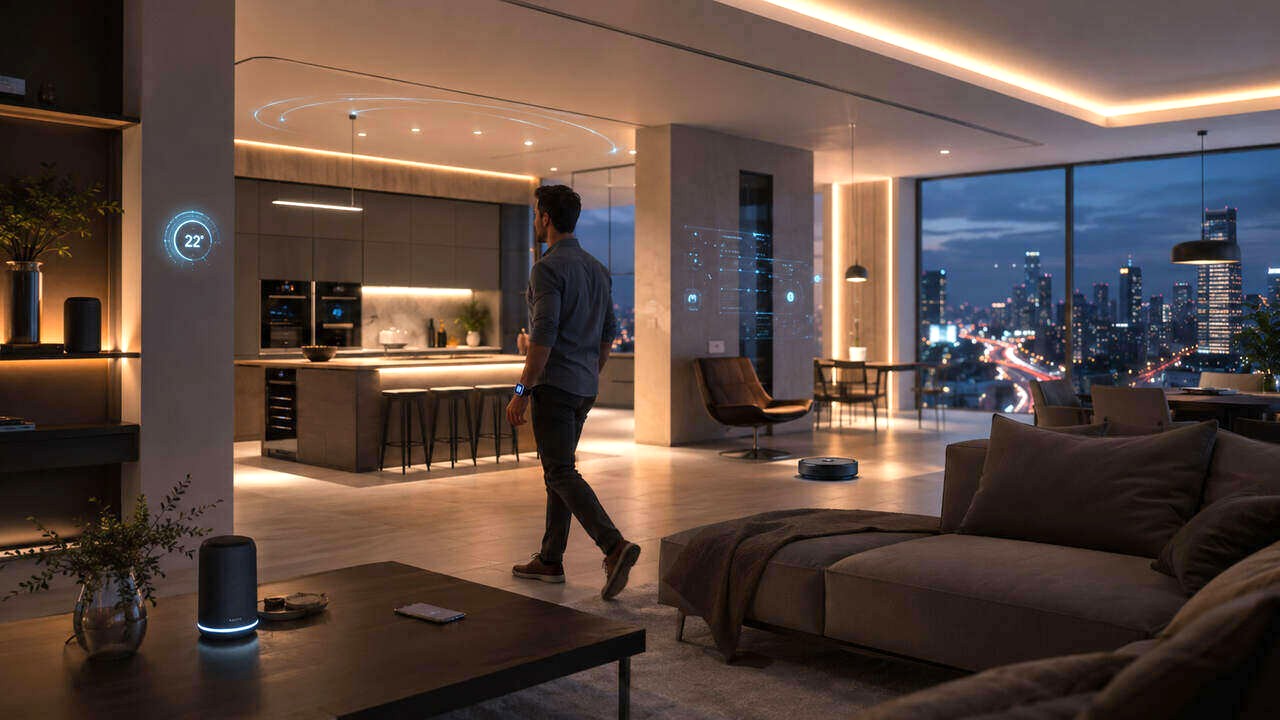
Picture this. You walk through your front door after a brutal day at work. As your foot hits the porch, the door quietly unlocks itself. The hallway lights fade up just enough to mimic the evening sky. Your living room feels perfectly cool because the house knew you left the office 20 minutes ago. You didn’t pull out a phone. You didn’t tap a screen. You didn’t even shout a command at a smart speaker. Your house just knew what you needed.
We spend most of our lives staring down at glowing rectangles, endlessly managing our digital chores. But the tech world is quietly pushing a massive shift. Technology is stepping out of our hands and disappearing into the walls, ceilings, and objects around us.
If you find yourself asking, “What is ambient computing?” you are witnessing the death of the traditional screen. We are moving away from devices that patiently wait for our direct commands. Instead, we are building intelligent environments that anticipate what we want before we even speak. Let’s break down exactly how this invisible technology works, where you can spot it in the real world right now, and why the tech industry is betting hundreds of billions on a screenless future.
What Is Ambient Computing? (Defining the Invisible Interface)
To really grasp what ambient computing is, you have to stop thinking about computers as physical objects sitting on a desk or resting in your pocket. Instead, picture a cognitive, invisible layer painted over your physical surroundings.
Ambient computing refers to a vast, connected network of smart devices, sensors, and artificial intelligence operating quietly in the background. Rather than demanding your attention and forcing you to navigate clunky menus, these systems work invisibly. They learn your daily habits, sense subtle changes in your room, and make split-second decisions without asking for permission.
The core difference between traditional tech and ambient tech boils down to anticipation. Traditional technology is entirely reactive. You have to open an app, swipe a screen, or issue a voice command to get a result. Ambient technology uses behavioral context to figure out what you want and just does it. It kills the friction between humans and computers. The ultimate goal? Making the technology so completely invisible that you forget it even exists.
|
Feature |
Traditional Computing |
Ambient Computing |
|
User Action Required |
Direct physical input (clicks, taps, voice) |
Operates automatically in the background |
|
Physical Visibility |
Screens, keyboards, hard drives, phones |
Invisible sensors, embedded chips |
|
System Responsiveness |
Reactive (waits patiently for your command) |
Anticipatory (predicts needs based on context) |
|
Primary Goal |
Information processing and task execution |
Frictionless living and invisible automation |
The Tech Powering the Shift
Ambient systems don’t rely on a single magical piece of software. They require a massive ecosystem of hardware, networking protocols, and code working perfectly in sync. For a room to act “smart,” it needs to see, think, and act on its own. Here is the exact tech stack powering the ambient revolution right now.
Edge AI (The Local Brain)
Historically, smart devices recorded your data and sent it to a distant cloud server. That caused lag and massive privacy risks. Today, devices use Edge AI. Neuromorphic chips process data directly on the device in milliseconds. In fact, industry data shows Edge AI now captures over 37% of the entire ambient market share. Your data stays local, and the response time is instant.
Ambient IoT and Low Energy Sensors
Tiny sensors track motion, temperature, and light. But more importantly, Bluetooth Low Energy (BLE) and RFID technologies let these sensors communicate using barely any power. We even see ambient sensors that harvest energy from ambient radio waves, meaning they never need a battery swap.
Context-Aware Logic
Data means nothing without context. If a motion sensor trips at 2 PM, the system ignores it. If it trips at 3 AM, the system triggers a security alarm. Context-aware algorithms analyze the time of day, your historical behavior, and environmental conditions to take the right action every single time.
Natural Language Processing (NLP)
When you do actually need to interact, you shouldn’t have to speak like a robot. NLP lets systems understand casual speech. You just say, “It’s a little bright in here,” and the room adjusts the blinds perfectly.
|
Technology |
Core Function in Ambient Systems |
Real-World Benefit |
|
Edge AI |
Processes complex data locally |
Slashes latency and keeps data private |
|
Ambient IoT |
Gathers environmental data |
Tracks room conditions without heavy battery drain |
|
Context Logic |
Applies smart rules to raw sensor data |
Prevents false alarms and bad assumptions |
|
NLP |
Understands human conversation |
Lets you speak naturally instead of using commands |
Real-World Applications: Where We See It Today
You might think this sounds like a sci-fi movie, but you interact with ambient environments every week. Major industries quietly adopted this tech to remove friction from our daily routines. Let’s look at how companies use it today.
Healthcare and Passive Radar Monitoring
Doctors and nurses spend hours staring at screens, typing up patient notes. Today, major clinics use ambient AI scribes that listen to the natural conversation between a doctor and patient, instantly turning that chat into clinical notes.
But it gets wilder. Companies like Smart Meter recently launched remote monitoring tools like iAmbientHealth. This is a purely passive ambient sensor. It doesn’t use cameras, microphones, or wearables. Instead, it uses advanced radar technology to track a patient’s heart rate, respiration, movement, and bed exits. It transmits this data over a secure cellular network, ensuring 100% privacy. Early studies show this tech can predict up to 75% of hospital transfers days in advance.
The Invisible Retail Experience
Think about checkout-free stores like Amazon Go. You scan an app at the entrance, put your phone in your pocket, and start shopping. You grab a coffee and walk out the door. Computer vision cameras and shelf sensors track exactly what you take. You never speak to a cashier or wait in line. Convenience stores and large retail chains are rushing to automate the shopping experience, pushing the ambient commerce market to dizzying new heights.
Smarter Commercial Buildings
While smart homes get all the flashy headlines, the commercial sector actually drives the real revenue. Office buildings deploy ambient sensor networks to automatically optimize lighting and HVAC systems based on how many people are in a room. This saves corporations millions in energy costs while tracking real-time carbon emissions to hit sustainability goals.
|
Industry |
How Ambient Tech is Applied |
Main Human Benefit |
|
Healthcare |
Radar vital tracking (iAmbientHealth) |
Reduces doctor burnout and protects patient privacy |
|
Retail |
Computer vision and RFID shelf sensors |
Eliminates checkout lines and shopping friction |
|
Commercial |
Automated HVAC and BLE lighting |
Slashes energy costs and hits sustainability targets |
|
Automotive |
Driver monitoring via eye-tracking |
Prevents fatal accidents by predicting driver fatigue |
Why Ambient Computing Is the Next Big Thing?
Why are tech giants pouring billions into making computers invisible? Because we hit “peak screen.” Consumers feel exhausted managing their devices. We want the perks of a connected life without the constant visual and mental distraction.
The financial data proves this shift is aggressive. According to 2026 reports from Fortune Business Insights and GlobeNewswire, the global ambient computing market sits anywhere from $71 billion to $85 billion today. By the mid-2030s, experts project it will skyrocket past $350 billion. North America completely dominates the space, holding around 35% of the global market share.
Here is exactly why this market is exploding.
1. The Craving for Frictionless Living
People absolutely hate mundane tasks. Nobody wants to manually adjust a thermostat or flip six different light switches every night. Ambient systems wipe out the micro-stresses of daily life. The ultimate modern luxury is a living space that simply takes care of itself.
2. Aging-in-Place Support
The global population is getting older rapidly. Ambient tech lets seniors live independently for much longer. Instead of relying on wearable panic buttons that seniors often forget to wear, passive sensors track movement automatically. If an elderly person slips and falls, the system detects the impact and calls an ambulance, even if they cannot speak.
3. The Move to Edge Processing
For years, the dream of ambient tech failed because internet speeds lagged. Sending data to the cloud was too slow. Now, neuromorphic chips prove that devices can process data locally. This drastically reduces lag and makes real-time environmental reactions possible without relying on a flawless Wi-Fi connection.
|
Growth Driver |
Impact on the Market |
Market Context |
|
Consumer Screen Burnout |
Demand for calm, invisible interfaces |
Market projected to exceed $350B by 2034 |
|
Commercial Energy Needs |
Offices adopting automated HVAC |
North America holds ~35% global market share |
|
Elder Care Innovations |
Hospitals investing in passive monitoring |
Healthcare drives massive sector growth |
|
Edge AI Advancements |
Devices operating without cloud latency |
Edge AI captures over 37% of market share |
The Dark Side: Privacy, Security, and Losing Control
We can’t praise the perks of this tech without tackling the massive risks. Building an environment that anticipates your every move requires that environment to literally watch your every move.
The “Always Listening” Problem
For an ambient system to work, it constantly collects data. Microphones listen for trigger words. Cameras and radar scan for motion. This sparks severe privacy anxieties. Do you really want corporate servers storing audio of your private household chats? While decentralized edge computing helps keep data local, living in a constantly surveilled space makes many people deeply uncomfortable.
The Loss of Human Agency
When our environments start making choices for us, we lose control. What happens when the system simply gets it wrong? Imagine an ambient smart fridge that decides you ran out of expensive groceries and automatically orders more—but you leave for a three-week vacation tomorrow. If we surrender too much decision-making power, we risk becoming passive passengers in our own homes.
Cybersecurity and Physical Threats
If a hacker gains access to your laptop, they steal your credit card data. If a hacker breaches your ambient home network, they unlock your front door, disable your security cameras, and crank your heat up to 100 degrees. As the physical and digital worlds merge, cyberattacks carry terrifying, real-world physical consequences.
Read Also: The Technology Behind Recycling
|
Core Risk |
What It Means for You |
How the Industry is Responding |
|
Privacy Loss |
Continuous audio/video surveillance |
Pushing Edge AI to keep data strictly local |
|
Loss of Agency |
Systems making incorrect assumptions |
Building manual override switches into hardware |
|
Cybersecurity |
Hackers controlling physical homes |
Enforcing strict biometrics and local networks |
|
Data Monetization |
Tech companies selling your habits |
Passing stricter global data protection laws |
What to Expect Next (2026 and Beyond)?
The foundation is already poured. So, where do we go from here? Expect a rapid drop in screen-based apps. The future of software is API-first, not app-first. Instead of pulling out your phone to check the weather, your smart mirror displays the forecast while you brush your teeth. Instead of setting a jarring alarm clock, your mattress sensors track your REM cycle and gently wake you up at the perfect moment by slowly raising the room’s lighting.
We will also see a massive leap in wearable AI agents talking directly to commercial buildings. Your smartwatch tells your office building that you arrived, automatically adjusting your workspace lighting and desk height the second you step off the elevator.
|
Future Trend |
What It Actually Means |
Expected Impact |
|
Invisible UI |
Screens replaced by behavioral triggers |
Massive drop in daily screen time |
|
Ambient Commerce |
Checkout-free stores becoming the norm |
Faster, frictionless retail experiences |
|
Zero-Click Homes |
Houses built with native AI algorithms |
Homes that manage their own energy use |
|
Passive Health |
Radar sensors replacing wearable trackers |
Better patient compliance and privacy |
Final Thoughts
Technology is finally getting out of our way. The era of staring down at screens, tapping through clunky menus, and managing digital chores is rapidly ending. We are moving toward a time of calm technology.
If you came here wondering what is ambient computing, the simplest answer is that it represents the return of the real world. By embedding intelligence directly into our surroundings, we stop managing our devices and start actually living in our environments. Sure, the privacy hurdles are huge, and the security risks demand serious attention. But the shift is inevitable. The future of technology isn’t a better screen. The future of technology is completely invisible.
Frequently Asked Questions (FAQs) About What is Ambient Computing
What is the difference between IoT and ambient computing?
Think of the Internet of Things (IoT) as the physical hardware—the smart bulbs, sensors, and thermostats. Ambient computing is the invisible brain connecting them all. IoT gives a room sensory organs; ambient intelligence gives the room a mind to make decisions.
Does ambient tech still work if my Wi-Fi goes down?
Yes. Thanks to modern local networking protocols and Edge AI chips, your devices talk to each other locally. Your smart home still adjusts lighting, detects break-ins, and runs local routines even if your internet provider has an outage.
Can ambient intelligence monitor health without using invasive cameras?
Absolutely. The healthcare sector rapidly adopted radar-based sensing tech, like Smart Meter’s iAmbientHealth. These sensors track a patient’s movement, heart rate, and breathing patterns entirely through radar waves, preserving patient privacy by ditching video feeds completely.
Why are retailers investing so heavily in ambient commerce?
It kills checkout friction and reduces labor costs. By using computer vision and shelf sensors, retailers track inventory in real-time, stop shoplifting, and let customers grab what they need and walk out.