Taking your first flight into aerial photography is incredibly exciting. But looking at the massive wall of technical specs, weight limits, and sensor packages can feel a little intimidating. The good news is that the technology has improved so rapidly that you no longer need hours of simulator practice just to keep a quadcopter from crashing.
Finding the right starter model is entirely about matching your budget and your specific goals, whether that means filming family vacations or trying out fast-paced first-person view flying. We have tested and analyzed the latest releases to bring you a comprehensive guide to the best drones for beginners. Our selections prioritize ease of use, safety features, durability, and excellent value for money. We look at everything from tiny micro-drones that launch from your palm to premium dual-camera systems that practically fly themselves. By the end of this guide, you will know exactly which model belongs in your backpack.
Why You Need a Beginner-Friendly Drone in 2026
Modern entry-level drones are incredibly smart machines. Just a few years ago, learning to fly meant risking a catastrophic crash on your very first day outdoors. Today, sophisticated sensors and intelligent software do the heavy lifting for you, keeping the aircraft stable in the wind and stopping you from hitting trees. This allows you to focus on framing the perfect shot and actually enjoying the flying experience rather than stressing over the controls.
Furthermore, the stabilization algorithms have evolved to a point where the drone can calculate wind resistance in real time, making micro-adjustments to the individual motor speeds without any pilot input. This means even a complete novice can achieve perfectly steady video on their very first outing. It also opens up the hobby to people who may not have fast reflexes but still want to explore creative angles from the sky.
|
Feature Category |
Why It Matters |
Beginner Benefit |
|
Obstacle Sensing |
Detects objects in the flight path |
Prevents accidental crashes |
|
Sub-250g Weight |
Falls under lighter regulatory rules |
Skips tedious paperwork |
|
Auto-Return |
GPS remembers takeoff point |
Brings the drone back if lost |
|
Subject Tracking |
AI keeps the camera locked on |
Shoots cinematic video automatically |
The Importance of Smart Sensors
If you have never held a transmitter before, your biggest fear is likely crashing your expensive new gadget. Modern drones eliminate this fear through advanced sensor arrays. Downward optical flow sensors look at the ground to keep the drone hovering perfectly still, even if you let go of the control sticks.
More advanced models feature omnidirectional sensing, using cameras and sometimes LiDAR to map the environment in 3D. If you push the control stick forward while facing a brick wall, a drone with these sensors will simply brake and refuse to hit it. This safety net is invaluable for building confidence during your first few weeks of flying.
Weight Classes and FAA Regulations
The drone industry revolves around a very specific weight limit of 250 grams. In the United States, Europe, and many other regions, any aircraft weighing 250 grams or more must be officially registered with civil aviation authorities. Manufacturers purposely design their entry-level consumer models to weigh exactly 249 grams.
This classification allows recreational pilots to bypass registration fees, remote ID broadcasting requirements in some areas, and strict flight restrictions. Buying a sub-250g drone is the fastest and easiest way to get from opening the box to actually flying in the sky.
Autonomous Flight Modes
You do not need to be a Hollywood camera operator to get sweeping, cinematic shots anymore. Today’s beginner models come loaded with automated flight paths. With a single tap on your smartphone screen, you can command the drone to fly in a perfect circle around you, rocket straight up into the sky, or slowly fly backward while keeping you centered in the frame.
These features, often called QuickShots, handle all the complicated control stick movements. You just pick your subject, hit record, and let the software create a highly shareable video ready for social media.
Top 8 Best Drones for Beginners in 2026
Choosing the ideal starter quadcopter requires looking at how different manufacturers balance price against software sophistication. The market is no longer a monopoly, meaning buyers have incredible choices across varying price brackets. Some models focus on delivering an immersive cockpit experience via virtual reality goggles, while others focus entirely on automated tracking for vlogging.
It is crucial to look at how each brand handles real-world battery life, wind stabilization, and app reliability. We spent weeks analyzing the flight characteristics of the top machines to separate marketing hype from actual performance. Below is the detailed breakdown of the absolute finest options available for entry-level pilots this year.
|
Drone Model |
Primary Advantage |
Target User |
Hardware Highlight |
|
DJI Mini 4 Pro |
Full obstacle protection |
Serious creators |
Omnidirectional avoidance |
|
DJI Neo |
Ultimate portability |
Casual vloggers |
Palm-launch mechanism |
|
Potensic Atom 2 |
Exceptional value |
Budget shoppers |
Three-axis stabilization |
|
DJI Avata 2 |
Total immersion |
Thrill seekers |
Integrated propeller guards |
|
Autel Evo Nano+ |
Low-light performance |
Night shooters |
Large sensor aperture |
|
BetaFPV Cetus X |
Manual skill building |
Aspiring racers |
Impact-resistant frame |
|
Potensic A20 Mini |
Safe indoor operation |
Young children |
Altitude lock function |
|
DJI Air 3S |
Wind and weather defense |
Advanced beginners |
Dual lens camera tower |
1. DJI Mini 4 Pro: The Best Overall Beginner Drone
If you want the absolute best mix of safety, camera quality, and portability, the DJI Mini 4 Pro remains totally undefeated in its class. It squeezes professional-grade features into a folding frame that fits easily inside a small jacket pocket. What makes this specific model perfect for newcomers is the omnidirectional obstacle sensing system. This means the drone can see trees, walls, and people from all directions and automatically brake or fly around them.
You get total peace of mind while capturing stunning 4K video at 60 frames per second. The camera gimbal also rotates 90 degrees to support true vertical shooting, which is ideal if you plan to share your uncropped footage directly to social media networks. With a flight time of up to 34 minutes on the standard battery, you have plenty of time in the air to compose your shots without rushing.
2. DJI Neo: The Best Hand-Launch Drone
Sometimes you do not want to deal with carrying a bulky remote controller, attaching your phone, or waiting for a complicated setup process. The DJI Neo solves this friction by offering a remarkably simple and stripped-down flying experience. You can literally launch this tiny 135-gram drone directly from the palm of your hand.
It uses artificial intelligence to lock onto your face and follow you around, capturing smooth 4K video completely autonomously. The fully enclosed propeller guards make it incredibly safe to fly indoors or close to your friends without worrying about spinning blades. While you can connect it to a smartphone app or a standard DJI controller for traditional manual flying, its standalone tracking capability makes it the ultimate grab-and-go camera for vloggers and absolute beginners.
3. Potensic Atom 2: The Best Budget DJI Alternative
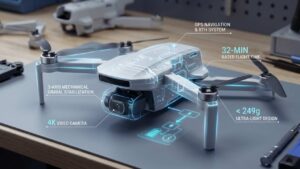
You do not have to spend a massive amount of money to get a highly capable GPS drone. The Potensic Atom 2 is proof that competition in the entry-level market seriously benefits the consumer. It comes in at a significantly lower price point than premium competitors but still delivers excellent performance. This model shoots smooth 4K video stabilized by a proper 3-axis mechanical gimbal, ensuring your footage looks professional and free of ugly jitters.
It weighs just under 249 grams, avoiding standard registration hurdles, and offers an impressive 32 minutes of rated flight time. While it lacks the advanced 360-degree obstacle avoidance found on pricier DJI models, its precise GPS hovering and highly reliable return-to-home function make it remarkably stable and safe for new pilots learning the ropes.
4. DJI Avata 2: The Best FPV Experience for Beginners
First-person view flying puts you directly in the cockpit. You wear a specialized video headset that streams live footage from the drone’s nose camera directly to your eyes. Historically, this type of flying was notoriously difficult to learn and prone to expensive crashes, but the DJI Avata 2 completely changes the rules. Designed as a cinewhoop, the Avata 2 features tough, built-in propeller guards that allow it to safely bounce off minor obstacles instead of tumbling out of the sky.
It pairs with an intuitive motion controller that lets you steer the aircraft simply by tilting your wrist, mimicking the way you point a laser pointer. If you ever feel disoriented or lose control, a dedicated panic button stops the drone immediately, leaving it hovering safely in place. It is hands down the most accessible way to experience the intense thrill of acrobatic flying.
5. Autel Evo Nano+: The Best Non-DJI Mini Drone
If you prefer a strong alternative to the dominant DJI ecosystem, the Autel Evo Nano+ is a spectacular piece of hardware. This folding micro-drone stands out primarily due to its exceptional camera sensor technology and unique color options. It utilizes an advanced RYYB color array design that pulls in massive amounts of light, making it arguably the best sub-250g drone for shooting during golden hour, at dusk, or in challenging low-light conditions.
Like our other top picks, it weighs less than 250 grams to skip registration. It also includes forward, backward, and downward obstacle avoidance sensors, providing excellent crash protection. The bright orange color option makes it incredibly easy to spot against a blue or overcast sky, helping beginners maintain visual line of sight at long distances.
6. BetaFPV Cetus X: The Best Starter FPV Bundle
If you want to dive into the raw, unassisted world of manual first-person view flying without risking hundreds of dollars, the BetaFPV Cetus X kit is the perfect training ground. It gives you everything you need in one box. This bundle includes the micro-drone, a radio transmitter, and video goggles for a very affordable price. The drone itself is tiny, lightweight, and robust, specifically designed to take a beating as you learn the tricky mechanics of full manual flight control.
It features an optical flow sensor that can help it hover when you need a quick break, but its true purpose is to teach you how to fly acrobatically before you graduate to larger, faster racing models. Just be aware that flight times are short, typically around five minutes per battery, which is completely standard for this specific class of aircraft.
7. Potensic A20 Mini: The Best Cheap Toy Drone for Kids
Sometimes you just want a cheap, fun toy to fly around the living room on a rainy afternoon. The Potensic A20 Mini fits the bill perfectly for young kids or anyone wanting a casual distraction without any serious commitment. It does not have a camera, GPS tracking, or advanced autonomous modes. Instead, it offers pure, simple joy at a rock-bottom price.
It features a reliable altitude hold function, meaning it stays at a steady height when you let go of the control sticks. This eliminates the most frustrating part of learning to fly cheap toy quadcopters. Full propeller guards prevent damage to your walls and furniture, and it comes with extra batteries to keep the fun going. It is the ideal stocking stuffer for younger aspiring pilots.
8. DJI Air 3S: The Best Premium Entry-Level Drone
If your primary goal is capturing professional-level photography and you do not mind carrying a slightly larger drone, the DJI Air 3S is an absolute powerhouse. It is larger and heavier than the mini drones, meaning it handles strong coastal winds significantly better. The main draw here is the incredible dual-camera system. You get a massive 1-inch sensor wide-angle lens and a medium telephoto lens, giving you incredible creative flexibility to compress backgrounds and shoot different perspectives without flying closer.
It features the most advanced omnidirectional obstacle avoidance available, including front-facing LiDAR for seeing thin branches even in low light. It boasts an incredible 45-minute battery life. While it requires formal registration due to its 724-gram weight and represents a larger financial investment, it is a flagship drone you will not outgrow for many years.
How to Choose Your First Drone: A Buyer’s Guide
Navigating the specifications of modern drones can get confusing fast. If you are comparing models on your own, you must look closely at how the physical hardware interacts with regional aviation laws. A drone that seems perfect on paper might require an expensive commercial permit depending on how you intend to use it. Additionally, understanding the difference between digital imagery stabilization and a physical motorized gimbal can save you from buying a machine that produces unwatchable, shaky video.
You also need to look at transmission technology, as cheaper drones use basic Wi-Fi that cuts out at short distances, while premium models use proprietary radio signals that remain crystal clear for miles. Below is a comprehensive guide to analyzing these factors before spending your hard-earned money.
|
Buying Factor |
Technical Metric |
Beginner Impact |
Real-World Consideration |
|
Weight Class |
Less than 249 grams |
No regulatory registration |
Easiest path to quick casual flying |
|
Stabilization |
Three-axis mechanical |
Completely smooth video |
Avoid electronic-only stabilization |
|
Signal Type |
Proprietary radio frequency |
Long range without dropouts |
Standard Wi-Fi signals drop quickly |
|
Power Supply |
Intelligent lithium polymer |
Automatic discharge safety |
Requires extra batteries for long days |
Weight and Registration Rules
The weight of your aircraft dictates your entire legal flying experience. Drones under 250 grams escape the vast majority of registry laws, making them the default choice for casual users. If you buy a heavier model, you must register it online and attach a unique tracking number to the chassis before your first takeoff.
Obstacle Avoidance Systems
Crash prevention hardware varies wildly across different price tiers. Entry-level models rely entirely on your eyes to avoid obstacles, while mid-tier options protect the front and back. If your budget allows, choosing a model with 360-degree vision ensures the drone will stop itself before colliding with hidden branches or power lines.
Flight Time and Battery Life
Advertised flight times are calculated in laboratory settings without wind resistance. In the real world, fighting against a light breeze drains the lithium batteries significantly faster than expected. You should always deduct five to six minutes from the manufacturer box specification to estimate your true safe flying window.
Camera Quality vs. Flying Experience
A larger camera sensor allows you to film crisp videos during sunset, but it adds weight and cost to the aircraft. If your goal is learning advanced aerobatics and racing maneuvers, you should sacrifice camera resolution in favor of a reinforced frame that can survive high-speed impacts.
Essential Drone Flying Tips for Absolute Beginners
Taking off for the first time requires preparation to ensure both your aircraft and the people around you remain perfectly safe. The most common mistake new pilots make is rushing into the air before the drone establishes a solid connection with global positioning satellites. Without this connection, the drone cannot automatically hover in place or return home if the controller loses power.
You must also learn to read changing weather conditions at higher altitudes, where wind speeds can double compared to what you feel on the ground. Developing a consistent pre-flight routine turns flying into a stress-free experience rather than a nerve-wracking gamble. Spending just five minutes checking your equipment before launch prevents expensive hardware failures in mid-air.
|
Pre-Flight Checklist Item |
Operational Action |
Safety Purpose |
|
Satellites |
Confirm minimum twelve GPS connections |
Ensures accurate automated return home |
|
Propellers |
Inspect plastic blades for micro-cracks |
Prevents catastrophic structural failure |
|
Software |
Update flight maps and firmware |
Avoids unexpected mid-air app crashes |
|
Environment |
Scout area for overhead power lines |
Identifies structural flight hazards |
Understanding Airspace and Restrictions
Before launching, you must consult local aviation maps via smartphone applications to verify that your chosen flight area is entirely legal. Heavy fines apply if you accidentally fly into restricted areas like municipal airports, state parks, or military test grounds.
The First Flight Checklist
Always verify that your propeller blades are securely fastened and free of hairline fractures before turning on the motors. Once airborne, keep the aircraft at eye level for the first sixty seconds to ensure it is responding correctly to your control inputs.
Weather and Wind Resistance
Never fly your quadcopter during active rainstorms or when fog limits your visibility. High humidity can short-circuit the electronic speed controllers inside the motor arms, causing the drone to drop instantly from the sky without warning.
Final Thoughts
The current market for the best drones for beginners offers unprecedented quality, safety, and ease of use. You no longer have to compromise between an affordable price and reliable performance. If you want a flawless all-rounder that will capture breathtaking high-resolution footage while actively keeping you safe from crashes, the DJI Mini 4 Pro is totally unmatched.
For those who prioritize a tight budget without sacrificing vital GPS stability, the Potensic Atom 2 is a brilliant alternative. Finally, if you want the absolute simplest way to capture yourself on video without learning dual-stick controls, the palm-sized DJI Neo feels like pure magic. Whichever path you choose, getting stunning video from the sky has never been more accessible.
Frequently Asked Questions (FAQs) About Best Drones Beginners 2026
Understanding the legal and practical limits of your new gadget helps you avoid legal trouble and hardware damage. Here are the answers to the most common questions new pilots ask.
Do I need a license to fly a drone as a beginner?
If you are flying a drone that weighs less than 250 grams strictly for recreational enjoyment, you generally do not need a commercial pilot license. However, many regions now require recreational flyers to pass a free, simple online safety test before taking off. If you plan to use your footage to make money on video platforms or use it for real estate marketing, you must obtain a professional remote pilot certificate regardless of how small your drone is.
What happens if I crash my drone?
Minor accidents into soft grass usually only result in chipped or bent plastic propeller blades. These can be quickly unscrewed and replaced using the spare parts included in the box. For severe impacts that shatter the camera or snap the structural frame, you will need to utilize manufacturer replacement programs like DJI Care Refresh, which provide a brand-new replacement drone for a small deductible fee.
Are cheap drones worth it for learning?
Toy quadcopters that cost under fifty dollars lack automated hovering sensors and global positioning systems. This means they require non-stop controller input just to stay in one place, making them incredibly difficult and frustrating for a beginner to control. Investing slightly more into a proper starter drone with automated stability ensures a smooth, stress-free learning curve that protects your financial investment.
How do I recover a lost drone?
If your drone goes down out of sight, do not panic or turn off your remote controller. Open the flight log menu inside your smartphone application to pinpoint the exact last known GPS coordinates of the aircraft on a satellite map. Most modern flight software also includes a find my drone tool that commands the downed aircraft to beep loudly and flash its LED lights so you can spot it in thick brush.
Can I fly my drone over private property?
While civil airspace is technically public property, hovering your camera drone directly over a neighbor’s backyard or close to residential windows violates localized privacy and harassment statutes. As a general rule of safety and courtesy, always keep your drone moving when passing over residential areas and maintain an altitude high enough that your aircraft does not create a noise disturbance for people on the ground.