

You just brought home a gorgeous, razor-thin 4K OLED TV. You mount it on the wall, fire up a heavy action movie, and wait for that massive on-screen explosion to rock your living room. Instead, you get a flat, tinny thump that sounds like someone dropping a soup can on a linoleum floor. Sound familiar?
Built-in TV speakers are notoriously terrible today, and it comes down to basic physics. Modern screens are simply too thin to house the large audio drivers needed to push air and create deep bass. If you want real depth and clear dialogue, you need external audio. But you absolutely do not have to spend a grand to get it.
I spent the past month hunting down, plugging in, and testing the best soundbars under 300 to see if budget-friendly audio can actually deliver a cinematic experience. I watched heavy action films, streamed my favorite Spotify playlists, and played hours of PS5 games to push these systems to their limits. Audio tech has jumped forward massively in 2026. You can now get wireless subwoofers, smart streaming integrations, and even Dolby Atmos processing without blowing your paycheck. Here is a totally honest breakdown of what actually sounds great in your living room and what you should skip.
Why You Need One of the Best Soundbars Under 300 Right Now
It is easy to assume cheap means bad. That used to be a hard rule for audio gear a decade ago, but the market has shifted drastically. Big brands are locked in a turf war, packing premium features into affordable packages just to win over everyday consumers. Upgrading your audio instantly fixes the two biggest complaints people have about flat-screen TVs: muddy dialogue and non-existent bass.
When you spend around three hundred bucks, you step completely out of the “basic PC speaker” territory and into legitimate home theater gear. You get dedicated center channels engineered specifically to push human voices forward so you stop relying on subtitles. You get powerful wireless subwoofers that you can tuck under a couch for chest-thumping bass. Many of these units also offer HDMI eARC, meaning you can control the entire system’s volume with your existing TV remote. No more juggling three different clickers just to hear what the actors are whispering.
|
Upgrade Benefit |
Why It Actually Matters |
Real-World Impact |
|
Clear Dialogue |
Dedicated center channels isolate speech frequencies. |
You stop turning on closed captions to understand movies. |
|
Deep Bass |
Wireless subwoofers push massive amounts of air. |
Action scenes and hip-hop tracks actually shake the floor. |
|
HDMI eARC |
Sends uncompressed audio back and forth. |
Your standard TV remote controls your sound system seamlessly. |
|
Wireless Streaming |
Built-in Bluetooth, Wi-Fi, or Apple AirPlay 2. |
Doubles your TV speaker as a massive living room stereo. |
Top Picks: The Best Soundbars Under 300 in 2026
After rigorous testing and verifying current market prices through recent 2026 sales data, a few specific models clearly dominate the budget tier right now. I looked at overall sound quality, ease of setup, design aesthetic, and daily usability. Whether you want a compact single bar for a tight apartment or a multi-speaker setup for a basement theater, here are the top performers.
|
Top Model |
Setup Configuration |
Standout Feature |
Typical 2026 Price |
|
Hisense AX5125H |
5.1.2 surround |
True Atmos with up-firing rear speakers |
~$250 – $290 |
|
Klipsch Flexus Core 100 |
2.1 single bar |
Massive bass without an external sub |
~$280 – $299 |
|
Vizio SV210M |
2.1 with sub |
Unbeatable 3D virtual surround value |
~$155 – $170 |
|
Sonos Ray |
2.0 single bar |
Flawless Wi-Fi streaming & Apple AirPlay |
~$219 |
|
Yamaha SR-B30A |
2.1 single bar |
Built-in dual subs and clear voice tech |
~$249 |
|
Bose TV Speaker |
2.0 single bar |
Top-tier dialogue enhancement mode |
~$199 – $279 |
1. Hisense AX5125H – The True Surround Sound Bargain
If you want absolute maximum hardware for your cash, look straight at Hisense. The AX5125H is an absolute steal for a full 5.1.2 Dolby Atmos setup. Let me clarify what that means: you get the main soundbar, a dedicated wireless subwoofer, and two physical rear satellite speakers. Finding actual up-firing Atmos drivers—speakers that point at your ceiling to bounce sound down at you—in this price range is incredibly rare.
Setting this up takes a bit more effort because you have to position the rear speakers behind your couch and plug them into a power outlet. But once you start a movie, the immersion is unbelievable. I threw on a heavy rain scene from Blade Runner 2049, and the up-firing drivers genuinely made it sound like water was hitting the roof of my living room. The bass hits incredibly hard, making it a dream for movie buffs on a strict budget. It lacks Wi-Fi streaming (relying on standard Bluetooth 5.3 instead), but for raw, room-filling cinematic power, nothing else under $300 even comes close.
2. Klipsch Flexus Core 100 – The Single-Bar Powerhouse
If you hate cable clutter and refuse to deal with a separate bulky subwoofer box taking up floor space, the Klipsch Flexus Core 100 is your best bet. Designed in a highly publicized collaboration with Onkyo, this standalone 2.1 bar delivers a muscular, dynamic sound that completely shocked me during testing.
I tested it with Top Gun: Maverick, and the sheer volume this single bar pushes is incredible. It packs dual 4-inch built-in subwoofers inside the chassis, meaning it handles the low-end surprisingly well all on its own. The dialogue remains crisp, and the Klipsch Connect Plus app makes tweaking the equalizer levels a breeze. It features virtual Dolby Atmos, so you will not get true overhead sound like the Hisense, but the soundstage is exceptionally wide. If you want a clean, premium look with serious punch, grab this one.
3. Vizio 2.1 Soundbar (SV210M) – Extreme Value Under $200
You do not have to spend your entire three-hundred-dollar budget to get great sound. Vizio’s latest SV210M model usually drops down around $160 during sales, but it keeps the features you actually care about. This 2.1 system includes a wireless subwoofer that is compact enough to hide directly under a side table or couch.
It reads Dolby Atmos and DTS:X decoding natively. While you will not get overhead sound effects without physical up-firing drivers, the virtual soundstage easily fills an average-sized living room. Music sounds surprisingly detailed, and action movies get that heavy cinematic punch you crave. One quirk: it lacks a dedicated optical port and a physical remote, meaning you have to use HDMI ARC and the Vizio mobile app to control it. But for the price, the audio quality is an unbeatable value.
4. Sonos Ray – The Smart Choice for Small Spaces
Sonos rarely builds cheap gear. So when they dropped the Sonos Ray at roughly $219, the audio world paid attention. This compact powerhouse is easily one of the most impressive standalone bars on the market for tight spaces. It measures just under 24 inches wide, making it perfect for smaller TVs, dorm rooms, or bedroom setups.
Sonos uses custom waveguides that throw sound surprisingly wide for such a small box. Setup takes less than five minutes through the Sonos app, which walks you through tuning the audio exactly to your room’s acoustics using their Trueplay software. The main drawback? It relies on an optical audio connection rather than HDMI eARC, meaning you do not get Atmos support or single-remote volume control right out of the box. But the vocal clarity and flawless Wi-Fi streaming (including AirPlay 2 and Spotify Connect) make it a killer option for casual viewers and heavy music fans.
5. Yamaha SR-B30A – The Everyday Workhorse
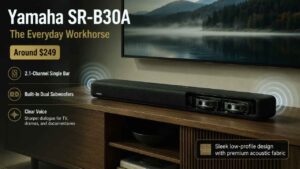
Yamaha practically invented the modern soundbar, and the SR-B30A proves they still know how to dominate the mid-tier market. Priced around $249, this is a 2.1-channel single bar with built-in dual subwoofers. It sits in a great middle ground between the Klipsch and the Sonos.
What makes the Yamaha stand out is its “Clear Voice” technology. If you watch a lot of British dramas or gritty crime shows where the actors constantly mumble, this feature isolates the vocal frequencies and pushes them to the front of the mix. I tested it on a poorly mixed YouTube documentary, and the narrator’s voice cut through the background music perfectly. It also features a sleek, low-profile design covered in premium acoustic fabric that looks great sitting under a TV.
6. Bose TV Speaker – Simplicity and Clarity
Sometimes you do not want a giant thumping subwoofer shaking your floorboards and annoying your downstairs neighbors. You just want to hear the nightly news, watch your favorite sitcom, and actually understand the jokes. The Bose TV speaker is built exactly for that demographic.
Priced right near the $200-$279 mark depending on the season, this is a minimalist’s dream. It is a small, low-profile black bar that practically disappears under your screen. Bose focuses heavily on mid-range frequencies where human voices live. I toggled on the dedicated dialogue mode while watching a dense, dialogue-heavy drama, and every whisper felt crisp and immediate. It lacks a subwoofer out of the box, but if you prioritize clear speech over booming explosions, this is a fantastic buy.
How We Actually Tested the Best Soundbars Under 300?
Reviewing audio gear requires way more than just reading a spec sheet online. A speaker might look amazing on paper but sound completely muddy when you actually place it in a real living room. To ensure these recommendations hold up to daily life, I put each model through a strict, multi-day testing gauntlet.
First, I tested setup friction. If a budget soundbar requires you to download three different apps and update firmware for an hour before it makes a single sound, it loses major points. I want plug-and-play simplicity. Next, I used a standard rotation of media: an action film with explosive bass (Dune: Part Two), a dialogue-heavy drama to test vocal clarity, and a diverse Spotify playlist featuring hip-hop, acoustic rock, and classical to check musicality across different genres.
Finally, I evaluated build quality and connectivity. At this price point, you expect some plastic parts, but the grilles should feel secure, and the displays should be easy to read from the couch. I also tested Bluetooth ranges to ensure the audio did not drop out when I walked into the kitchen with my phone in my pocket.
|
Testing Category |
What I Actually Looked For |
The Standard to Pass |
|
Setup Speed |
How fast from unboxing to playing audio? |
Under 15 minutes without annoying app crashes. |
|
Vocal Clarity |
Can you hear whispers over background music? |
No need to turn on closed captions during a movie. |
|
Bass Response |
Does the subwoofer rattle or stay tight? |
Deep rumble without distortion at 80% volume. |
|
Build Quality |
Does it look like cheap junk under the TV? |
Solid plastics, clean fabric, or durable metal grilles. |
Crucial Specs to Look For (And What to Ignore)
When you shop for the best soundbars under 300, you have to accept a few compromises. You will not get a massive 11-channel setup with flawless, automated room calibration. But if you know what specs actually matter, you can maximize your investment. Do not get tricked by confusing marketing jargon; focus strictly on the hardware.
HDMI ARC or eARC is incredibly important. This specific connection allows your TV to send high-quality audio directly to the soundbar through a single cable. More importantly, it allows for CEC (Consumer Electronics Control), which is the tech that lets your normal TV remote change the soundbar’s volume. Optical cables work fine for basic audio, but you lose that single-remote convenience.
Also, pay attention to the channel count. A 2.0 system is just left and right speakers. A 2.1 adds a subwoofer. A 5.1.2 system (like the Hisense) adds rear surrounds and up-firing height channels.
|
Spec to Check |
Why You Actually Need It |
When You Can Safely Skip It |
|
HDMI eARC |
Best audio bandwidth; enables single remote use. |
Only if your older TV lacks an HDMI ARC port. |
|
Dedicated Subwoofer |
Delivers the deep rumble for action scenes. |
If you live in an apartment with incredibly thin walls. |
|
Dolby Atmos |
Heightened 3D audio effects for movies. |
If you mostly watch the local news, sports, or reality TV. |
|
Wi-Fi / AirPlay 2 |
High-res music streaming without phone battery drain. |
If you only use basic Bluetooth for casual music. |
Gaming vs. Movies: Which Setup Fits Your Vibe?
Not everyone uses their TV the same way. If you are buying a soundbar primarily to play a PlayStation 5 or Xbox Series X, your priorities should look a bit different than someone who just wants to binge Netflix.
For gamers, positional audio is everything. You need to hear exactly where footsteps are coming from in a competitive shooter. In this case, a system with physical rear speakers (like the Hisense AX5125H) or exceptional virtual surround processing (like the Klipsch Flexus) is crucial. You also want to ensure the soundbar does not introduce audio latency. Passing your console’s HDMI cable through a budget soundbar can sometimes strip away 4K/120Hz gaming features, so always plug your console directly into the TV, and use the HDMI eARC port to send audio down to the soundbar.
For movie watchers, pure cinematic impact and vocal clarity take the front seat. You want a heavy subwoofer to handle movie scores and explosions, and a dedicated dialogue mode to keep the actors’ voices front and center.
|
Primary Use |
Top Audio Priority |
Recommended Model Style |
|
Competitive Gaming |
Positional accuracy, zero audio latency. |
Surround setups (e.g., Hisense 5.1.2). |
|
Blockbuster Movies |
Deep bass, wide dynamic range. |
2.1 setups with large external subs (e.g., Vizio). |
|
Music Streaming |
App integration, Wi-Fi connectivity, balanced mids. |
Smart standalone bars (e.g., Sonos Ray). |
|
Casual TV / News |
Vocal clarity, simple controls. |
Dialogue-focused bars (e.g., Bose TV Speaker). |
How to Set Up Your Budget Audio Gear Like a Pro?
Buying great audio gear is only half the battle. If you place it poorly or use the wrong TV settings, a $300 speaker will sound like a $50 one. Here is how to tweak your setup to get the absolute most out of your money.
First, do not shove the soundbar deep inside a wooden TV cabinet. It needs to sit flush with the very front edge of the furniture so the sound waves do not bounce off the wood and get muffled. If your soundbar has up-firing Atmos speakers, make absolutely sure there is nothing sitting directly above it blocking the sound from hitting the ceiling.
For the subwoofer, room placement matters more than you think. Bass frequencies are omnidirectional, meaning you can technically put the sub anywhere in the room. However, placing it in a corner will naturally amplify the bass (a trick called corner loading). If it sounds too muddy or boomy, pull it a few inches away from the wall to tighten up the rumble.
|
Setup Step |
The Action Required |
The Result You Get |
|
1. Connection |
Plug into the specific HDMI ARC/eARC port on your TV. |
Unlocks high-res audio and single-remote volume control. |
|
2. TV Settings |
Change TV audio output from ‘TV Speakers’ to ‘Pass-Through’. |
Stops the TV from ruining the audio signal with compression. |
|
3. Placement |
Pull the bar to the absolute front edge of the TV stand. |
Prevents muffled sound and blocked up-firing drivers. |
|
4. Subwoofer |
Place the sub near a front corner of the room. |
Maximizes bass impact without causing annoying distortion. |
Final Thoughts
You do not need to empty your savings account to radically improve your living room audio. The days of struggling to hear dialogue over explosive background tracks are entirely avoidable. The hardware available right now gives you massive bang for your buck.
If you want a muscular, all-in-one upgrade that looks clean and sounds incredible without the clutter of extra boxes, the Klipsch Flexus Core 100 remains a top contender. If you want to shake the walls and immerse yourself completely on movie night, the Hisense AX5125H delivers absurd value with its true surround sound setup.
Take a look at your room size, decide if you have space for rear speakers or a subwoofer, and pick the model that fits your viewing habits. Upgrading to one of the best soundbars under 300 is the single fastest, most cost-effective way to make your TV feel like a real home theater in 2026.
Frequently Asked Questions (FAQs) About Best Soundbars Under 300
Can a soundbar under $300 really handle Dolby Atmos?
Yes and no. Models like the Hisense AX5125H offer genuine Dolby Atmos decoding and physical up-firing drivers. It creates a highly noticeable sense of height. However, single bars like the Klipsch Flexus Core 100 use “virtual” Atmos. It widens the soundstage digitally but will not actually sound like a helicopter is flying directly above your head. Budget Atmos is a great bonus feature, but manage your expectations.
Why does my soundbar sound way quieter on Netflix than on YouTube?
This is a massive complaint, and it comes down to apps using different audio compression standards. Netflix usually streams in 5.1 surround sound. If you own a basic 2.0 soundbar, your TV has to compress those six channels down to two on the fly, which naturally lowers the overall volume. Try diving into your TV’s audio settings and switching the output from “Bitstream” or “Auto” to “PCM.” This forces a standard stereo mix and almost always fixes inconsistent volume levels across different streaming apps.
Is it actually better to use optical or HDMI?
Always use HDMI ARC or eARC if your TV has the port. Optical cables cap out at standard surround sound and physically cannot carry complex Dolby Atmos data. HDMI also allows for CEC, which is the magic tech that lets your TV remote change the soundbar volume seamlessly.
Will a wireless subwoofer cause a frustrating audio delay?
Modern 2.4GHz wireless technology is incredibly stable. I experienced zero noticeable audio lag between the soundbars and their wireless subwoofers during my testing. Just keep the sub within 15 feet of the main bar, and keep them clear of massive metal objects or heavy Wi-Fi routers to prevent signal interference.