
Long narrow hallways can feel a bit tricky. You walk through them every day, but they rarely feel warm or inviting. Most of the time, they’re just a pass-through space with a single light and empty walls.
But here’s the thing. They don’t have to stay that way.
With the right narrow hallway decorating ideas, you can completely shift the mood of the space. It doesn’t take a big renovation either. Small, smart changes do most of the work.
Think better lighting, a well-placed mirror, a simple runner, and a few calm design choices. That’s really it.
Let’s break it down step by step.
Why Narrow Hallways Feel Hard to Work With
Hallways are not like normal rooms. You don’t live in them. You move through them. That alone changes how they should be designed.
Most narrow hallways suffer from the same issues. They feel dark, tight, or just a bit forgotten. And honestly, that usually comes down to three things: poor lighting, wrong scale, and too much or too little decor.
A standard hallway is often only about 36 to 42 inches wide. That doesn’t leave much room for error. Even small decor choices can feel big in a tight space.
- Limited walking space
- Poor natural lighting
- Long visual stretch
- No natural focal point
It’s not about adding more. It’s about choosing better.
Table: Common hallway issues and simple fixes
|
Problem |
What it feels like |
Simple fix |
|
Dark tunnel effect |
Tunnel effect |
Add layered lighting |
|
Visual clutter |
Too many items |
Reduce decor |
|
Flat design |
No depth |
Use mirrors or texture |
Before You Start Decorating
Before jumping into ideas, take a quick look at your space. It helps more than you think.
Measure the hallway. Notice where light comes from. Check how doors open. These small things decide what will actually work.
A narrow space doesn’t forgive mistakes. A rug that’s too wide or a shelf that sticks out too far can make it feel even tighter.
- Hallway width and length
- Natural light sources
- Wall space availability
- Door clearance
- Existing flooring and wall color
Table: Pre-decor planning guide
|
What to check |
Why it matters |
|
Width |
Keeps movement easy |
|
Light |
Avoids dark corners |
|
Walls |
Plans decor placement |
|
Floor space |
Prevents clutter |
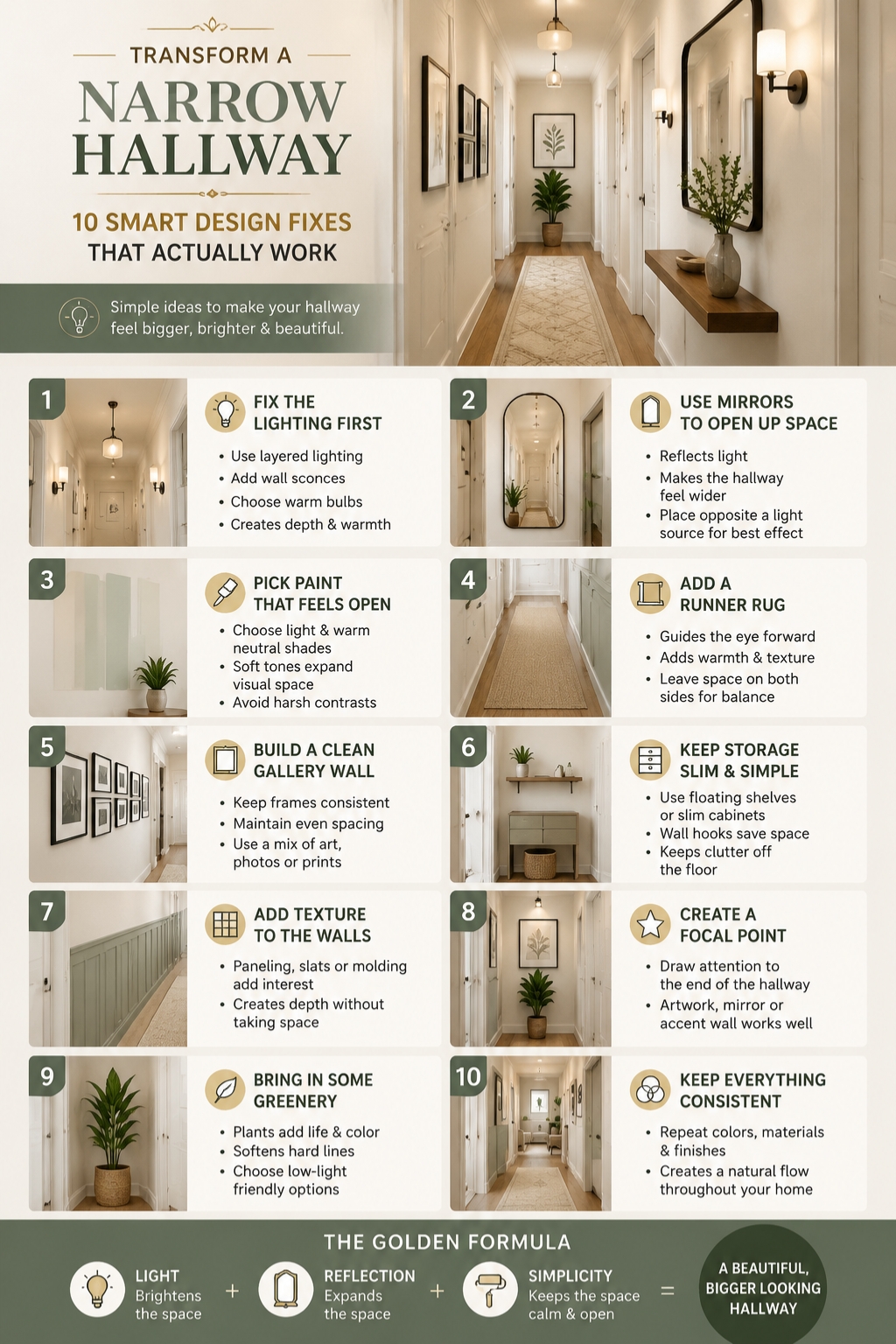
1. Fix the Lighting First
If there’s one thing that changes everything, it’s lighting.
Most hallways rely on a single ceiling bulb. It works, but barely. It flattens the space and creates shadows that make everything feel tighter.
A better approach is layering light. Think of it as spreading brightness instead of blasting it from one point.
- Ceiling lights for base brightness
- Wall lights for depth
- Warm bulbs for comfort
- Soft accent lighting for detail
Warm light (around 2700K to 3000K) usually feels more natural in homes. It softens edges and makes narrow spaces feel less harsh.
Table: Lighting comparison
|
Type |
Role |
Effect |
|
Ceiling light |
Main light |
Basic visibility |
|
Wall sconces |
Side glow |
Adds depth |
|
LED strips |
Accent light |
Modern touch |
|
Warm bulbs |
Mood |
Cozy feel |
2. Use Mirrors to Open Things Up
Mirrors are a simple trick, but they work every time.
They reflect light and space, which makes a narrow hallway feel wider than it really is. It’s not magic. It’s just reflection and perspective.
The trick is placement. A mirror across from light works best. If you place it poorly, it can reflect clutter or exaggerate length in a weird way.
- Near entry points
- Above a slim console
- Opposite a window or light source
- On a feature wall
Read Also: How to Fix a Hole in the Wall: 5 Sizes Covered
Table: Mirror styles
|
Type |
Best use |
Effect |
|
Round mirror |
Soft look |
Breaks lines |
|
Tall mirror |
Tight spaces |
Adds height |
|
Large mirror |
Main walls |
Expands space |
|
Cluster mirror |
Decor wall |
Visual interest |
3. Pick Paint That Feels Open
Paint can completely change how a hallway feels.
Pure white sounds safe, but it can sometimes feel cold under artificial light. Softer tones usually work better.
Warm neutrals, light greys, and muted greens help the space breathe a little more.
Dark colors can work too, but only if the lighting is strong and balanced.
- Warm white
- Soft beige
- Light grey
- Pale sage
- Muted blue
Table: Color impact
|
Color type |
Feel |
Best use |
|
Light tones |
Open |
Small hallways |
|
Warm neutrals |
Cozy |
Most homes |
|
Soft greens/blues |
Fresh |
Modern spaces |
|
Dark tones |
Bold |
Large lit halls |
4. Add a Runner Rug
A runner does more than cover the floor. It guides your eyes forward.
That simple direction makes a hallway feel longer but more organized at the same time.
The key is balance. Don’t let the rug touch both walls. Leave breathing space on each side.
- Low pile for easy cleaning
- Non-slip backing for safety
- Simple or soft patterns
- Proper length alignment
Table: Runner rug types
|
Style |
Best for |
Why it works |
|
Striped |
Modern homes |
Direction flow |
|
Vintage |
Cozy spaces |
Warm feel |
|
Neutral |
Minimal look |
Clean finish |
|
Patterned |
Busy homes |
Hides dirt |
5. Build a Clean Gallery Wall
Hallway walls are long and blank. A gallery wall helps break that stretch.
But here’s where people go wrong: too many frames, too much variety, no structure.
Keep it simple. Repeat frame styles. Keep spacing even. Let it breathe.
- Straight line of frames
- Grid-style arrangement
- Mixed but balanced layout
- One large anchor piece
Table: Gallery styles
|
Style |
Mood |
Best use |
|
Linear |
Clean |
Modern homes |
|
Grid |
Structured |
Neat spaces |
|
Mixed |
Personal |
Family hallways |
6. Keep Storage Slim and Simple
Hallways are not storage rooms. They just need a little support.
Think slim, wall-mounted, and hidden where possible.
- Floating shelves
- Slim shoe cabinets
- Wall hooks
- Small wall ledges
Table: Storage options
|
Type |
Space used |
Purpose |
|
Shelves |
Very low |
Decor |
|
Cabinets |
Low |
Shoes, bags |
|
Hooks |
Minimal |
Daily items |
7. Add Texture to the Walls
Flat walls can make long hallways feel endless.
Adding texture breaks that visual stretch. It gives the eye something to follow.
- Board and batten
- Simple wall molding
- Vertical slats
- Half-wall panels
Table: Wall texture effects
|
Style |
Feel |
Best fit |
|
Paneling |
Classic |
Traditional homes |
|
Slats |
Modern |
Clean interiors |
8. Create a Focal Point
Every long hallway needs a stop point for the eye.
Without it, the space just keeps going.
A focal point can be simple. One strong piece is enough.
- Large artwork
- Statement mirror
- Indoor plant
- Accent wall
Table: Focal points
|
Element |
Impact |
Space needed |
|
Art |
Strong focus |
Low |
|
Mirror |
Depth |
Low |
|
Plant |
Soft touch |
Medium |
9. Bring in Some Greenery
Plants make a hallway feel less rigid.
But not every hallway gets enough light, so choose carefully.
- Snake plant
- Pothos
- Dried branches
- Faux greenery
Table: Plant guide
|
Type |
Light need |
Care level |
|
Snake plant |
Low |
Easy |
|
Pothos |
Medium |
Medium |
|
Faux plants |
None |
None |
10. Keep Everything Consistent
This is where most people miss the mark.
A hallway connects your home. It shouldn’t feel random.
Repeat colors, finishes, and materials from nearby rooms. That’s what creates flow.
- Wall colors
- Frame styles
- Metal finishes
- Wood tones
Table: Consistency guide
|
Element |
Match with |
|
Color |
Adjacent rooms |
|
Metal |
Light fixtures |
|
Wood |
Flooring |
Final Thoughts
A narrow hallway doesn’t need a big makeover. It just needs thoughtful choices.
The best narrow hallway decorating ideas focus on light, flow, and simplicity. When you get those right, the space naturally feels bigger and calmer.
Start small. Fix the lighting. Add one mirror or runner. Then build from there.
That’s usually enough.
FAQs
Why does my hallway feel so narrow?
Usually because of poor lighting, cluttered walls, or no visual direction.
Do mirrors really help small hallways?
Yes. They reflect light and create a sense of space when placed correctly.
What’s the safest rug choice?
Low-pile runners with a non-slip base work best.
Can dark colors work in hallways?
Yes, but only if lighting is strong and balanced.
What’s the biggest design mistake?
Trying to add too much instead of keeping things simple.