
The technology making this possible is the brain-computer interface (BCI). At its core, a BCI strips away the need for buttons, keyboards, and touchscreens, creating a direct digital highway between human gray matter and external machines.
If you want to look past the dense academic jargon and the sensationalized sci-fi headlines, you are in the right place. This guide covers exactly how brain-computer interfaces work in plain English, breaking down the mechanics, the real-world applications, and the massive hurdles scientists are working to overcome.
Why This Topic Matters
We are living through a massive shift in how humans interact with technology. For decades, computers required physical input—a click, a tap, or a spoken command. BCIs bypass the physical body entirely, which is an absolute game-changer for accessibility and human capability.
For someone living with severe paralysis or conditions like ALS, this technology represents a return to independence. But the implications stretch far beyond medicine. As these systems become faster, smaller, and more accurate, they will fundamentally change everything from virtual reality to how we protect our personal data. Understanding this tech today gives you a window into how we will interact with the digital world tomorrow.
Comprehensive Overview: The Architecture of a BCI
Before diving into the specific steps, let us look at the big picture. Every BCI system relies on a loop of four basic stages: signal acquisition, preprocessing, feature extraction, and device command generation.
|
Phase |
Core Objective |
Example Tech Used |
|
1. Acquisition |
Recording raw electrical activity from the brain. |
EEG caps, implanted microelectrode arrays. |
|
2. Preprocessing |
Cleaning up the raw data and removing unwanted noise. |
High-pass and low-pass digital filters. |
|
3. Extraction |
Identifying specific patterns or mathematical features in the signals. |
Machine learning models, neural networks. |
|
4. Execution |
Turning those translated patterns into digital actions. |
Robotic limbs, computer cursors, speech synthesizers. |
Top 4 Core Stages of a Brain-Computer Interface
To truly grasp how brain-computer interfaces work in plain English, it helps to trace a single thought as it travels from a cluster of firing neurons out into the digital world. Here is exactly how that process plays out across the four primary stages.
Item #1: Signal Acquisition (Catching the Brain Waves)
Your brain is incredibly noisy. Every time you think, move, or feel, billions of neurons fire off tiny electrical pulses. Signal acquisition is all about capturing those weak electrical currents so a computer can read them.
Engineers use different tools depending on how clear the signal needs to be. Non-invasive tools, like an Electroencephalography (EEG) cap, sit on top of your scalp to listen to the collective hum of millions of neurons through skin and bone. Invasive tools, like Neuralink’s N1 chip or Blackrock’s NeuroPort array, are surgically placed directly into or on the brain tissue to record individual neurons with crystal clarity.
|
Metric |
Non-Invasive (Scalp Caps) |
Invasive (Brain Implants) |
|
Surgical Risk |
None (Completely safe) |
High (Requires neurosurgery) |
|
Signal Quality |
Blurry, muffled by the skull |
Sharp, highly detailed |
|
Primary Use |
Gaming, focus tracking, basic research |
Advanced medical rehabilitation |
Item #2: Signal Preprocessing (Filtering the Noise)
The brain waves collected during the acquisition phase are incredibly messy. The sensors do not just pick up your thoughts; they also grab electrical interference from blinking eyes, swallowing, jaw clenching, and nearby electronic devices.
Preprocessing acts as a digital strainer. Using specialized software filters, the BCI strips away the garbage frequencies—like the muscle static from an eye blink—and isolates the specific brain wave frequencies that actually matter for the task at hand.
|
Filter Type |
What It Keeps |
What It Discards |
|
High-Pass Filter |
Fast, deliberate neural shifts |
Slow drifts caused by sweating or movement |
|
Low-Pass Filter |
Rhythmic brain waves (Alpha, Beta) |
High-frequency electrical hum from wall outlets |
|
Notch Filter |
Clean physiological data |
Specific grid interference (e.g., 50Hz or 60Hz hum) |
Item #3: Feature Extraction (Translating the Intention)
Once the data is clean, the computer has to figure out what it actually means. If a user imagines moving their right hand, their brain displays a very specific rhythm change in the motor cortex.
Feature extraction utilizes advanced artificial intelligence and machine learning algorithms to scan the filtered data for these distinct signatures. The software strips away the irrelevant background brain activity and isolates the mathematical values that signal a clear, deliberate intent.
|
Technique |
How It Works |
Best Used For |
|
Frequency Analysis |
Measures changes in the power of specific brain rhythms. |
Identifying general states like focus or relaxation. |
|
Deep Learning |
Uses neural networks to automatically learn complex patterns. |
Complex, real-time control over multi-joint limbs. |
|
Time-Domain Tracking |
Looks for spikes at exact millisecond intervals after a prompt. |
Typing on virtual keyboards using visual flashes. |
Item #4: Device Configuration & Execution (Taking Digital Action)
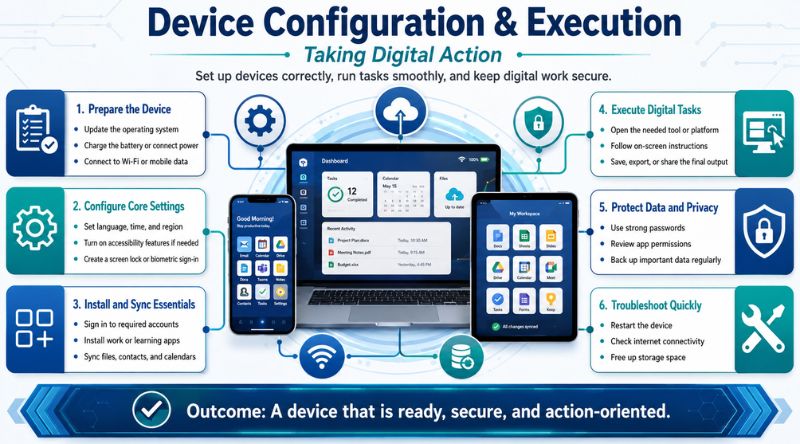
This final stage is where the magic happens. The extracted features are converted into code that external hardware or software can execute.
The machine learning model outputs a command like “move cursor up” or “close robotic hand.” The external device receives this command over a wireless or wired connection, completing the loop. The user sees the result of their thought in real time, allows their brain to adjust based on what they see, and fires off the next neural command.
|
Target Device |
Action Taken |
Real-World Impact |
|
Virtual Keyboard |
Selecting letters on a screen |
Restoring communication for locked-in patients |
|
Robotic Prosthetic |
Opening, closing, or rotating a mechanical limb |
Restoring independence to amputees |
|
Smart Home System |
Flipping digital switches or adjusting lights |
Allowing hands-free environmental control |
How Brain-Computer Interfaces Work: Plain English Breakdown of Types
To fully map out how brain-computer interfaces work in plain English, we have to look at the hardware choices that dictate where the sensors sit. The closer a sensor gets to a neuron, the better it listens—but the higher the surgical stakes become.
1. Non-Invasive Systems
These devices never breach the skin. They typically look like swimming caps lined with electrodes or sleek headbands worn across the forehead. They read the tiny electrical voltages that manage to pass through the skull. While they are incredibly safe, convenient, and cheap, the skull acts like a thick blanket, muffling the high-frequency details of the brain’s signals.
2. Partially Invasive Systems
These interfaces sit inside the skull but rest on top of the brain’s delicate surface rather than piercing the gray matter itself. A prime example is Electrocorticography (ECoG) or newer flexible mesh designs like Precision Neuroscience’s Layer 7 interface. They offer an excellent middle ground: superb signal quality with a much lower risk of causing tissue scarring or brain damage.
3. Fully Invasive Systems
These are the deep-dive chips. Surgeons place microelectrode arrays directly into the motor or visual cortex. Because the sensors are mere micrometers away from active neurons, they can capture the firing of single cells. This allows users to perform incredibly complex tasks, like controlling individual fingers on a robotic hand or translating internal monologues into digital text at conversational speeds.
Real-World Bottlenecks and Roadblocks
Despite the breathtaking speed of recent breakthroughs, widespread adoption still faces major engineering and biological hurdles:
- Biocompatibility: The human body hates foreign objects. Over time, the immune system treats hard silicon chips as intruders, building up scar tissue around the electrodes. This tissue acts as an insulator, eventually blocking the signals.
- The Calibration Grind: Your brain signals change slightly from day to day based on sleep, caffeine levels, and mood. Currently, many BCI users have to spend 10 to 15 minutes calibrating the software every single morning before the system works smoothly.
- Data Privacy (Neuroethics): If a device can decode what you intend to do before you do it, who owns that data? Protecting raw neural information from corporate monetization and malicious hacking is quickly becoming a critical legal frontier.
Conclusion
We have broken down how brain-computer interfaces work in plain English, stripping away the mystery behind this monumental leap in engineering. By capturing raw neural signals, scrubbing out background noise, translating intentions via machine learning, and mapping those patterns to machine code, BCIs allow thoughts to escape the physical body and alter the digital world directly.
We are moving quickly from an era where technology requires physical inputs to an era where intent is enough. Whether through consumer focus headbands or life-altering medical implants, the line between human thought and machine execution is permanently blurring.
Frequently Asked Questions
Can a BCI read my private thoughts against my will?
No. Current BCI systems cannot magically read your inner monologues, secrets, or memories. They only decode active, focused intentions—like the deliberate mental effort required to move a limb or focus on a flashing letter. If you are not actively trying to control the device, it cannot pull hidden data out of your head.
How long do invasive brain implants last before needing replacement?
Historically, rigid silicon implants would begin losing signal quality after 2 to 5 years due to scar tissue buildup. However, newer flexible, thread-like materials are designed to move naturally with brain tissue, aiming for lifespans that last a decade or longer without requiring revision surgery.
Can a BCI be used to write data back into the brain?
Yes, this is called a bidirectional BCI. While most consumer tech only reads signals, advanced medical implants can write small electrical pulses back into neural tissue. This is currently used to give patients tactile feedback through robotic hands, allowing them to “feel” how hard they are gripping an object.