

Many people think a beautiful room starts with a matching furniture set. Same bed, same nightstands, same dresser. Same sofa, same side tables, same coffee table. It feels safe. It also often feels flat.
The better-looking rooms usually have a more collected feel. A modern sofa sits beside a vintage table. A wood dresser works with an upholstered bed. A black metal lamp connects with a dark picture frame across the room. Nothing is random, but nothing looks copied from a showroom either.
That is the real trick behind learning how to mix and match furniture. You are not throwing different pieces together and hoping they behave. You are creating links between them through color, scale, shape, texture, material, and mood.
Design coverage in recent years has moved strongly toward lived-in, personal homes rather than perfectly staged rooms. Recent interior design reports highlight lived-in spaces, imperfection, time-worn pieces, and homes that feel built over years. Design experts also note that mismatched furniture helps a home feel more authentic and collected.
|
Article Snapshot |
Details |
|
Main goal |
Help readers mix furniture styles without making a room feel messy |
|
Best for |
Living rooms, bedrooms, dining rooms, apartments, family homes |
|
Core design idea |
Different pieces should share at least one visual connection |
|
Skill level |
Beginner-friendly |
|
Biggest mistake |
Mixing pieces without a color, scale, or style plan |
Why Matching Furniture Sets Can Make A Room Feel Flat
Matching furniture sets are convenient. They remove the guesswork, which is why stores still sell them. But a fully matched room can also lose personality fast. When every table, chair, dresser, and shelf has the same finish and shape, the room may feel more like a catalog than a real home.
Designers often prefer rooms that look collected over time. A collected room has contrast. It has one or two pieces that feel older, softer, bolder, or more handmade. That contrast gives the eye something to enjoy.
Design experts often point out that poor scale, small rugs, missing accessories, and over-reliance on matching choices can make a room feel unfinished or less personal. Many designers are also moving away from predictable builder-grade choices and toward pieces with more character and quality.
|
Matching Set Issue |
What Happens |
Better Choice |
|
Same finish everywhere |
Room feels one-note |
Add another wood, metal, or painted finish |
|
Same shape repeated |
Space feels stiff |
Mix straight, curved, slim, and chunky shapes |
|
No personal pieces |
Room feels generic |
Add vintage, handmade, or meaningful items |
|
Too much symmetry |
Room feels formal |
Keep some balance but add relaxed contrast |
The Problem With Buying Everything From One Collection
Buying everything from one collection can work in a hotel room, but it often feels too controlled at home. A bedroom set with a matching bed, two nightstands, dresser, mirror, and chest may be practical, but it rarely feels personal. The same problem happens in living rooms when the coffee table, side tables, TV unit, and shelves all come from the same line.
A better method is to choose one or two anchor pieces from a set and then bring in contrast. Keep the bed, but change the nightstands. Keep the sofa, but use a different coffee table. Keep the dining table, but add chairs with a different material or silhouette.
Why A Collected Look Feels More Expensive
A collected room usually looks more expensive because it feels edited. It suggests that each piece was chosen for a reason. That does not mean every item must be costly. A secondhand chair, a painted cabinet, or a family table can add more character than a brand-new matching set.
Recent furniture trend reports point to refinement with personality, traditional silhouettes, handcrafted details, and eclectic vignettes. That supports the broader move away from flat, overly matched spaces.
What Mixed But Cohesive Really Means
Mixed but cohesive means different pieces still talk to each other. They may share a color, finish, height, material, curve, or mood. A black metal side table can connect with black curtain rods. A warm wood chair can connect with a warm picture frame. A cream sofa can connect with a cream lampshade or rug.
The pieces do not need to match. They need to relate.
Choose One Main Design Direction First
Before you mix anything, choose the main direction of the room. This does not need to be complicated. You only need a basic answer to one question: What should this room feel like?
Maybe you want it to feel calm and modern. Maybe you want it warm and traditional. Maybe you prefer a relaxed coastal look, a cozy farmhouse feel, or a clean Scandinavian room. Once the main direction is clear, the rest becomes easier.
The safest formula is one main style plus one or two supporting styles. More than that can work, but it takes a sharper eye. For most homes, a simple mix creates the best result.
|
Main Style |
Supporting Style |
What It Creates |
|
Modern |
Vintage |
Clean but warm |
|
Traditional |
Contemporary |
Classic but fresh |
|
Scandinavian |
Industrial |
Simple but grounded |
|
Coastal |
Organic modern |
Light and relaxed |
|
Mid-century |
Boho |
Casual and playful |
|
Farmhouse |
Modern |
Cozy but not outdated |
Pick One Anchor Style
Your anchor style should cover the biggest pieces in the room. In a living room, that might be the sofa and rug. In a bedroom, it may be the bed and dresser. In a dining room, it could be the table and cabinet.
If your anchor style is modern, let the largest furniture pieces stay clean and simple. Then add warmth through a vintage chair, woven basket, textured rug, or wood side table. If your anchor style is traditional, keep the classic shapes but freshen the room with modern lighting or a simple coffee table.
Add Contrast In Smaller Pieces
The easiest way to avoid mistakes is to add contrast through smaller pieces first. Accent chairs, side tables, lamps, pillows, artwork, benches, and stools are safer than expensive sofas or dining tables.
This gives you room to experiment. If the contrast feels too strong, you can move the piece, repaint it, reupholster it, or replace it without ruining the whole room.
Read Also: How to Make a Small Bedroom Look Bigger: 12 Tricks
Avoid Too Many Strong Personalities
A room becomes tiring when every piece tries to be the main character. One bold chair is interesting. Five bold pieces in five different styles can feel chaotic.
Use this simple rule: let one or two pieces stand out, and let the rest support them. A statement sofa needs quieter chairs. A dramatic vintage cabinet needs simpler tables. A patterned rug needs calmer upholstery.
Use Color To Mix And Match Furniture Naturally
Color is the easiest bridge between mismatched pieces. If two pieces have nothing else in common, a shared color can still make them feel connected.
Start with three or four core colors. You need one base color, one secondary color, one accent color, and one grounding neutral. For example, you could use warm white as the base, olive green as the secondary color, rust as the accent, and walnut brown as the grounding neutral.
Once you have a palette, repeat it around the room. Repetition makes a mixed room look planned instead of accidental.
|
Color Role |
Example |
Where To Use It |
|
Base color |
Warm white, beige, soft gray |
Walls, sofa, curtains, large rug |
|
Secondary color |
Olive, navy, terracotta |
Accent chair, bedding, cabinet, artwork |
|
Accent color |
Mustard, rust, blush, teal |
Pillows, vase, lamp, throw |
|
Grounding neutral |
Walnut, black, charcoal, bronze |
Tables, frames, legs, hardware |
Repeat Colors Across The Room
A color should appear more than once if you want it to feel intentional. A single blue chair may look random. A blue chair, blue artwork, and blue patterned pillow will feel planned.
This does not mean everything must be the exact same shade. Similar tones work well. For example, caramel leather, warm oak, and tan linen can sit together because they share warmth.
Use Neutrals To Calm The Mix
Neutral colors help different furniture styles sit together. Cream, beige, white, gray, taupe, brown, and black can all act as visual glue.
A neutral sofa can handle bolder chairs. A neutral rug can calm mixed wood tones. A black lamp can sharpen a soft room. This is why designers often keep expensive anchor pieces neutral and bring color through accents.
Keep Trend Colors Flexible
Trend colors can date quickly. If you love a bold color, use it where change is easy. Pillows, throws, curtains, lampshades, artwork, and small stools are safer than a full sofa or dining set.
This also keeps the room affordable to update. When your taste changes, you do not need to replace the big furniture.
How To Mix And Match Furniture By Scale And Proportion
A room can have beautiful furniture and still look wrong if the scale is off. Scale means how the size of one piece feels compared with the room and the other pieces around it.
A tiny coffee table beside a huge sectional will look weak. A bulky armchair beside a slim apartment sofa may look heavy. A tall cabinet beside low furniture can work, but only if it is balanced elsewhere in the room.
Designers often flag scale as one of the first problems they notice in a home. Poor proportion, cramped rooms, and too much furniture can make a room feel off-balance.
|
Area |
Helpful Measurement |
|
Walkway between large furniture pieces |
30–36 inches when possible |
|
Smaller living room walkway |
18–24 inches minimum |
|
Sofa to coffee table |
Around 18 inches or 46 cm |
|
Dining table to wall or furniture |
90 cm minimum |
|
Dining table to doorway |
Around 120 cm clearance |
|
Dining rug size |
At least 60 cm beyond table on each side |
Match Visual Weight, Not Exact Size
Visual weight is how heavy a piece looks. A dark leather chair has more visual weight than a slim linen chair. A chunky wood coffee table feels heavier than a glass one. A tall bookcase feels heavier than a small open shelf.
When you mix furniture styles, balance visual weight around the room. If the sofa is large and dark, use a coffee table with enough presence. If the bed is heavy wood, use lighter nightstands or soft lamps to keep the room from feeling too dense.
Leave Enough Space To Move
Good furniture mixing is not only about looks. The room still has to work. Interior design spacing guidance often recommends 30 to 36 inches of walkway between large furniture pieces when space allows, or at least 18 to 24 inches in tighter rooms.
For the coffee table, around 18 inches or 46 cm between the sofa and table is a useful guideline. That gives enough room to walk and sit while keeping the table useful.
Balance Tall And Low Pieces
Do not let all the tall furniture sit on one side of the room. If you have a tall bookcase on the left, balance it with curtains, artwork, a floor lamp, or a plant on the right.
The same idea applies to low furniture. A low sofa, low media unit, and low coffee table can make a room feel squat. Add height through lighting, shelves, art, or a tall cabinet.
How To Mix Wood Tones Without Making The Room Look Messy
Wood tones make many people nervous. They worry that oak, walnut, pine, cherry, and painted wood cannot live in the same room. They can. The secret is to control undertones and repetition.
First, identify the dominant wood tone. This is usually the floor, dining table, bed frame, large dresser, or media unit. Then add one or two supporting wood tones. More than three can work, but it gets harder to manage.
Also notice whether the wood feels warm, cool, or neutral. Warm woods have yellow, orange, or red notes. Cool woods may look gray or ashy. Neutral woods sit somewhere in the middle.
|
Wood Tone Type |
Common Look |
Best Pairing Idea |
|
Warm wood |
Oak, pine, cherry, honey tones |
Cream, brass, terracotta, olive |
|
Dark warm wood |
Walnut, mahogany |
Linen, black, stone, muted colors |
|
Cool wood |
Ashy gray, washed oak |
White, charcoal, chrome, blue-gray |
|
Neutral wood |
Balanced beige-brown |
Most palettes, especially soft neutrals |
Choose One Dominant Wood Tone
Let one wood tone lead the room. If your floor is warm oak, that may be the dominant tone. If your dining table is dark walnut, that can be the anchor. Once you know the leader, the other woods should support it rather than fight it.
This makes the room easier to read. The eye understands which finish is the main one.
Repeat Each Wood Tone At Least Twice
A single odd wood piece can feel accidental. But if the same tone appears two or three times, it feels intentional.
For example, a walnut coffee table can connect with walnut picture frames or a walnut chair leg. A light oak dresser can connect with a light oak mirror or tray. Repetition is what turns mismatch into design.
Break Up Wood With Other Materials
If you have several wood pieces, bring in fabric, metal, stone, glass, ceramic, or woven texture. A rug can separate wood furniture from wood floors. A metal lamp can stop the room from feeling too brown. A stone or glass tabletop can lighten a room with heavy wood.
Recent furniture trend reports also note a move from pale woods toward richer tones like walnut and mahogany, helped by the growing interest in vintage pieces.
Mix Materials And Textures For A Designer Look
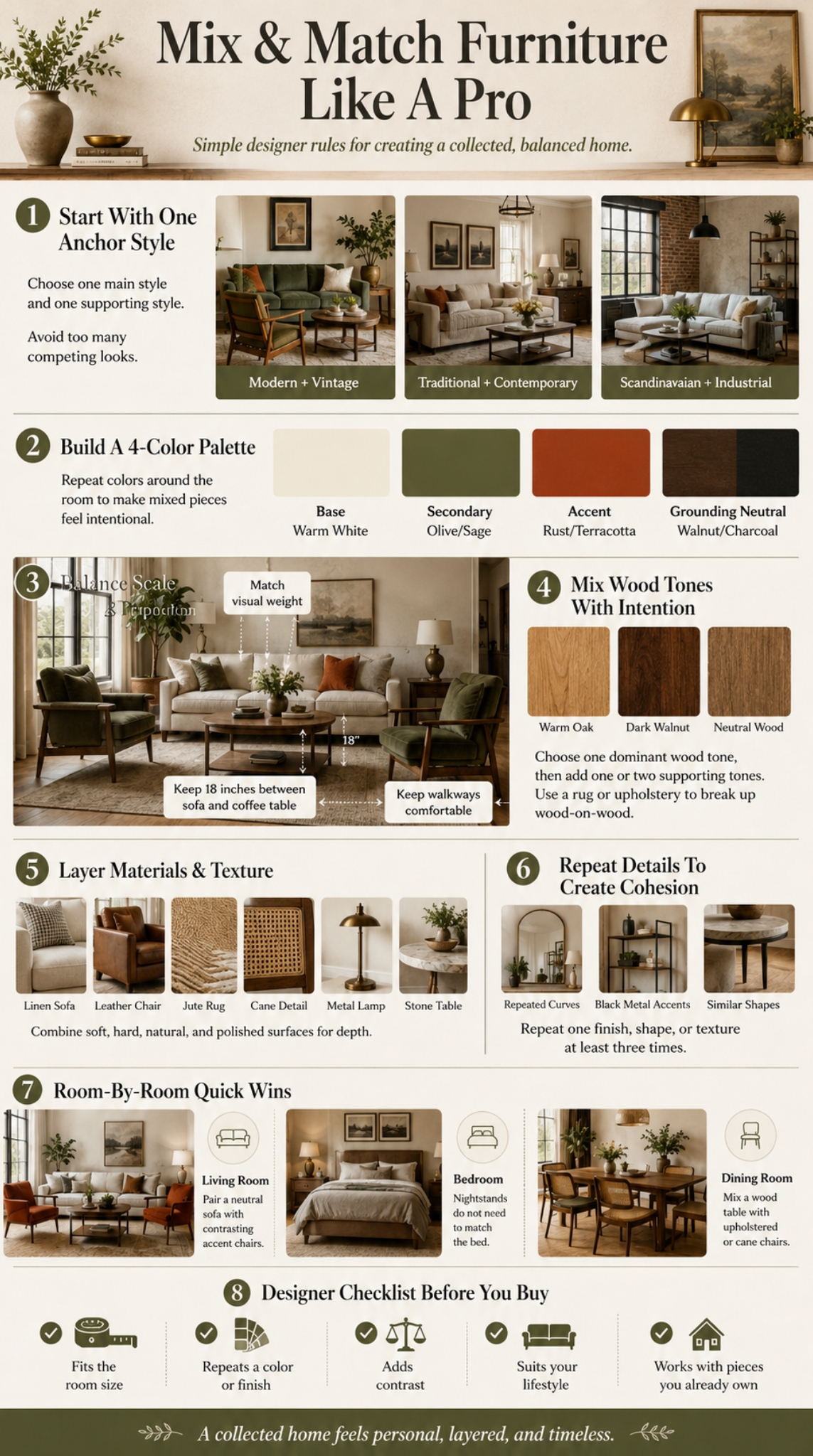
Texture is what makes a room feel rich even when the color palette is simple. A beige room can be boring or beautiful. The difference is usually texture.
Think of soft, hard, rough, smooth, shiny, matte, natural, and polished surfaces. When you mix these, the room gets depth. A linen sofa, leather chair, jute rug, ceramic lamp, wood table, and metal frame can all sit in one room because each adds a different layer.
This is also where budget-friendly decorating becomes easier. You do not always need new furniture. Sometimes a woven tray, textured throw, better lamp, or larger rug can make old pieces feel more intentional.
|
Material |
What It Adds |
Good Pairing |
|
Linen |
Softness and casual comfort |
Wood, rattan, black metal |
|
Leather |
Warmth and durability |
Wool, oak, brass, stone |
|
Velvet |
Depth and softness |
Glass, dark wood, marble |
|
Rattan or cane |
Natural texture |
Modern sofas, painted furniture |
|
Metal |
Structure and contrast |
Wood, upholstery, stone |
|
Glass |
Lightness |
Heavy wood, small rooms |
|
Stone |
Weight and polish |
Linen, leather, brass |
Combine Soft And Hard Surfaces
A room with only hard surfaces feels cold. A room with only soft surfaces can feel shapeless. Mix both.
Pair a soft sofa with a wood or stone coffee table. Pair upholstered chairs with a metal floor lamp. Pair a wooden bed with linen bedding and a soft rug.
Use Natural Materials For Warmth
Natural materials make rooms feel more relaxed. Rattan, jute, cane, clay, wool, linen, and wood help soften modern furniture.
This is useful when you have sleek or glossy pieces. A clean-lined media unit feels warmer with a woven basket nearby. A modern dining table feels less severe with cane chairs or linen curtains.
Add One Polished Detail
A polished detail gives the room a finished look. This could be a brass lamp, chrome chair frame, glass vase, marble tray, or polished stone table.
Do not overdo it. One or two polished details are enough. Too many shiny surfaces can make the room feel cold.
Mix And Match Furniture In The Living Room
The living room is usually the hardest place to mix furniture because it has many visible pieces. Sofa, chairs, coffee table, side tables, TV unit, shelves, lamps, rug, and artwork all need to work together.
Start with the sofa. It is usually the largest piece, so it sets the tone. Then choose chairs that contrast but still connect. A fabric sofa can work with leather chairs. A modern sofa can work with vintage wood chairs. A plain sofa can work with patterned accent chairs.
This is the best place to use the focus keyword naturally: if you want to mix and match furniture in a living room, connect the big pieces through color, scale, and repeated finishes.
|
Living Room Piece |
Safe Choice |
More Designed Choice |
|
Sofa |
Neutral fabric sofa |
Neutral sofa with textured upholstery |
|
Accent chairs |
Matching pair |
Different material or shape |
|
Coffee table |
Matching set table |
Wood, stone, metal, or glass contrast |
|
Side tables |
Same as coffee table |
Different shape but shared finish |
|
Rug |
Small plain rug |
Larger rug with texture or soft pattern |
|
Lighting |
One ceiling light |
Floor lamp, table lamp, and dimmable light |
Mix Sofas And Accent Chairs
The sofa and chairs do not need to match. In fact, they often look better when they do not. The key is to connect them in one clear way.
A beige sofa can work with cognac leather chairs because both feel warm. A gray sofa can work with black-framed chairs because both feel cool and modern. A green velvet chair can work with a neutral sofa if green appears again in artwork or pillows.
Mix Coffee Tables And Side Tables
Coffee tables and side tables should not look like strangers. But they also do not need to be twins.
Try a wood coffee table with metal side tables. Or a round stone coffee table with slim wood side tables. Keep one element connected, such as black legs, warm undertones, or rounded shapes.
Use The Rug To Pull Everything Together
A rug can make mismatched furniture feel like one group. It creates a visual zone and helps anchor the seating area.
Designers often notice rugs that are too small because they make rooms feel disconnected. A larger rug that sits under the main furniture grouping can make the room feel more balanced and cozy.
Mix And Match Furniture In The Bedroom And Dining Room
Bedrooms and dining rooms are easier to mix once you stop believing every piece has to match. Your nightstands do not have to match the bed. Your dining chairs do not have to match the table. Your dresser does not have to match your mirror.
The goal is calm connection. Bedrooms need softer contrast because the room should feel restful. Dining rooms can handle more visual contrast because they are social spaces.
If you want to mix and match furniture in these rooms, focus on height, comfort, finish, and mood before style labels.
|
Room |
Easy Mixing Idea |
What To Watch |
|
Bedroom |
Upholstered bed with wood nightstands |
Nightstand height and lamp scale |
|
Bedroom |
Wood bed with painted dresser |
Keep undertones calm |
|
Dining room |
Wood table with upholstered chairs |
Seat height and spacing |
|
Dining room |
Matching side chairs with different end chairs |
Keep color or material connected |
|
Dining room |
Vintage cabinet with modern table |
Repeat one finish or color |
Should Nightstands Match The Bed?
No. Nightstands only need to work with the bed. They should be close to mattress height, practical for storage, and connected through color, finish, or shape.
For example, an upholstered bed can work with wood nightstands because the materials contrast. A dark wood bed can work with painted nightstands because the paint breaks up the heaviness. A modern bed can work with vintage nightstands if the lamps or bedding connect the styles.
How To Mix Dressers, Beds, And Mirrors
A dresser does not need to match the bed frame. A mirror does not need to match the dresser. But the group should still feel balanced.
If the bed is simple, the dresser can have more character. If the dresser is ornate, choose a cleaner mirror. If the bed and dresser are both wood, use bedding, lamps, art, or a rug to soften the wood-on-wood effect.
How To Mix Dining Tables And Chairs
Dining rooms are perfect for mixing. A wood table can pair with upholstered chairs, black chairs, cane chairs, or a bench. You can also use two statement chairs at the ends and simpler chairs on the sides.
For dining clearances, interior design spacing guidelines often recommend at least 90 cm between the table edge and a wall or nearby furniture, with 110 cm being more comfortable. A dining table height of 70 to 74 cm and a dining chair seat height of around 45 cm are also common practical measurements.
Common Mistakes To Avoid When Mixing Furniture
Mixing furniture is not about buying random things you like. That is where most mistakes begin. A room can have several beautiful pieces and still feel wrong if they do not connect.
The most common problems are poor scale, too many finishes, no color plan, and too many statement pieces. Another big mistake is copying trends too literally. Trends can inspire you, but your room still needs to fit your home, budget, and daily life.
Designers often warn that overused details such as scallops, fluting, and impractical tufted seating can quickly feel predictable or hard to maintain when used without restraint.
|
Mistake |
Why It Hurts The Room |
Better Move |
|
No plan |
Pieces feel random |
Choose style, color, and scale first |
|
Too many wood tones |
Room feels busy |
Limit to two or three tones |
|
Wrong scale |
Pieces feel awkward |
Measure before buying |
|
Too many trends |
Room dates faster |
Use trends in small accents |
|
Tiny rug |
Furniture feels disconnected |
Size up when possible |
|
No repetition |
Nothing feels related |
Repeat color, shape, or finish |
Mistake 1: Ignoring Scale
Scale problems are easy to miss in a showroom or online. A chair may look perfect in a product photo but too small beside your sofa. A coffee table may look stylish but too tall for your seating.
Measure before buying. Check width, depth, height, and clearance. A good-looking piece still has to fit real life.
Mistake 2: Mixing Without Repetition
Repetition is what makes mixed furniture feel intentional. If nothing repeats, the room feels scattered.
Repeat at least one of these things three times: color, wood tone, metal finish, shape, texture, or pattern. This small trick can fix many rooms.
Mistake 3: Buying Too Many Trend Pieces
A trendy piece can be fun. A room full of trends can look dated quickly.
Use trends in items that are easy to change. Try trendy colors in pillows, lamps, artwork, throws, or small stools. Keep expensive pieces more timeless.
Step-By-Step Process To Mix And Match Furniture
The easiest way to mix furniture is to slow down. Do not buy everything at once. Rooms improve when you look, test, edit, and adjust.
Start with what you already own. Take photos of the room. Notice what feels too heavy, too empty, too dark, or too repeated. Then decide what must stay and what can change.
This process helps readers avoid impulse purchases. It also makes the finished room feel more natural because it grows from real needs, not a shopping list.
|
Step |
What To Do |
Why It Helps |
|
1 |
Take photos of the room |
Shows balance problems clearly |
|
2 |
List what must stay |
Prevents waste and overspending |
|
3 |
Choose a main style |
Gives the room direction |
|
4 |
Pick a color palette |
Makes mixed pieces connect |
|
5 |
Add contrast slowly |
Reduces expensive mistakes |
|
6 |
Repeat one detail |
Creates cohesion |
|
7 |
Edit the room |
Keeps the final look clean |
Step 1: Start With Your Anchor Piece
Your anchor piece is the item that sets the room’s direction. It may be a sofa, bed, dining table, rug, cabinet, or artwork.
Once you know the anchor, build around it. If the anchor is modern, add warmth. If it is traditional, add freshness. If it is dark and heavy, add lighter pieces nearby.
Step 2: Choose What Should Contrast
Not everything needs contrast. Pick one or two places where contrast will make the room better.
You may contrast a modern sofa with a vintage table. Or a wood bed with painted nightstands. Or a rectangular dining table with curved chairs.
Step 3: Edit Before You Add More
Editing is part of design. Remove anything that makes the room feel crowded, repeated, or confusing.
Sometimes the problem is not that the room needs more. It may need less. Fewer pieces with stronger connections often look better than a room packed with furniture.
Budget-Friendly Ways To Mix And Match Furniture
You do not need a designer budget to create a designer-looking room. You need a better plan. Many mixed rooms work because they combine new, old, simple, textured, and meaningful pieces.
Shop your own home first. Move a side table from the bedroom to the living room. Try a dining chair as a desk chair. Use an old bench at the end of a bed. Small changes can reveal combinations you had not considered.
Secondhand furniture is also useful. Vintage and thrifted pieces add character, and they can stop a room from looking like everyone else’s home.
|
Budget Method |
Best Use |
Why It Works |
|
Move furniture between rooms |
Tables, chairs, benches, lamps |
Costs nothing |
|
Paint furniture |
Dressers, cabinets, nightstands |
Connects mismatched pieces |
|
Change hardware |
Cabinets, drawers, doors |
Adds a fresh detail |
|
Reupholster small pieces |
Stools, chairs, benches |
Updates style without replacing frame |
|
Buy secondhand |
Wood furniture, mirrors, chairs |
Adds character |
|
Upgrade textiles |
Pillows, curtains, rugs, throws |
Changes mood quickly |
Shop Your Home First
Before buying anything, look at every room. You may already own the missing piece. A small chest can become a nightstand. A stool can become a plant stand. A console table can move behind a sofa.
This method also helps you understand your taste. You will see which colors, woods, and shapes you already repeat naturally.
Use Paint And Hardware
Paint can connect furniture that does not match. Two different nightstands can feel like a pair if they are painted the same color. A dated dresser can feel modern with new hardware.
Hardware matters more than people think. Black pulls, brass knobs, or simple wood handles can connect furniture to lighting, frames, or curtain rods.
Spend On Anchors, Save On Accents
Spend more on pieces you use every day. Sofas, mattresses, dining tables, desk chairs, and storage pieces deserve more attention. Save on items that are easier to change, such as side tables, pillows, lamps, trays, and decor.
This keeps the room flexible. You can refresh the style later without replacing everything.
Final Thoughts
Learning how to mix and match furniture is really about learning how to connect different pieces. A room does not need a complete matching set to feel finished. It needs balance, repetition, comfort, and a clear mood.
Start with one main design direction. Choose a simple color palette. Respect scale and walking space. Repeat wood tones, metal finishes, shapes, and textures. Then add contrast slowly.
The best rooms do not look as if they were bought in one afternoon. They look lived in. They carry small signs of taste, time, and personality. That is why the mix matters. When you mix and match furniture with intention, your home feels warmer, more personal, and far more interesting.
Frequently Asked Questions About Mix And Match Furniture
Can You Mix Different Furniture Styles In The Same Room?
Yes, you can mix different furniture styles in the same room. The safest method is to choose one dominant style and one or two supporting styles. Then connect the pieces through color, scale, material, or shape.
Do Wood Furniture Pieces Need To Be The Same Color?
No, wood furniture does not need to be the same color. It usually looks better when there is some variation. Try to keep the undertones controlled and repeat each wood tone at least twice.
Can A Modern Sofa Work With Traditional Chairs?
Yes, a modern sofa can work with traditional chairs. Keep the connection simple. Use similar fabric tones, repeated wood finishes, matching metal details, or a shared color palette.
Is It Okay To Have Different Nightstands?
Yes, different nightstands can look stylish. Keep their heights similar and connect them through lamps, color, material, or shape. This works especially well in relaxed, collected bedrooms.
How Many Wood Tones Are Too Many In One Room?
Two to three wood tones are easiest for most rooms. More can work, but you need stronger repetition and enough fabric, rugs, metal, or painted pieces to break up the wood.
Should Dining Chairs Match The Dining Table?
Dining chairs do not have to match the dining table. A wood table can work with upholstered, metal, painted, cane, or mixed chairs. Just check seat height, comfort, and spacing before buying.
What Is The Easiest Piece To Change First?
Start with a small piece. Try an accent chair, side table, lamp, rug, throw pillow, or artwork. These items can shift the room’s mood without a major investment.