
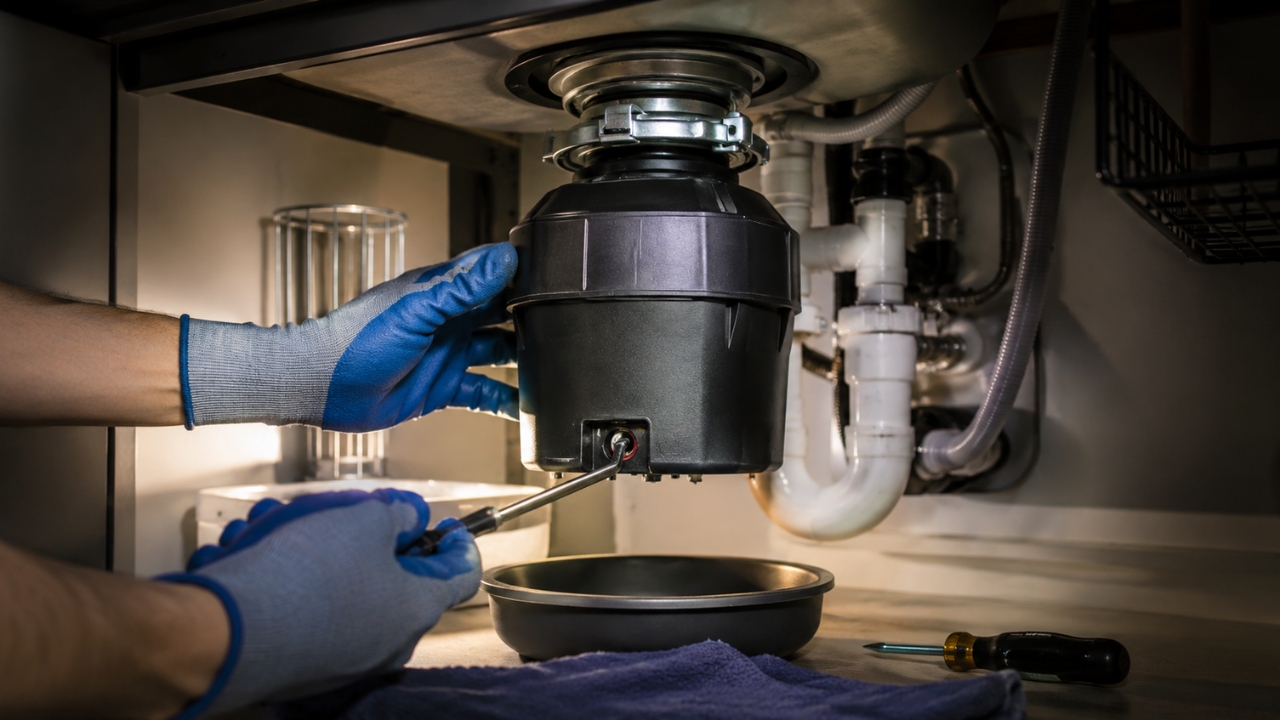
A garbage disposal that hums but doesn’t grind is frustrating. You flip the switch, expect the usual grinding sound, and instead hear a dull buzz under the sink.
Nothing moves. The sink may drain slowly. The motor sounds like it’s trying, but the disposal won’t do its job.
The good news? You can often fix humming garbage disposal problems without replacing the whole unit. Most of the time, the motor still has power. Something is simply stopping the grinding plate from spinning.
That “something” might be a fruit pit, a bone chip, a spoon, a bottle cap, or food packed too tightly inside the chamber. Sometimes the overload button trips because the motor worked too hard.
Still, don’t treat this like a harmless kitchen hiccup. A garbage disposal has electrical parts, metal grinding pieces, and sharp edges. You need to slow down, cut the power, and work safely.
This guide walks you through the full repair in plain English. You’ll learn what the humming sound means, how to clear a jam, how to reset the unit, what to check if it still won’t run, and when it’s smarter to call a pro.
What Does a Humming Garbage Disposal Mean?
A humming garbage disposal usually means one thing: the motor is getting power, but the grinding plate can’t turn.
That hum is the motor trying to start. It wants to spin the plate. But something is blocking it.
If you keep flipping the switch, the motor can overheat. That may trip the reset button. In worse cases, it can damage the motor.
|
Symptom |
Likely Cause |
What It Means |
|
Hums but doesn’t grind |
Jammed grinding plate or flywheel |
The motor has power, but the plate is stuck |
|
Hums, then shuts off |
Overload button tripped |
The motor got too hot or strained |
|
No sound at all |
No power, tripped outlet, bad switch, or breaker issue |
The electrical path needs checking |
|
Hums with burning smell |
Overheating or motor failure |
Stop using it right away |
|
Hums after jam is cleared |
Weak motor or internal fault |
You may need repair or replacement |
A garbage disposal doesn’t work like a blender. It doesn’t have sharp spinning knife blades slicing food. Instead, a spinning plate throws food scraps against a grind ring. Small metal lugs push the scraps around until they break down.
So when people say “the blades are stuck,” they usually mean the grinding plate or flywheel is stuck.
Common causes include:
- Fruit pits
- Chicken or fish bones
- Popcorn kernels
- Coffee grounds packed into sludge
- Rice or pasta clumps
- Potato peels
- Celery strings
- Corn husks
- Onion skins
- Bottle caps
- Small utensils
- Broken glass or plastic pieces
A short hum is not always a big problem. But repeated humming is a warning. Don’t keep testing it over and over. That’s how a simple jam turns into a burned-out motor.
Safety Steps Before You Touch the Disposal
Before you try to fix humming garbage disposal issues, make the area safe. This is not the step to skip.
Turn off the wall switch first. Then unplug the disposal under the sink if it has a power cord. If it is hardwired, turn off the correct breaker at the electrical panel.
Never put your hand inside the disposal. Even if the switch is off, the grinding plate can shift suddenly. Stuck objects can also cut your fingers.
|
Safety Step |
Why It Matters |
|
Turn off the wall switch |
Stops normal operation |
|
Unplug the disposal if possible |
Prevents accidental startup |
|
Turn off the breaker if hardwired |
Adds another layer of safety |
|
Use a flashlight |
Helps you spot stuck items |
|
Use tongs or pliers |
Keeps your hands out of the chamber |
|
Avoid chemical drain cleaners |
Protects the unit and reduces splash risk |
|
Remove tools before testing |
Prevents damage and injury |
Use long tongs, needle-nose pliers, or a wooden spoon handle. Keep your fingers out of the chamber at all times.
Also look under the sink before you begin. If you see water near the outlet, loose wiring, sparks, melted plastic, or smell burning, stop. That’s not a basic DIY jam anymore.
Call a plumber or electrician if the setup looks unsafe.
Tools You’ll Need
You don’t need a huge toolbox for this repair. Most humming disposal fixes use simple tools.
The most important one is usually a 1/4-inch Allen wrench. Many disposals have a hex-shaped hole at the bottom center of the unit. When you turn that socket, you manually move the grinding plate and free the jam.
Some disposals come with a special jam-buster wrench. If you still have it, use that.
|
Tool |
What It Does |
Helpful Tip |
|
Flashlight |
Lets you see inside the chamber |
Keep your phone dry if using its light |
|
Long tongs |
Removes visible stuck items |
Safer than using your hand |
|
Needle-nose pliers |
Grabs small objects |
Good for caps, clips, and metal bits |
|
1/4-inch Allen wrench |
Turns the flywheel from below |
Works on many common models |
|
Wooden spoon handle |
Moves the plate from above |
Use gently with power off |
|
Bucket or towel |
Catches water under the sink |
Helpful if the sink is backed up |
|
Work gloves |
Protects your hands outside the unit |
Still don’t reach inside |
If your disposal doesn’t have a bottom hex socket, check the manual. Some models use a different jam-clearing method.
Avoid random metal tools inside the chamber. A screwdriver can scratch the grind ring, break parts, or get stuck.
How to Fix Humming Garbage Disposal Step by Step
Here’s the safest repair order. Follow it slowly. Don’t press reset first and hope the problem disappears. Clear the jam first. Reset comes later.
|
Step |
What to Do |
Good Sign |
|
1 |
Cut the power |
The unit cannot start |
|
2 |
Inspect the chamber |
You spot the jam or confirm it’s clear |
|
3 |
Remove visible debris |
The object comes out with tongs |
|
4 |
Turn the wrench below |
The plate starts moving |
|
5 |
Press the reset button |
The button stays in |
|
6 |
Run cold water |
Water flows smoothly |
|
7 |
Test briefly |
The disposal spins and grinds normally |
Step 1: Cut the Power
Turn the disposal switch off. Unplug the unit if you can reach the cord. If it’s hardwired, turn off the breaker.
Don’t rely only on the wall switch when working around the disposal. Someone could bump it. A faulty switch could also surprise you.
Step 2: Look Inside With a Flashlight
Shine a flashlight through the sink opening. If the rubber splash guard blocks your view, move the flaps gently with a spoon handle.
Look for obvious trouble. You may see a bone, pit, cap, piece of glass, utensil, or packed food.
Use tongs or pliers to remove anything visible. Keep your hand out.
Step 3: Use the Allen Wrench Under the Unit
Look at the bottom center of the disposal. Find the small hex hole.
Insert the Allen wrench. Work it back and forth. Don’t force it hard in one direction. The goal is to rock the flywheel until the stuck object loosens.
At first, it may feel locked. That’s normal with a jam. Apply steady pressure. Once it breaks free, keep turning it both ways until it moves smoothly.
When the wrench turns freely, the jam is likely loose.
Step 4: Check the Chamber Again
Look inside the disposal again. The object that caused the jam may now be loose.
Use tongs to remove it.
This second check matters. If you skip it, the same item can jam the disposal again as soon as you test it.
Step 5: Press the Reset Button
Find the reset button on the bottom or lower side of the disposal. It is often red or black.
Press it firmly.
If it clicks and stays in, the overload protector has reset. If it pops back out, wait a few minutes. The motor may still be hot.
If the button still won’t stay in after the jam is cleared and the unit cools down, stop testing. Something else may be wrong.
Read Also: How to Make Your Older Home Smart in 2026
Step 6: Test With Cold Water
Remove the Allen wrench and every tool from the area.
Turn on a steady stream of cold water. Restore power. Flip the disposal switch for a short test.
If it starts grinding normally, let it run for a few seconds. Then turn the disposal off first. Let the water run a little longer to flush the drain.
That’s the right way to finish the repair.
If the Reset Button, GFCI, or Breaker Is the Problem
Sometimes the disposal hums once and shuts off. Other times, it makes no sound at all.
That may point to the reset button, outlet, GFCI, breaker, wall switch, or wiring.
A hum usually means power is reaching the motor. Silence often means power is missing or the reset button has tripped.
|
Problem |
Sign |
What to Check |
|
Tripped reset button |
Button has popped out |
Press it after clearing the jam |
|
Tripped GFCI outlet |
Outlet reset button is out |
Press reset if the area is dry |
|
Tripped breaker |
Circuit has shut off |
Reset the breaker once |
|
Loose plug |
Unit works only sometimes |
Check the plug under the sink |
|
Bad switch |
Outlet has power, but disposal won’t respond |
Call an electrician |
|
Hardwired fault |
No plug and hidden wiring |
Get professional help |
Many kitchens use GFCI protection because sinks and electricity sit close together. If your under-sink outlet has “test” and “reset” buttons, it may have tripped.
Only reset it if the area is dry and safe.
If the breaker trips again right away, don’t keep resetting it. A breaker that keeps tripping is trying to tell you something.
Call an electrician if:
- The outlet is wet
- The switch sparks
- You smell burning plastic
- The breaker trips again and again
- The disposal hums only when wires move
- You see damaged wiring
- The disposal is hardwired and you’re not trained to inspect it
A jam is a mechanical problem. A tripping breaker may be an electrical problem. Don’t treat them the same.
What If the Disposal Still Hums After the Jam Is Clear?
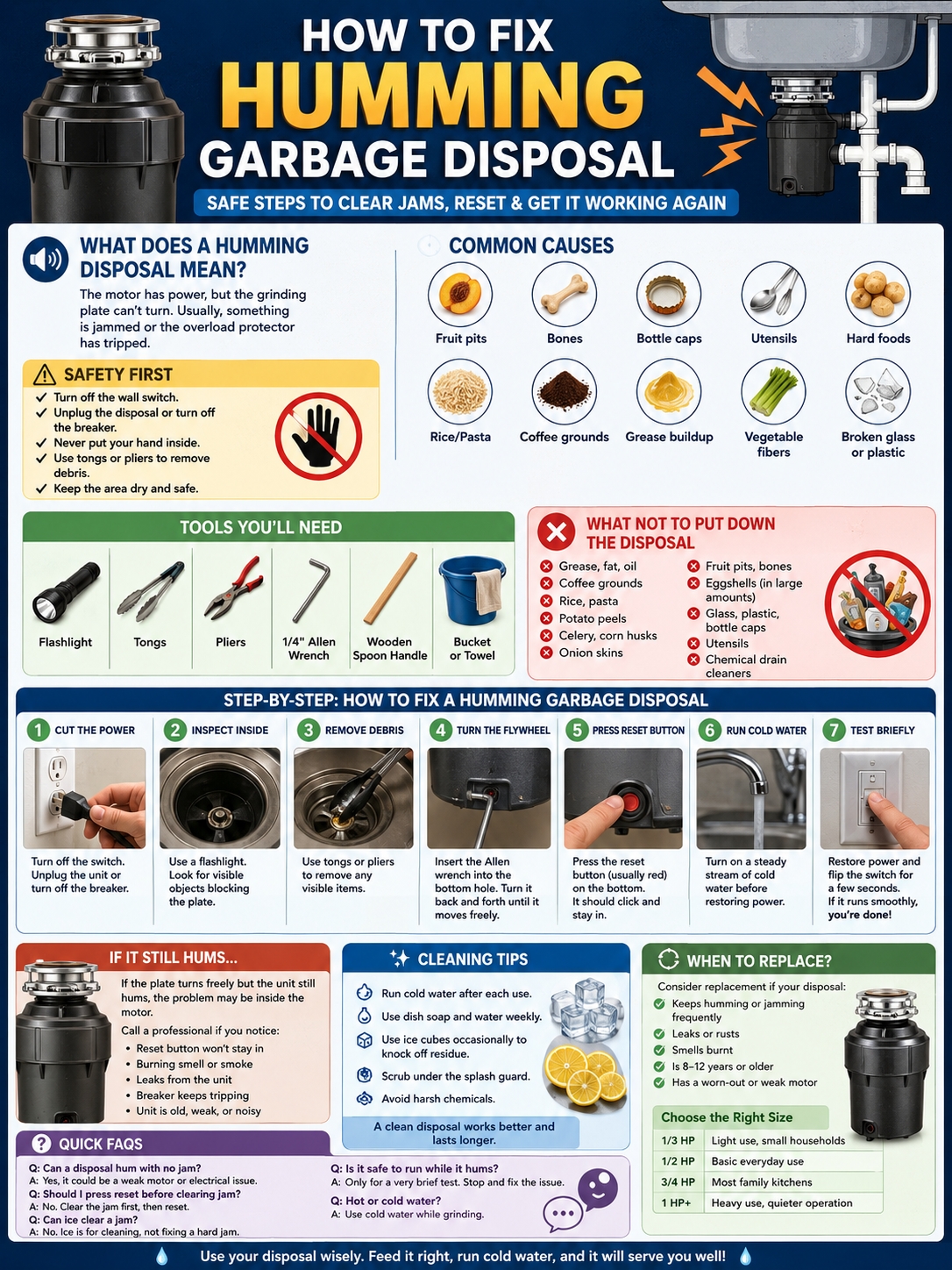
If the flywheel turns freely by hand but the disposal still only hums, the problem may be inside the motor.
At that point, stop testing it. Repeated humming can overheat the motor.
|
Situation |
Possible Meaning |
Best Move |
|
Wrench turns freely, but unit hums |
Motor may not be starting |
Call a pro or replace the unit |
|
Reset trips again quickly |
Overload or internal fault |
Stop using it |
|
Burning smell appears |
Motor overheating |
Cut power right away |
|
Unit leaks from the body |
Internal seal failure |
Replace the disposal |
|
Loud metal noise continues |
Loose metal or damaged parts |
Inspect with power off |
|
Disposal is old and weak |
Wear and motor fatigue |
Compare repair vs replacement |
A professional can check the motor, capacitor, wiring, bearings, and mounting. But in many homes, rebuilding a disposal isn’t worth the money.
Replacement often makes more sense if the unit is old, rusty, leaking, noisy, or always jamming.
Think about replacing it if:
- The reset button won’t stay in
- The disposal leaks from the body
- The motor smells burnt
- It jams during normal use
- It sounds weak or uneven
- Repair costs almost as much as a new unit
- The same problem keeps coming back
A newer disposal with one jam is worth saving. An older one with repeat problems may be ready to retire.
Foods and Items That Cause Humming Disposal Problems
A garbage disposal is not a trash can. It can handle small food scraps, but it should not swallow everything from your plate.
Many humming problems start with the wrong items going down the drain.
Different brands give slightly different advice. Some stronger models can handle tougher scraps than smaller models. Still, the safest rule is easy: avoid hard, fibrous, greasy, starchy, and non-food items.
|
Avoid This |
Why It Causes Trouble |
|
Hot grease, fat, and oil |
Coats pipes and traps debris |
|
Coffee grounds |
Clumps into dense sludge |
|
Rice and pasta |
Expands and creates sticky buildup |
|
Potato peels |
Turns into a thick paste |
|
Celery and corn husks |
Fibers can wrap and jam |
|
Onion skins |
Thin layers can block the drain |
|
Fruit pits |
Hard enough to jam the plate |
|
Large bones |
Can lock or damage the grind system |
|
Eggshells in large amounts |
May create gritty buildup |
|
Bottle caps, glass, plastic, utensils |
Can damage internal parts |
|
Chemical drain cleaners |
Can corrode metal and splash back |
Better habits make a big difference.
Run cold water before you turn on the disposal. Keep the water running while it grinds. Feed scraps slowly. Let the disposal finish before switching it off. Then keep the water running for a few more seconds.
Also, don’t pour grease down the sink. Let it cool, scrape it into the trash, and wipe the pan before washing.
Use the disposal for small scraps. Use the trash or compost bin for bigger waste.
That simple habit can prevent most jams.
Cleaning the Disposal After You Fix It
Once the disposal runs again, clean it. A jam can leave food stuck around the grind ring or under the rubber splash guard.
If the disposal smells bad after the repair, don’t panic. That smell usually comes from trapped food, not a broken motor.
|
Cleaning Method |
Best For |
How Often |
|
Cold water flush |
Loose food bits |
After each use |
|
Dish soap and water |
Light grease and odor |
Weekly |
|
Ice cubes |
Knocking off soft residue |
Occasionally |
|
Baking soda on splash guard |
Odor near sink opening |
As needed |
|
Small citrus peel pieces |
Fresh scent |
Occasionally |
|
Brush cleaning splash guard |
Hidden grime |
Weekly or biweekly |
Here’s a safe cleaning routine:
- Turn off the disposal.
- Scrub the underside of the splash guard with a brush.
- Rinse with water.
- Add a little dish soap.
- Turn on cold water.
- Run the disposal briefly.
- Let the water flush the line.
Do not pour harsh drain cleaners into the disposal. These products can damage metal parts and create splash-back risk.
If the sink still drains slowly after the disposal works, the clog may be in the P-trap or drain line. That’s a plumbing issue, not a disposal motor issue.
When to Call a Plumber or Replace the Garbage Disposal
DIY repair works well for a simple jam. But not every humming disposal should be handled at home.
Call a plumber if the jam won’t release, the sink backs up, the unit leaks, or you’re not comfortable working under the sink.
Call an electrician if the problem involves wiring, outlets, breakers, or switches.
|
Call a Pro If… |
Why It Matters |
|
The Allen wrench won’t turn |
The motor may be seized or the jam may be severe |
|
The reset button trips again and again |
There may be a motor or electrical fault |
|
You smell burning |
The motor may be overheating |
|
Water leaks from the disposal body |
Internal seals may have failed |
|
The breaker keeps tripping |
There may be an electrical problem |
|
Sink water backs up into both bowls |
The clog may be deeper in the drain |
|
The unit is old and unreliable |
Replacement may be the smarter choice |
If you need a new disposal, match the motor size to your kitchen habits.
|
Motor Size |
Best For |
|
1/3 HP |
Light use and small households |
|
1/2 HP |
Basic everyday kitchen use |
|
3/4 HP |
Most family kitchens |
|
1 HP or higher |
Heavy use and quieter premium models |
Also check noise insulation, warranty length, grind chamber material, septic compatibility, and mounting style.
A cheap unit may work for light use. But if your kitchen handles daily cooking, a stronger and quieter model may be worth it.
Final Thoughts
|
Key Point |
What to Remember |
|
Humming usually means the motor has power |
The unit is trying to run |
|
A jam is the most common cause |
Clear it before pressing reset |
|
Safety comes first |
Cut power and keep hands out |
|
Cold water helps |
Run it before, during, and after grinding |
|
Repeated humming is bad |
It can overheat the motor |
|
Some problems need a pro |
Leaks, burning smells, wiring faults, and repeat trips are warning signs |
A humming disposal sounds bad, but it’s often fixable. Start simple. Cut the power. Look for debris. Remove stuck items with tongs. Turn the flywheel with an Allen wrench. Press reset. Test with cold water.
Don’t keep forcing the switch. Don’t reach inside. Don’t pour harsh chemicals into the unit.
If you want to fix humming garbage disposal problems safely, follow the right order: power off, jam cleared, reset pressed, water running, short test.
If the disposal still hums after that, the problem may be deeper than a basic jam. At that point, stop guessing and get help.
A good garbage disposal should grind smoothly, drain cleanly, and make kitchen cleanup easier. Treat it well, avoid problem scraps, and you’ll save yourself a lot of under-sink trouble.
Uncommon FAQs About Humming Garbage Disposals
These questions come up often, but many repair guides skip them.
|
Question |
Short Answer |
|
Can a disposal hum with no jam? |
Yes. A weak motor or electrical fault can also cause humming. |
|
Should I press reset before clearing the jam? |
No. Clear the jam first, then reset. |
|
Can ice clear a jam? |
No. Ice helps clean residue, but it won’t fix a hard jam. |
|
Why does it hum only for one second? |
The overload protector may be tripping fast. |
|
Can I use hot water while grinding? |
Cold water is usually better while the disposal runs. |
|
Is a humming disposal dangerous? |
It can become unsafe if you keep running it while stuck. |
|
Can a dishwasher cause disposal humming? |
Not usually. It may affect drainage, not motor spinning. |
|
Should renters fix it themselves? |
They should check the lease or contact the landlord first. |
Why does my garbage disposal hum but not spin?
The motor is probably getting power, but the grinding plate is stuck. A jammed object or packed food is the most common reason.
Can I fix a humming disposal without an Allen wrench?
Sometimes, yes. If your model has no bottom hex opening, you may be able to move the plate from above with a wooden spoon handle. Turn the power off first. Never use your hand.
The disposal may still be jammed, overheated, or damaged inside. Let it cool, make sure the plate moves freely, and try once. If it keeps popping out, stop using the unit.
What if the Allen wrench will not move?
Work it gently both ways. Don’t force it until something breaks. If it stays locked, the jam may be serious or the motor may be seized.
Can a humming garbage disposal burn out?
Yes. A stuck disposal can overheat if you keep running it. Stop after a short test and clear the jam before trying again.
Why does my disposal hum after sitting unused?
Old food, mineral buildup, or light corrosion may have stuck the turntable. Try the wrench method with the power off. If the plate moves freely but the motor still hums, call a pro.
Is it better to repair or replace a humming garbage disposal?
Repair it if the unit is newer and only jammed. Replace it if it leaks, smells burnt, trips often, or keeps humming after the plate moves freely.