
The smart home market has grown past its awkward early phases, and picking the right platform is more important than ever. You no longer buy a voice assistant just to set a simple cooking timer or check the local weather before work. Today, these intelligent devices act as the central brain of your entire household, connecting dozens of different gadgets seamlessly.
They manage ambient lighting, control climate settings, secure your front door, and deliver high-fidelity audio across multiple rooms simultaneously. If you are upgrading your setup or starting from scratch right now, you face a major, long-term decision. Finding the best smart speaker ecosystem requires looking far beyond the physical hardware sitting on your shelf. It means committing to a specific software platform that dictates exactly how your digital life and physical space interact daily.
Amazon, Google, and Apple have taken very different paths to win control of your living room, and each brings unique strengths to the table. We are going to break down their distinct strategies, physical hardware, and AI capabilities so you can figure out which path makes the most sense for your daily routine.
The Evolution of Smart Speakers in 2026
The smart home space has grown up completely. You no longer buy a speaker just to set a kitchen timer. These devices now act as the brain of your entire house, connecting locks, lights, and thermostats without breaking a sweat. Finding the best smart speaker ecosystem means looking at how these platforms handle the new Matter and Thread standards. The days of struggling with proprietary bridges and overlapping Wi-Fi networks are fading, replacing a fragmented mess with a unified vision of home automation.
As tech savvy buyers look to upgrade their living spaces, understanding this evolution is crucial for making a sound investment. We are moving toward homes that anticipate our needs rather than just responding to our vocal commands. The underlying voice assistants have evolved from rigid command machines into highly generative AI companions that actually understand context. Making the right choice means evaluating your current tech stack, setting your privacy boundaries, and defining your exact expectations for daily convenience.
|
Ecosystem Factor |
Past Limitations |
Current 2026 Reality |
Impact on User Experience |
|
Voice Interaction |
Rigid exact phrasing required |
Natural conversational understanding |
Less frustration and intuitive daily use |
|
Device Connectivity |
Fragmented Wi-Fi and bridges |
Unified Thread and Matter protocols |
Faster response times and easier setup |
|
Audio Quality |
Flat basic stereo sound |
Spatial audio and acoustic mapping |
Immersive home theater replacements |
|
Privacy Controls |
Default cloud storage |
Advanced local execution |
Higher security for personal conversations |
Why the Choice Matters More Than Ever
Investing in a smart platform today completely defines your daily digital friction and how smoothly your home operates. If you use an iPhone religiously, live inside Google Calendar, or order all your groceries through Amazon Prime, your existing habits strongly influence which speaker feels natural to use. You are not just buying a single speaker; you are buying the foundation for every smart bulb, security camera, and thermostat you will purchase over the next five years. The introduction of universal standards has helped, but the central hub you choose still controls the entire user experience. You want a system that works locally, responds instantly, and stays out of your way when you do not need it.
Meet the Voice Assistants: Brains Behind the Brawn
The physical hardware is just a shell for the AI living inside. Over the last year, generative AI has transformed how we talk to our devices entirely. Amazon, Google, and Apple took completely different approaches to building their digital assistants from the ground up. You have to decide if you want conversational intelligence, a vast knowledge graph, or strict ecosystem privacy. The assistant you choose will dictate how frustrating or seamless your daily interactions become. If you want the best smart speaker ecosystem, you need an assistant that actively learns your routine rather than just answering basic queries. A savvy user understands that the software running in the cloud matters much more than the fabric covering the speaker itself. Finding the right voice assistant means matching its core strengths to your actual daily lifestyle.
|
Voice Assistant |
Primary AI Strength |
Best Use Case Scenario |
Common Weakness |
|
Amazon Alexa |
Deep smart home control |
Controlling dozens of varied devices |
Occasional shopping suggestions |
|
Google Assistant |
Search queries and facts |
Managing schedules and answering trivia |
Slower local network execution |
|
Apple Siri |
Local data privacy |
Seamless iOS device integration |
Limited general web knowledge |
Amazon Alexa and the Conversational AI Upgrades
Amazon has consistently positioned Alexa as the ultimate smart home operator, and recent updates have made it incredibly responsive. With the massive rollout of the Alexa Plus AI models, the assistant gained a huge boost in conversational awareness and memory. Instead of memorizing specific phrasing, you can speak to Alexa exactly like a normal person in your house. You can ask it to turn on the living room lights, dim them to fifty percent, and play some relaxing acoustic music, all in one single breath. Alexa boasts the largest library of third-party integrations and developer skills on the market today. If you buy a random, obscure smart plug online, there is a near certainty it connects natively to Alexa. The assistant is highly proactive, occasionally reminding you that a connected lock needs new batteries or that an important package is outside your door.
Google Assistant: The Power of the Knowledge Graph
Google Assistant remains the undisputed champion of answering random questions and pulling data from the web. Backed by the massive Google search index and fully integrated AI models, it understands nuance and context far better than anyone else when it comes to general knowledge. If you need a recipe substitute on the fly while your hands are covered in flour, or want to know a highly specific historical fact, Google Assistant almost never fails you. For users who are heavily invested in the Google ecosystem, the daily integration is incredibly smooth and helpful. It reads your calendar appointments aloud, pulls up traffic data for your commute based on real-time Google Maps data, and plays nicely with YouTube Music playlists.
Apple Siri: Privacy and Tight Ecosystem Integration
Siri used to be the punchline of smart assistant jokes, but the narrative shifted dramatically over the past two years of intense development. With the deep integration of Apple Intelligence, Siri on the HomePod became significantly more capable and genuinely helpful. It focuses heavily on contextual understanding based strictly on your personal data held securely and locally on your own devices. Siri knows your daily routines, your specific contacts, and your media preferences, but it processes almost all of this locally rather than sending it out to a server farm. You do not buy a HomePod to use Siri for answering obscure trivia questions about geography. You use it because you already own an iPhone, an Apple Watch, and an Apple TV, and you want them all to work together perfectly.
Breaking Down the Hardware Lineups
You cannot pick an ecosystem without looking at the physical speakers you will place around your home. Every brand offers a tiered approach, from small budget pucks to massive high-fidelity sound engines. In 2026, the focus has shifted toward devices that double as networking hubs for your house. Let us look at what each company brings to the table and how much space they take up on your counter. Whether you live in a sprawling house or a compact apartment, the right form factor makes a massive difference. Finding the best smart speaker ecosystem means matching the hardware dimensions and aesthetic to your personal living space. A massive speaker might sound great, but it could look entirely out of place sitting on a small bedside table.
|
Hardware Brand |
Budget Option |
Flagship Device |
Key Hardware Advantage |
|
Amazon |
Echo Dot Max |
Echo Studio |
Built-in Zigbee and Thread hubs |
|
|
Google Nest Audio |
Nest Hub Max |
Large and highly responsive touch screens |
|
Apple |
HomePod Mini |
HomePod Second Gen |
Advanced acoustic room mapping |
The Amazon Echo Family
Amazon refreshes its hardware at a rapid pace, and the current lineup focuses heavily on devices acting as completely standalone smart home hubs. They want you to bypass third-party bridges entirely to simplify the setup process for regular consumers. The Echo Dot Max is the current sweet spot in the Amazon lineup, offering incredible value for the price tag. Retaining a modern spherical design, it packs surprisingly punchy bass and highly clear vocals into a footprint roughly the size of a grapefruit. Crucially, the Echo Dot Max includes built-in Thread and Zigbee networking antennas right out of the box. This means it acts as a direct router for your smart home, allowing low-power devices like sensors to connect directly to it.
Google Home and Nest Offerings
Google historically prioritizes soft, fabric-covered, unobtrusive designs that blend directly into your home decor without looking like obvious tech gadgets. Their current hardware lineup leans heavily into smart displays alongside their traditional audio speakers. Google recently refreshed its core lineup with a brand new smart speaker aimed directly at competing with the Echo Dot Max for the living room center stage. Moving completely away from older pill shapes, the new aesthetic prioritizes massive 360-degree sound projection for room-filling audio. It also finally includes comprehensive Thread border router capabilities, catching up to the competition in native smart networking standards.
The Apple HomePod Series
Apple keeps things incredibly simple and intentionally avoids an overwhelming variety of odd shapes, sizes, and screen types. They exclusively offer two premium audio products designed from the ground up with obsessive attention to acoustic detail. The second-generation HomePod is a heavy, substantial piece of audio equipment wrapped in a seamless, visually pleasing acoustic mesh. It features a custom high-excursion woofer and a complex beamforming array of five tweeters to deliver incredibly rich sound. It includes built-in temperature and humidity sensors, which you can easily use to trigger specific smart routines automatically, like turning on a fan.
Audio Quality and Listening Experience
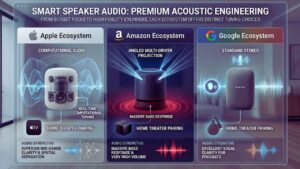
For a lot of people, these devices are primarily music players first and smart assistants second. The audio landscape has moved away from standard stereo and toward spatial, room-filling sound. Computational audio now allows a single speaker to map your room and adjust its output automatically. Finding the best smart speaker ecosystem requires you to match your audio preferences with the right hardware setup. If you host parties or simply enjoy winding down with a high-fidelity playlist, the acoustic engineering inside these cylinders is paramount. A truly savvy listener will notice the distinct tuning choices each brand makes, from heavy bass profiles to perfectly balanced mid-tones. Audio quality is subjective, but the jump from budget pucks to premium speakers is instantly recognizable.
|
Ecosystem |
Acoustic Strategy |
Home Theater Pairing |
Audio Strengths |
|
Apple |
Real-time computational tuning |
Apple TV 4K |
Superior mid-range clarity and spatial separation |
|
Amazon |
Angled multi-driver projection |
Fire TV Stick or Cube |
Massive bass response and very high volume |
|
|
Standard stereo and tuning |
Chromecast or Google TV |
Excellent vocal clarity for podcasts |
Computational Audio and Room Sensing
Apple definitely leads the pack in pure acoustic engineering with the massive, full-sized HomePod. Its ability to actively sense the physical environment around it feels entirely futuristic and magical. It literally uses internal microphones to continuously listen to the reflection of sound bouncing off nearby physical surfaces in real-time. If it detects a solid wall behind it, it smartly directs lead vocals to the exact center of the room while bouncing ambient backing tracks off the wall behind it. This brilliant engineering creates an incredibly wide soundstage from a single, simple cylinder. Amazon attempts a very similar feat with the Echo Studio by utilizing multiple angled internal drivers. The Studio produces truly massive volume and deep, floor-shaking bass, but the HomePod often edges it out slightly in pure mid-range clarity and musicality.
Spatial Audio and Home Theater Setups
Spatial audio is absolutely the current frontier for modern living room entertainment, transforming how we watch movies and listen to music. Both the Apple HomePod and the Amazon Echo Studio natively support Dolby Atmos processing for an immersive experience. When you listen to a high-quality track mixed heavily in Atmos, you hear distinct, individual instruments coming from specific areas around your head, rather than a flat wall of noise. Both Apple and Amazon brilliantly allow you to create completely wireless, high-fidelity home theaters in minutes. Two full-sized HomePods paired effortlessly with an Apple TV 4K provide an incredible cinematic experience that completely replaces a messy, expensive receiver and wired surround speakers.
Smart Home Integration and Compatibility
The main reason to invest in these devices is to command your house. Your chosen platform will dictate every smart bulb, plug, lock, and thermostat you purchase in the future. The rollout of the Matter standard was supposed to fix compatibility issues, but your central hub still matters a lot. Automations and routines are where these platforms truly separate themselves from one another. To build the best smart speaker ecosystem for your family, you need a hub that communicates flawlessly with third-party gadgets. Nobody wants to deal with a smart light that fails to turn on when you walk into a dark room. Investing in a robust hub upfront saves you countless hours of troubleshooting connection drops later on.
|
Smart Platform |
Automation Tool |
Protocol Support |
Primary Setup Advantage |
|
Amazon Alexa |
Routine builder in app |
Matter, Thread, Zigbee |
Easiest for beginners to learn |
|
Google Home |
App builder and Script Editor |
Matter and Thread |
Advanced coding for power users |
|
Apple HomeKit |
Shortcuts and Home app |
Matter and Thread |
Most reliable conditional logic |
The Impact of Matter and Thread Protocols
The massive rollout of the universal Matter standard was supposed to fix all industry compatibility issues permanently. Matter is a powerful universal protocol developed jointly by the biggest competing tech companies in the world to ensure gadgets work together. In theory, any Matter-certified device works perfectly on all major platforms right out of the box. Thread is the actual wireless networking technology that makes Matter operate quickly and efficiently behind the scenes. It operates as a highly secure, low-power mesh network that does not drain your bandwidth. Unlike standard Wi-Fi, where every single device connects straight to your main router and slows down your internet speeds, Thread devices connect directly to each other to share the load.
Creating Routines and Automations
The real, undeniable magic of a modern smart home happens when you stop using your voice entirely and let the house think for itself. Apple HomeKit confidently offers the absolute most robust and highly reliable automation engine available natively on a smartphone today. You can easily create highly complex conditions based strictly on the time of day, your exact physical location, and the status of various door sensors. For example, you can build a clever rule that says if the last person leaves the house and the indoor temperature is high, instantly close the smart blinds and activate the indoor security cameras. Amazon routines are incredibly user-friendly and highly customizable for beginners, allowing you to trigger actions based on simple sound detection.
Privacy, Security, and Data Handling
Putting internet-connected microphones in your living room requires a massive amount of trust. Understanding how these companies handle your voice data is a critical step in your buying journey. The shift toward processing commands locally on the device has changed the privacy game completely. You need to know where your audio recordings go and who actually has access to them. Building the best smart speaker ecosystem is not just about convenience; it is about protecting your personal conversations. Savvy consumers are now demanding transparency, forcing tech giants to rethink how they store and utilize ambient audio collected from our most private spaces. Knowing exactly how to mute your devices gives you total control over your digital boundaries.
|
Ecosystem |
Processing Location |
Data Policy |
Microphones |
|
Apple |
Primarily local processing |
Zero ad tracking and anonymized data |
Physical mute available |
|
Amazon |
Hybrid cloud and local processing |
Used to improve shopping and ads |
Physical mute available |
|
|
Hybrid cloud and local processing |
Used to improve search profiles |
Physical mute available |
How Your Voice Data is Processed
When you speak a specific wake word out loud, your device immediately wakes up and begins recording your audio. Historically, both Amazon and Google aggressively sent these audio snippets directly to their remote cloud servers to be processed and translated into physical actions. Both companies still rely heavily on cloud processing today because it allows them to leverage massive computing power to quickly understand complex questions. However, they both currently offer dedicated privacy dashboards where you can manually review, permanently delete, or firmly choose not to save your audio recordings at all. Apple takes a fundamentally entirely different approach to consumer data right from the start, prioritizing local analysis.
On-Device Processing vs Cloud Storage
The massive industry shift toward fast on-device processing is the single most important privacy development in the smart speaker market right now. This incredible technology means that simple, everyday commands do not require your voice to travel to a server farm hundreds of miles away. The audio physically stays inside your living room and is instantly processed by the microchip inside the actual speaker. The Apple HomePod massively excels at this localized local execution, providing lightning-fast responses for smart home controls. However, Amazon and Google have also heavily upgraded their newer hardware with significantly better local processing chips to catch up and protect user data better.
Pricing, Subscriptions, and True Value
Figuring out the true cost of a smart speaker requires looking beyond the sticker price on the box. You are buying into a service model that often requires ongoing subscriptions to unlock its full potential. Whether you use Spotify, Apple Music, or YouTube Premium will heavily influence which platform feels like a good deal. Ecosystem lock-in is a real thing, and switching later becomes an expensive headache. To genuinely evaluate the best smart speaker ecosystem, you have to calculate the recurring monthly fees for music and expanded AI features. A cheap piece of hardware can quickly become a massive financial burden if it demands premium subscriptions just to perform the most basic tasks you expect it to do.
|
Hardware Platform |
Entry-Level Cost |
Best Native Service |
Spotify Integration |
|
Amazon |
Very Low due to frequent sales |
Amazon Music |
Excellent native support |
|
|
Low to Medium |
YouTube Music |
Excellent native support |
|
Apple |
Premium |
Apple Music |
Limited native voice control |
Upfront Hardware Costs
The entry-level consumer tier is highly competitive across the board, making it very accessible for anyone to start building a smart home. The Amazon Echo Dot, Apple HomePod Mini, and Google Nest speakers generally hover in the exact same affordable price bracket. This affordable pricing makes it incredibly easy to put a helpful device in every single bedroom and hallway of your house. Amazon frequently discounts its hardware extremely heavily during massive promotional events like Prime Day or Black Friday. Because of these steep discounts, Amazon is almost always the absolute cheapest ecosystem to build out quickly on a tight budget when you need multiple units.
The Hidden Cost of Ecosystem Subscriptions
A modern, high-end smart speaker feels practically useless in your home without an active, premium music subscription to back it up. You are effectively buying directly into a massive service model that often demands a recurring monthly subscription to unlock its absolute best features. The Apple HomePod undeniably works best natively with Apple Music for voice commands. While Apple slowly opened up the HomePod to third-party services, you still cannot set Spotify as the default voice player with the exact same seamless fluidity. Amazon devices are very deeply integrated natively with Amazon Music and the broader Amazon Prime ecosystem. If you already actively pay for Prime, you get basic music streaming included entirely for free.
Final Verdict: Which Smart Speaker Should You Buy?
There is no single perfect speaker that flawlessly works for every single person on the planet. The right choice depends entirely on your exact current tech habits, your budget, and what you specifically want your home to do. We broke down the winners based on specific user needs so you can make an informed decision without the guesswork. Here is how the big three stack up when you look at the whole picture objectively. Finding the best smart speaker ecosystem means being honest about how much time you want to spend tinkering with settings. Whether you are a highly technical developer or someone who just wants the lights to turn on automatically, your ideal hardware match is out there waiting for you.
|
Category Winner |
Ecosystem Choice |
The Ultimate Reason to Buy |
|
Smart Home Automation |
Amazon Alexa |
Unmatched hardware hub compatibility |
|
Visuals and Web Search |
Google Home |
Superior search and smart screens |
|
Apple Hardware Owners |
Apple HomePod |
Absolute privacy and seamless integration |
Best for Smart Home Enthusiasts
If your primary goal is to buy dozens of smart bulbs, smart switches, and motion sensors from various manufacturers and have them all work together effortlessly, you should choose Amazon Alexa. The Echo hardware acts as an absolutely incredible, rock-solid foundation due to the built-in Zigbee and Thread networking hubs. You do not need to buy a bunch of extra plastic bridges to plug into your internet router. Alexa boasts amazing proactive features and a truly massive, unparalleled library of developer skills that make it the ultimate digital property manager for complex houses.
Best for General Information and Search
If you want a highly capable assistant that actually understands your complex, multi-part questions and manages your busy daily schedule seamlessly, you need Google Home. The Google Assistant remains the smartest, most capable intelligence in the room when it comes to raw web knowledge and factual accuracy. It pulls data smoothly from the greatest search engine on earth to ensure you get the right answer immediately. Furthermore, if you are a visual learner who prefers tapping visual interfaces over simply listening to audio feedback, Google wins easily with their responsive screen layouts.
Best for Apple Devotees
If you already live your digital life entirely within the protected iOS environment, the buying decision truly requires no thought at all. You should absolutely buy the premium Apple HomePod or the highly capable HomePod Mini to complete your home setup. The incredibly seamless audio handoff from your iPhone feels amazing, saving you the hassle of digging through Bluetooth menus. The smooth ability to control your Apple TV effortlessly using just your voice makes movie nights significantly better. Furthermore, the incredibly strict privacy standards make it the absolute only logical choice for security-minded individuals.
Final Thoughts
Building out a highly connected, intelligent house absolutely takes time, patience, and a bit of trial and error along the way. The smart devices available on the market today are incredibly powerful, serving perfectly as both immersive entertainment centers and central command hubs. As you weigh your various options, remember that the absolute best smart speaker ecosystem is simply the one that fits completely naturally into the exact life you already live.
Finding the right fit prevents daily frustration and ensures you actually use the features you pay for. A savvy shopper knows that future-proofing a living space requires picking a brand that consistently updates its software. Take your time, weigh the pros and cons, and start enjoying the amazing convenience of a truly automated home.
Frequently Asked Questions (FAQs) About Alexa vs Google Home vs Homepod
What happens if my internet connection goes completely down?
Modern smart home devices equipped with Thread support handle annoying internet outages much better than older Wi-Fi models. Basic local commands, like turning on a smart bulb connected via a local Thread network, can absolutely still work without an active internet connection. However, any complex query requiring cloud intelligence, such as streaming a fresh playlist or asking a factual question, will unfortunately fail completely until your connection returns.
Do I absolutely need a monthly fee to use basic voice commands?
You do not need to pay anything extra to use the core voice assistant, control your smart lights, or set daily alarms. Those highly useful features remain completely free for the life of the product. However, if you want to request and listen to specific, popular songs on demand rather than ad-supported random radio stations, you must pay for a premium subscription like Apple Music.
Can I mix and match different speaker brands in one single house?
Technically, you can easily place an Echo in your kitchen and a HomePod in your living room, but it creates a truly terrible, frustrating user experience. They absolutely cannot synchronize music playback together, their smart routines refuse to communicate, and you have to constantly remember which specific wake word to use in which room. You should firmly choose one ecosystem and stick with it for your entire house.
Does the new Matter protocol actually work flawlessly now?
Matter is the official, powerful industry standard in 2026, and it works incredibly well for basic, everyday devices like lights and smart plugs. When purchasing new smart accessories, simply look for the Matter logo printed right on the box. This guarantees that if you eventually decide to switch from Alexa to Google next year, your expensive accessories will transition with you without needing to be thrown away.